



 Chat with AI
Exam 22: Developing Countries: Growth, Crisis, and Reform

Exam 1: Introduction37 Questions
Exam 2: World Trade: an Overview18 Questions
Exam 3: Labor Productivity and Comparative Advantage: the Ricardian Model47 Questions
Exam 4: Specific Factors and Income Distribution62 Questions
Exam 5: Resources and Trade: the Heckscher-Ohlin Model66 Questions
Exam 6: The Standard Trade Model45 Questions
Exam 7: External Economies of Scale and the International Location of Production37 Questions
Exam 8: Firms in the Global Economy: Export Decisions, Outsourcing, and Multinational Enterprises69 Questions
Exam 9: The Instruments of Trade Policy71 Questions
Exam 10: The Political Economy of Trade Policy57 Questions
Exam 11: Trade Policy in Developing Countries33 Questions
Exam 12: Controversies in Trade Policy46 Questions
Exam 13: National Income Accounting and the Balance of Payments72 Questions
Exam 14: Exchange Rates and the Foreign Exchange Market: an Asset Approach74 Questions
Exam 15: Money, Interest Rates, and Exchange Rates65 Questions
Exam 16: Price Levels and the Exchange Rate in the Long Run79 Questions
Exam 17: Output and the Exchange Rate in the Short Run114 Questions
Exam 18: Fixed Exchange Rates and Foreign Exchange Intervention80 Questions
Exam 19: International Monetary Systems: an Historical Overview153 Questions
Exam 20: Financial Globalization: Opportunity and Crisis113 Questions
Exam 21: Optimum Currency Areas and the Euro99 Questions
Exam 22: Developing Countries: Growth, Crisis, and Reform112 Questions
Select questions type


Please consider Table 22-2 below. 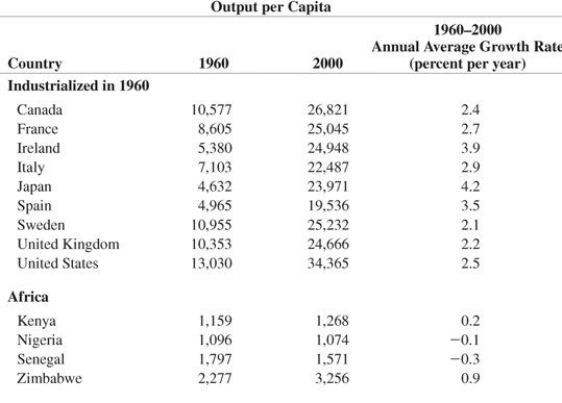
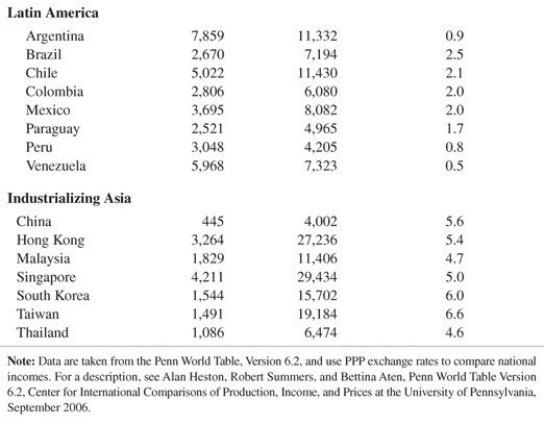 Assuming constant Annual Average Growth Rate in the future, calculate the output per capita for the United States and South Korea for the year 2040.
 (Essay)
4.8/5  (71)
(71) List and explain 3 major channels through which developing countries have financed their external deficits.
(Essay)
4.8/5 (82)
(82) Explain how Brazil was able to reduce the rate of inflation from 2,669 percent in 1994 to less than 10 percent in 1997?
(Essay)
5.0/5 (68)
(68) If a developing country institutes a currency board, it relinquishes control over having
(Multiple Choice)
4.8/5 (76)
(76) When a government defaults on its obligations, the event is called a
(Multiple Choice)
4.9/5 (83)
(83) Explain what the four main categories of world economies are and give examples?
(Essay)
4.9/5 (73)
(73) Describe alternative forms of capital inflow to finance external deficits and explain why these methods were used in different times?
(Essay)
4.9/5 (86)
(86) Which of the following economic lessons should we take from developing country crises in Latin America (and elsewhere)?
(Multiple Choice)
4.9/5 (71)
(71) What weakness in the economic structures of Asian countries contributed to the severe financial crisis that Asian economies experienced in 1997?
(Multiple Choice)
4.8/5 (84)
(84) When one compares per-capital output growth rates among countries
(Multiple Choice)
4.8/5 (71)
(71) Which of the following does NOT explain why developing countries encouraged new manufacturing industries of their own in the mid 20th century?
(Multiple Choice)
4.9/5 (75)
(75) A currency board can ________ a country's ability to act as a lender of last resort.
(Multiple Choice)
4.9/5 (77)
(77) The main reason for the crisis in Argentina in 2001 and 2002, has to do with exchange rate policy, i.e., the continued peg of the exchange rate to the dollar. Discuss.
(Essay)
4.9/5 (78)
(78) Based on the 1997 Crisis and your own experience, what are the main weaknesses of the East Asian economies?
(Essay)
4.8/5 (69)
(69) 
Filters
- Essay(0)
- Multiple Choice(0)
- Short Answer(0)
- True False(0)
- Matching(0)