



 Chat with AI
Exam 22: Developing Countries: Growth, Crisis, and Reform

Exam 1: Introduction37 Questions
Exam 2: World Trade: an Overview18 Questions
Exam 3: Labor Productivity and Comparative Advantage: the Ricardian Model47 Questions
Exam 4: Specific Factors and Income Distribution62 Questions
Exam 5: Resources and Trade: the Heckscher-Ohlin Model66 Questions
Exam 6: The Standard Trade Model45 Questions
Exam 7: External Economies of Scale and the International Location of Production37 Questions
Exam 8: Firms in the Global Economy: Export Decisions, Outsourcing, and Multinational Enterprises69 Questions
Exam 9: The Instruments of Trade Policy71 Questions
Exam 10: The Political Economy of Trade Policy57 Questions
Exam 11: Trade Policy in Developing Countries33 Questions
Exam 12: Controversies in Trade Policy46 Questions
Exam 13: National Income Accounting and the Balance of Payments72 Questions
Exam 14: Exchange Rates and the Foreign Exchange Market: an Asset Approach74 Questions
Exam 15: Money, Interest Rates, and Exchange Rates65 Questions
Exam 16: Price Levels and the Exchange Rate in the Long Run79 Questions
Exam 17: Output and the Exchange Rate in the Short Run114 Questions
Exam 18: Fixed Exchange Rates and Foreign Exchange Intervention80 Questions
Exam 19: International Monetary Systems: an Historical Overview153 Questions
Exam 20: Financial Globalization: Opportunity and Crisis113 Questions
Exam 21: Optimum Currency Areas and the Euro99 Questions
Exam 22: Developing Countries: Growth, Crisis, and Reform112 Questions
Select questions type


Which of the following is NOT a common characteristic of a developing country?

Free
(Multiple Choice)
4.9/5  (84)
(84) Correct Answer: Verified
B
Does it appear that currency boards make low-inflation policies credible?
Free
(Essay)
4.9/5 (76)
(76) Correct Answer:Verified
VerifiedCurrency boards have the power to bring in anti-inflation credibility from the country to which the domestic currency is hooked. Currency boards typically may not acquire government debt, but it can discourage fiscal deficits leading to reduce a major cause of inflation and devaluation. In order for a currency board to be successful is by increasing the banking sector and that can get the government under pressure to abandon the currency board. Moreover, if the markets anticipate that the government is leaving the currency board, the country may not benefit from the potential of a currency board.
How would you describe the world distribution of income?
Free
(Multiple Choice)
4.9/5 (89)
(89) Correct Answer:Verified
VerifiedA
Over the period 1960-2014, the United States economy grew at roughly
(Multiple Choice)
4.8/5 (81)
(81) The term Original Sin by two economists Barry Eichengreen and Ricardo Hausmann is used to describe what?
(Multiple Choice)
4.9/5 (66)
(66) In developing economies, national saving is often ________ relative to developed economies.
(Multiple Choice)
4.7/5 (69)
(69) Explain the reasons for the economic "miracle" of the East Asian countries between 1960 and 1997. Is it only because of the common Asian practice of industrial policy and business-government cooperation?
(Essay)
4.8/5 (69)
(69) In general, the development of underground economic activity ________ economic efficiency
(Multiple Choice)
4.9/5 (87)
(87) Explain why Argentina, one of the world's richest countries at the start of the twentieth century, has become progressively poorer relative to the industrial countries. [An alternative question: What explains Argentina's regress from riches to rags?]
(Essay)
4.8/5 (76)
(76) Between 1960 and 2010, the annual growth rate in percent per year was the highest in
(Multiple Choice)
5.0/5 (67)
(67) What are the three main lessons on crisis learned from early developing countries in Latin America?
(Multiple Choice)
4.9/5 (83)
(83) In the early 1960s South Korea was an extremely poor country. However, in 1963, the country began a remarkable economic ascent. What was a direct cause of this?
(Multiple Choice)
4.9/5 (73)
(73) The $50 billion emergency loan orchestrated by the U.S. Treasury and the IMF to Mexico in 1994
(Multiple Choice)
5.0/5 (89)
(89) In 1991, Argentina established a radical institutional reform after experiencing a decade marked by financial instability. This program was called the new Convertibility Law. What did this law do?
(Multiple Choice)
4.8/5 (79)
(79) Write an essay on the importance of a sound banking system in developing countries.
(Essay)
5.0/5 (75)
(75) Please consider Table 22-2 below. 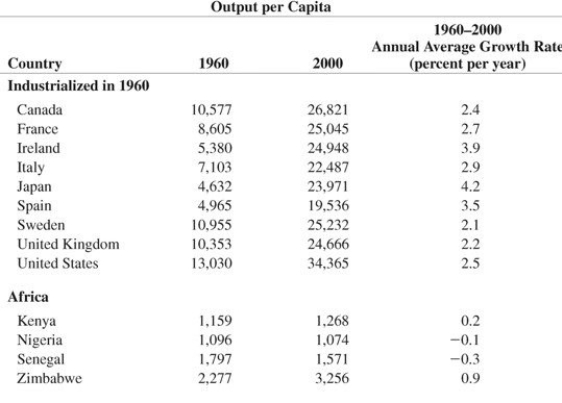
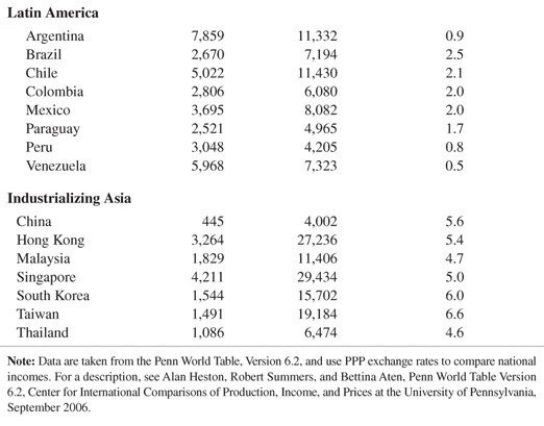 Assuming constant Annual Average Growth Rate in the future, determine the year in which the United States will have the same output per capita as South Korea?
 (Essay)
4.8/5 (82)
(82) "Developing countries should delay opening the capital account until the domestic financial system is strong enough to withstand the sometimes violent ebb and flow of world capital." Discuss.
(Essay)
4.8/5 (76)
(76) 
Filters
- Essay(0)
- Multiple Choice(0)
- Short Answer(0)
- True False(0)
- Matching(0)