



 Chat with AI
Exam 22: Developing Countries: Growth, Crisis, and Reform

Exam 1: Introduction37 Questions
Exam 2: World Trade: an Overview18 Questions
Exam 3: Labor Productivity and Comparative Advantage: the Ricardian Model47 Questions
Exam 4: Specific Factors and Income Distribution62 Questions
Exam 5: Resources and Trade: the Heckscher-Ohlin Model66 Questions
Exam 6: The Standard Trade Model45 Questions
Exam 7: External Economies of Scale and the International Location of Production37 Questions
Exam 8: Firms in the Global Economy: Export Decisions, Outsourcing, and Multinational Enterprises69 Questions
Exam 9: The Instruments of Trade Policy71 Questions
Exam 10: The Political Economy of Trade Policy57 Questions
Exam 11: Trade Policy in Developing Countries33 Questions
Exam 12: Controversies in Trade Policy46 Questions
Exam 13: National Income Accounting and the Balance of Payments72 Questions
Exam 14: Exchange Rates and the Foreign Exchange Market: an Asset Approach74 Questions
Exam 15: Money, Interest Rates, and Exchange Rates65 Questions
Exam 16: Price Levels and the Exchange Rate in the Long Run79 Questions
Exam 17: Output and the Exchange Rate in the Short Run114 Questions
Exam 18: Fixed Exchange Rates and Foreign Exchange Intervention80 Questions
Exam 19: International Monetary Systems: an Historical Overview153 Questions
Exam 20: Financial Globalization: Opportunity and Crisis113 Questions
Exam 21: Optimum Currency Areas and the Euro99 Questions
Exam 22: Developing Countries: Growth, Crisis, and Reform112 Questions
Select questions type


The real resource a government earns when it prints money and spends it on goods and services is called
(Multiple Choice)
4.8/5  (78)
(78) "Trade liberalization should precede capital account liberalization." Discuss.
(Essay)
4.8/5 (75)
(75) Until recently, per-capita income increased in East Asian countries such as Hong Kong, Singapore, South Korea, and Taiwan by ________-fold every generation
(Multiple Choice)
4.9/5 (64)
(64) Please consider Table 22-2 below. 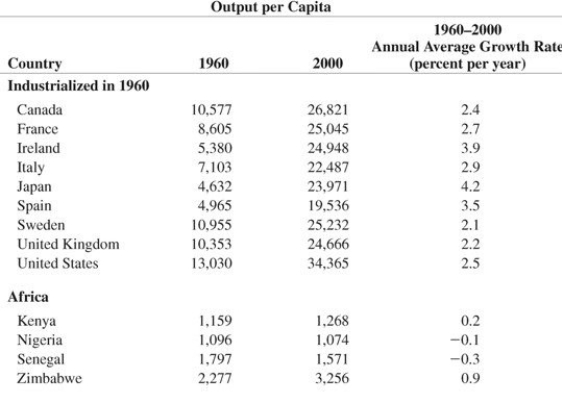
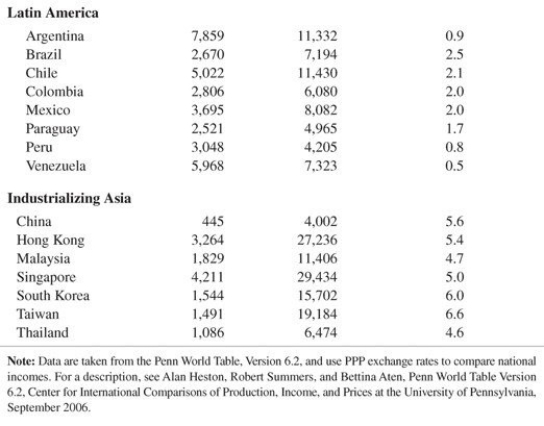 At that Annual Average Growth Rate, how many years does it take for the output per capita to double in both the United States and South Korea.
 (Essay)
4.9/5 (82)
(82) Economists Eichengreen and Hausmann coined the phrase original sin to describe developing countries inability to borrow in their own currencies. Where do they believe that this inability comes from? What are other beliefs on this topic?
(Essay)
4.7/5 (90)
(90) Explain why despite enormous natural resources, much of Latin America's population remains in poverty and the region has been repeatedly experiencing financial crises.
(Essay)
4.7/5 (78)
(78) Which of the following countries had a larger growth rate since 1960?
(Multiple Choice)
4.7/5 (80)
(80) Explain the extensive economic role of government within a developing country.
(Essay)
4.7/5 (86)
(86) The main factors that discourage investment in capital and skills in developing countries are
(Multiple Choice)
4.9/5 (76)
(76) There are many ways developing countries finance their external deficits EXCEPT
(Multiple Choice)
4.8/5 (90)
(90) Why may equity finance be preferred to debt finance for developing countries?
(Multiple Choice)
4.8/5 (84)
(84) Since 1960, South Korea and Singapore enjoyed average per-capita growth rates ________ the average industrialized world.
(Multiple Choice)
4.9/5 (72)
(72) Explain why an exchange rate-based stabilization plan may result in a real appreciation?
(Essay)
4.8/5 (80)
(80) 
Filters
- Essay(0)
- Multiple Choice(0)
- Short Answer(0)
- True False(0)
- Matching(0)