



 Chat with AI
Exam 6: The Standard Trade Model


Suppose Albania is exporting product B, and experienced economic growth biased in favor of product B as seen in the figure above. We are also told that Albania's new consumption point is at point d. Would you still consider the economic growth, which took place biased in favor of B? If Albania were a large country how would this growth affect its terms of trade?

 (81)
 Verified
This is a relatively difficult case. On the one hand, the growth is still technically export biased. However, Albania's consumption clearly shifted in favor of its import product, A. In this case, the deterioration in the terms of trade would be much more pronounced than before, and may lead to a case of immiserizing growth. However, for this to occur, there must have been a major shift in the taste patterns (the old community indifference map is not longer applicable). Therefore, when we try to judge the direction and magnitude of the welfare change, we are comparing the old versus new taste preferences, which raises the classic index number problem.
What is intertemporal comparative advantage?
(80) VerifiedIntertemporal comparative advantage arises when a country can produce goods for future consumption at a relatively low cost in terms of current consumption. Such a country can import investments (loans) from other countries with intertemporal comparative disadvantages at terms of trade that benefit both countries.
If Slovenia were a large country in world trade, then if it instituted a large set of subsidies for its exports, this must
(84) VerifiedD
It may be argued that theoretically, international capital movements
(75) An export subsidy will cause the terms of trade of the ________ country to ________ and will ________ the country.
(95) An increase in the real interest rate, all other things held constant, will cause a country's ________ to ________.
(79) When the production possibility frontier shifts out relatively more in one direction, we have
(80) If a small country were to levy a tariff on its imports then this would
(81) 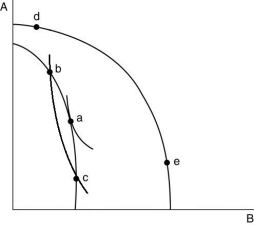 -Refer to the figure above, which shows a country's possible production possibility frontiers and indifference curves. If the country is producing at ________, then moving to ________ will cause utility to ________.
 (75) 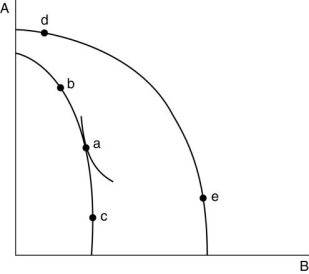 -Suppose, as a result of various dynamic factors associated with exposure to international competition, Albania's economy grew, and is now represented by the rightmost production possibility frontier in the figure above. If its point of production with trade was point b, would you consider this growth to be export-biased or import biased? If Albania were a large country with respect to the world trade of A and B, how would this growth affect Albania's terms of trade? Its real income? What if Albania were a small country?
 (91) If the economy is producing at point a on its production possibility frontier, then
(82) Other things being equal, a rise in a country's terms of trade increases its welfare. What would happen if we relax the ceteris paribus assumption, and allow for the law of demand to operate internationally?
(82) If one observes that Japan was traditionally a net foreign lender, one could conclude that relative to its international trade and financial partners
(88) If the ratio of price of cloth (PC) divided by the price of food (PF) increases in the international marketplace, then
(86) A fall in the real interest rate, all other things held constant, will cause a country's ________ to ________.
(88) 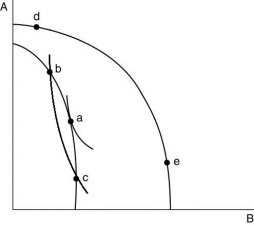 -Refer to the figure above, which shows a country's possible production possibility frontiers and indifference curves. If the country is producing at ________, then moving to ________ will cause utility to ________.
 (87) If Slovenia were a large country in world trade, then if it imposes a large set of tariffs on its imports, this must
(77) A country cannot produce a mix of products with a higher value than where
(93) International borrowing and lending may be interpreted as one form of
(62) 
Filters
- Essay(0)
- Multiple Choice(0)
- Short Answer(0)
- True False(0)
- Matching(0)