



 Chat with AI
Exam 8: Firms in the Global Economy: Export Decisions, Outsourcing, and Multinational Enterprises

Exam 1: Introduction37 Questions
Exam 2: World Trade: an Overview18 Questions
Exam 3: Labor Productivity and Comparative Advantage: the Ricardian Model47 Questions
Exam 4: Specific Factors and Income Distribution62 Questions
Exam 5: Resources and Trade: the Heckscher-Ohlin Model66 Questions
Exam 6: The Standard Trade Model45 Questions
Exam 7: External Economies of Scale and the International Location of Production37 Questions
Exam 8: Firms in the Global Economy: Export Decisions, Outsourcing, and Multinational Enterprises69 Questions
Exam 9: The Instruments of Trade Policy71 Questions
Exam 10: The Political Economy of Trade Policy57 Questions
Exam 11: Trade Policy in Developing Countries33 Questions
Exam 12: Controversies in Trade Policy46 Questions
Exam 13: National Income Accounting and the Balance of Payments72 Questions
Exam 14: Exchange Rates and the Foreign Exchange Market: an Asset Approach74 Questions
Exam 15: Money, Interest Rates, and Exchange Rates65 Questions
Exam 16: Price Levels and the Exchange Rate in the Long Run79 Questions
Exam 17: Output and the Exchange Rate in the Short Run114 Questions
Exam 18: Fixed Exchange Rates and Foreign Exchange Intervention80 Questions
Exam 19: International Monetary Systems: an Historical Overview153 Questions
Exam 20: Financial Globalization: Opportunity and Crisis113 Questions
Exam 21: Optimum Currency Areas and the Euro99 Questions
Exam 22: Developing Countries: Growth, Crisis, and Reform112 Questions
Select questions type


An industry is characterized by scale economies, and exists in two countries. Should these two countries engage in trade such that the combined market is supplied by one country's industry, then

Free
(Multiple Choice)
5.0/5  (88)
(88) Correct Answer: Verified
A
Modeling trade in imperfectly competitive industries is problematic because
Free
(Multiple Choice)
4.8/5 (85)
(85) Correct Answer:Verified
VerifiedB
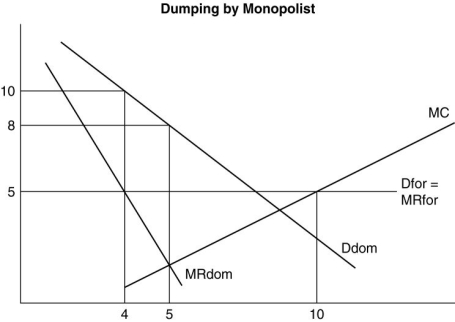 -The figure above represents the demand and cost functions facing a Brazilian steel producing monopolist. If it were unable to export, and was constrained by its domestic market, what quantity would it sell at what price?
Free
(Short Answer)
4.9/5 (71)
(71) Correct Answer:Verified
VerifiedIt would sell 5 (million tons) at a price of $8/ton.
When a multinational affiliate replicates production in a foreign country it is called ________ foreign direct investment.
(Multiple Choice)
4.9/5 (81)
(81) When a multinational affiliate replicates elements of a production process in a foreign country it is called ________ foreign direct investment.
(Multiple Choice)
4.8/5 (80)
(80) When a country both exports and imports a type of commodity, the country is engaged in
(Multiple Choice)
4.9/5 (73)
(73) In the model of monopolistic competition, an increase in industry output will cause individual firms' demand curves to become ________, which will ________ demand for higher-priced goods and ________ demand for lower-priced goods.
(Multiple Choice)
4.8/5 (88)
(88) In the model of monopolistic competition, an increase in industry output will ________ market shares and ________ profits of producers of higher-priced goods and will ________ market shares and ________ profits of producers of lower-priced goods.
(Multiple Choice)
4.7/5 (88)
(88) Imagine scale economies were not only external to firms, but were also external to individual countries. That is, the larger the worldwide industry (regardless of where firms or plants are located), the cheaper would be the per-unit cost of production. Describe what world trade would look like in this case.
(Essay)
4.7/5 (86)
(86) Intra-industry trade is most common in the trade patterns of
(Multiple Choice)
4.8/5 (75)
(75) If a firm increases its output in the ________ and unit costs ________, then the firm is experiencing ________ of scale.
(Multiple Choice)
4.8/5 (71)
(71) If an industry is imperfectly competitive, and markets are segmented then
(Multiple Choice)
4.8/5 (81)
(81) If there are a large number of firms in a monopolistically competitive industry
(Multiple Choice)
5.0/5 (73)
(73) If a firm increases its output in the ________ and unit costs ________, then the firm is experiencing ________ of scale.
(Multiple Choice)
4.9/5 (72)
(72)  -Refer to above figure. The monopolist can export as much as it likes of its steel at the world price of $5/ton. How much steel will the monopolist sell, and at what price?
 (Short Answer)
4.9/5 (73)
(73) If the market for products produced by firms in a monopolistically competitive industry becomes ________, then there will be ________ firms and each firm will produce ________ output and charge a ________ price.
(Multiple Choice)
4.8/5 (76)
(76) Two countries engaged in trade in products with no scale economies, produced under conditions of perfect competition, are likely to be engaged in
(Multiple Choice)
4.8/5 (81)
(81) Imperfectly competitive firms have a demand curve that ________ and a marginal revenue curve that ________ and is ________ the demand curve.
(Multiple Choice)
4.9/5 (70)
(70) 
Filters
- Essay(0)
- Multiple Choice(0)
- Short Answer(0)
- True False(0)
- Matching(0)