



 Chat with AI
Exam 19: Work, heat, and the First Law of Thermodynamics

Exam 1: Concepts of Motion52 Questions
Exam 2: Kinematics in One Dimension59 Questions
Exam 3: Vectors and Coordinate Systems33 Questions
Exam 4: Kinematics in Two Dimensions49 Questions
Exam 5: Force and Motion30 Questions
Exam 6: Dynamics I: Motion Along a Line46 Questions
Exam 7: Newtons Third Law43 Questions
Exam 8: Dynamics II: Motion in a Plane20 Questions
Exam 9: Work and Kinetic Energy66 Questions
Exam 10: Interactions and Potential Energy55 Questions
Exam 11: Impulse and Momentum43 Questions
Exam 12: Rotation of a Rigid Body116 Questions
Exam 13: Newtons Theory of Gravity50 Questions
Exam 14: Fluids and Elasticity72 Questions
Exam 15: Oscillations49 Questions
Exam 16: Traveling Waves51 Questions
Exam 17: Superposition51 Questions
Exam 18: A Macroscopic Description of Matter46 Questions
Exam 19: Work, heat, and the First Law of Thermodynamics96 Questions
Exam 20: The Micromacro Connection41 Questions
Exam 21: Heat Engines and Refrigerators44 Questions
Exam 22: Electric Charges and Forces26 Questions
Exam 23: The Electric Field32 Questions
Exam 24: Gausss Law41 Questions
Exam 25: The Electric Potential40 Questions
Exam 26: Potential and Field57 Questions
Exam 27: Current and Resistance32 Questions
Exam 28: Fundamentals of Circuits68 Questions
Exam 29: The Magnetic Field83 Questions
Exam 30: Electromagnetic Induction66 Questions
Exam 31: Electromagnetic Fields and Waves52 Questions
Exam 32: Ac Circuits44 Questions
Exam 33: Wave Optics51 Questions
Exam 34: Ray Optics60 Questions
Exam 35: Optical Instruments52 Questions
Exam 36: Relativity49 Questions
Exam 37: The Foundations of Modern Physics7 Questions
Exam 38: Quantization45 Questions
Exam 39: Wave Functions and Uncertainty18 Questions
Exam 40: One-Dimensional Quantum Mechanics32 Questions
Exam 41: Atomic Physics38 Questions
Exam 42: Nuclear Physics64 Questions
Select questions type


The figure shows a pV diagram for 0.95 mol of gas that undergoes the process 1 → 2.The gas then undergoes an isochoric heating from point 2 until the pressure is restored to the value it had at point 1.What is the final temperature of the gas? The ideal gas constant is R = 8.314 J/mol ∙ K =  .

. (Multiple Choice)
4.8/5  (74)
(74) Betelgeuse is a red supergiant star in the constellation Orion.It radiates heat at the rate of 2.70 × 1030 W and has a surface temperature of 3000 K.Assuming that it is a perfect emitter,what is the radius of Betelgeuse? The Stefan-Boltzmann constant is 5.670 × 10⁻⁸ W/m2 · K4.
(Multiple Choice)
4.9/5 (80)
(80) An ideal monatomic gas cools from 455.0 K to 405.0 K at constant volume as 831 J of energy is removed from it.How many moles of gas are in the sample? The ideal gas constant is R = 8.314 J/mol ∙ K.
(Multiple Choice)
4.9/5 (64)
(64) A thermally isolated system is made up of a hot piece of aluminum and a cold piece of copper; the aluminum and the copper are in thermal contact.The specific heat of aluminum is more than double that of copper.Which object experiences the greater temperature change during the time the system takes to reach thermal equilibrium?
(Multiple Choice)
4.8/5 (58)
(58) A block of ice at 0.000°C is added to a well-insulated 147-g aluminum calorimeter cup that holds 200 g of water at 10.0°C.The water and aluminum cup are in thermal equilibrium,and the specific heat of aluminum is 910 J/(kg ∙ K).If all but 2.00 g of ice melt,what was the original mass of the block of ice? The specific heat of water is 4190 J/(kg ∙ K),its latent heat of fusion is 334 kJ/kg,and its latent heat of vaporization is 2260 kJ/kg.
(Multiple Choice)
4.7/5 (93)
(93) A cube at 100°C radiates heat at a rate of 80.0 J/s.If its surface temperature is increased to 200°C,the rate at which it will now radiate is closest to
(Multiple Choice)
4.9/5 (89)
(89) A person pours 330 g of water at 45°C into an 855-g aluminum container with an initial temperature of 10°C.The specific heat of aluminum is 900 J/(kg ∙ K)and that of water is 4190 J/(kg ∙ K).What is the final temperature of the system,assuming no heat is exchanged with the surroundings?
(Multiple Choice)
4.9/5 (74)
(74) 
A monatomic ideal gas undergoes an isothermal expansion at 300 K,as the volume increased from  to
 The final pressure of the gas is
 The ideal gas constant is R = 8.314 J/mol ∙ K.The change in the internal (thermal)energy of the gas is closest to
to The final pressure of the gas is The ideal gas constant is R = 8.314 J/mol ∙ K.The change in the internal (thermal)energy of the gas is closest to (Multiple Choice)
4.9/5 (77)
(77) A substance has a melting point of 20°C and a heat of fusion of 3.9 × 10⁴ J/kg.The boiling point is  and the heat of vaporization is 7.8 × 10⁴ J/kg at a pressure of 1.0 atm.The specific heats for the solid,liquid,and gaseous phases are 600 J/(kg∙K),1000 J/(kg∙K),and 400 J/(kg∙K),respectively.The quantity of heat required to raise the temperature of
 of the substance from
 to
 at a pressure of 1.0 atm,is closest to
and the heat of vaporization is 7.8 × 10⁴ J/kg at a pressure of 1.0 atm.The specific heats for the solid,liquid,and gaseous phases are 600 J/(kg∙K),1000 J/(kg∙K),and 400 J/(kg∙K),respectively.The quantity of heat required to raise the temperature of of the substance from to at a pressure of 1.0 atm,is closest to (Multiple Choice)
4.8/5 (87)
(87) It is necessary to determine the specific heat of an unknown object.The mass of the object is measured to be 199.0 g.It is determined experimentally that it takes 16.0 J to raise the temperature 10.0°C.Find the specific heat of the object.
(Multiple Choice)
4.8/5 (86)
(86) An 80-g aluminum calorimeter contains 380 g of water at an equilibrium temperature of  A
 piece of metal,initially at
 is added to the calorimeter.The final temperature at equilibrium is 32°C.Assume there is no external heat exchange.The specific heats of aluminum and water are 910 J/kg ∙ K and 4190 J/kg ∙ K,respectively.The specific heat of the metal is closest to
A piece of metal,initially at is added to the calorimeter.The final temperature at equilibrium is 32°C.Assume there is no external heat exchange.The specific heats of aluminum and water are 910 J/kg ∙ K and 4190 J/kg ∙ K,respectively.The specific heat of the metal is closest to (Multiple Choice)
4.8/5 (68)
(68) During an adiabatic process,an ideal gas does 25 J of work.What is the change in the internal (thermal)energy of the gas during this process?
(Multiple Choice)
4.9/5 (74)
(74) A compression,at a constant pressure of 190 kPa,is performed on 5.0 moles of an ideal monatomic gas.The compression reduces the volume of the gas from  to
 The ideal gas constant is R = 8.314 J/mol ∙ K. The work done by the gas is closest to
to The ideal gas constant is R = 8.314 J/mol ∙ K. The work done by the gas is closest to (Multiple Choice)
4.9/5 (92)
(92) The pV diagram shown is for 7.50 moles of an ideal diatomic gas taken through a cycle from a to b to c.The ideal gas constant is R = 8.314 J/mol ∙ K. 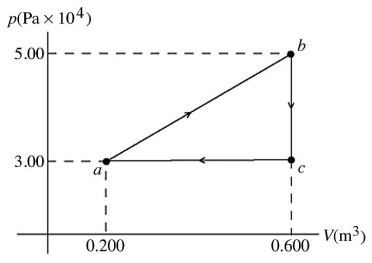 (a)What is the highest temperature reached by the gas during the cycle?
(b)What net work does the gas do during the cycle?
(c)How much heat is exchanged with the gas during part bc of the cycle? Does it enter or leave the gas?
(d)What is the change in the internal (thermal)energy of the gas during part bc of the cycle?
(e)What is the change in the internal (thermal)energy of the gas during the entire cycle?
(a)What is the highest temperature reached by the gas during the cycle?
(b)What net work does the gas do during the cycle?
(c)How much heat is exchanged with the gas during part bc of the cycle? Does it enter or leave the gas?
(d)What is the change in the internal (thermal)energy of the gas during part bc of the cycle?
(e)What is the change in the internal (thermal)energy of the gas during the entire cycle? (Essay)
4.8/5 (82)
(82) An ideal gas with γ = 1.30 occupies 7.0 L at 300 K and 200 kPa pressure.It is compressed adiabatically to 1/7 of its original volume,then cooled at constant volume to 300 K,and finally allowed to expand isothermally to 7.0 L.How much work does the gas do during this process? The ideal gas constant is R = 8.314 J/mol ∙ K = 0.0821 L ∙ atm/mol ∙ K.
(Multiple Choice)
4.8/5 (87)
(87) 
Filters
- Essay(0)
- Multiple Choice(0)
- Short Answer(0)
- True False(0)
- Matching(0)