



 Chat with AI
Exam 19: Work, heat, and the First Law of Thermodynamics

Exam 1: Concepts of Motion52 Questions
Exam 2: Kinematics in One Dimension59 Questions
Exam 3: Vectors and Coordinate Systems33 Questions
Exam 4: Kinematics in Two Dimensions49 Questions
Exam 5: Force and Motion30 Questions
Exam 6: Dynamics I: Motion Along a Line46 Questions
Exam 7: Newtons Third Law43 Questions
Exam 8: Dynamics II: Motion in a Plane20 Questions
Exam 9: Work and Kinetic Energy66 Questions
Exam 10: Interactions and Potential Energy55 Questions
Exam 11: Impulse and Momentum43 Questions
Exam 12: Rotation of a Rigid Body116 Questions
Exam 13: Newtons Theory of Gravity50 Questions
Exam 14: Fluids and Elasticity72 Questions
Exam 15: Oscillations49 Questions
Exam 16: Traveling Waves51 Questions
Exam 17: Superposition51 Questions
Exam 18: A Macroscopic Description of Matter46 Questions
Exam 19: Work, heat, and the First Law of Thermodynamics96 Questions
Exam 20: The Micromacro Connection41 Questions
Exam 21: Heat Engines and Refrigerators44 Questions
Exam 22: Electric Charges and Forces26 Questions
Exam 23: The Electric Field32 Questions
Exam 24: Gausss Law41 Questions
Exam 25: The Electric Potential40 Questions
Exam 26: Potential and Field57 Questions
Exam 27: Current and Resistance32 Questions
Exam 28: Fundamentals of Circuits68 Questions
Exam 29: The Magnetic Field83 Questions
Exam 30: Electromagnetic Induction66 Questions
Exam 31: Electromagnetic Fields and Waves52 Questions
Exam 32: Ac Circuits44 Questions
Exam 33: Wave Optics51 Questions
Exam 34: Ray Optics60 Questions
Exam 35: Optical Instruments52 Questions
Exam 36: Relativity49 Questions
Exam 37: The Foundations of Modern Physics7 Questions
Exam 38: Quantization45 Questions
Exam 39: Wave Functions and Uncertainty18 Questions
Exam 40: One-Dimensional Quantum Mechanics32 Questions
Exam 41: Atomic Physics38 Questions
Exam 42: Nuclear Physics64 Questions
Select questions type


A quantity of ideal gas requires 800 kJ to raise the temperature of the gas by 10.0 K when the gas is maintained at constant volume.The same quantity of gas requires 900 kJ to raise the temperature of the gas by 10.0 K when the gas is maintained at constant pressure.What is the adiabatic constant γ for this gas?
(Multiple Choice)
4.8/5  (85)
(85) A 648-g empty iron kettle is put on a stove.How much heat.in joules.must it absorb to raise its temperature from  to
 (The specific heat for iron is 113 cal/kg ∙ C°, 1 cal = 4.190 J)
to (The specific heat for iron is 113 cal/kg ∙ C°, 1 cal = 4.190 J) (Multiple Choice)
4.8/5 (71)
(71) A 905-g meteor impacts the earth at a speed of 1629 m/s.If all of its energy is entirely converted to heat in the meteor,what will be the resulting temperature rise of the meteor,assuming it does not melt? The specific heat for the meteor material is 472 J/kg ∙ K,which is about the same as that of iron.
(Multiple Choice)
4.8/5 (81)
(81) The figure shows a pV diagram for 4.3 g of oxygen gas (O2)in a sealed container.The temperature T1 of the gas in state 1 is 21°C.What are the temperatures T3 and T4 of the gas in states 3 and 4? The ideal gas constant is R = 8.314 J/mol ∙ K = 0.0821 L ∙ atm/mol ∙ K,and the ATOMIC weight of oxygen is 16 g/mol. 
(Multiple Choice)
4.9/5 (80)
(80) During an adiabatic process,20 moles of a monatomic ideal gas undergo a temperature change from 450 K to 320 K starting from an initial pressure is 400 kPa.The ideal gas constant is R = 8.314 J/mol ∙ K.
(a)What is the final volume of the gas?
(b)How much heat does the gas exchange during this process?
(c)What is the change in the internal (thermal)energy of the gas during this process?
(Essay)
5.0/5 (70)
(70) A certain amount of ideal monatomic gas is maintained at constant volume as it is cooled from 455K to 405 K.This feat is accomplished by removing 400 J of heat from the gas.How much work is done by the gas during this process? The ideal gas constant is R = 8.314 J/mol ∙ K.
(Multiple Choice)
4.7/5 (77)
(77) A fixed amount of ideal gas goes through a process abc.In state a,the temperature of the gas is 152°C,its pressure is 1.25 atm,and it occupies a volume of 0.250 m3.It then undergoes an isothermal expansion to state b that doubles its volume,followed by an isobaric compression back to its original volume at state c.(Hint: First show this process on a pV diagram.)The ideal gas constant is 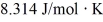 ,and 1.00 atm = 1.01 × 10⁵ Pa.
(a)How many moles does this gas contain?
(b)What is the change in the internal energy of the gas between states a and b?
(c)What is the net work done on (or by)this gas during the entire process?
(d)What is the temperature of the gas in state c?
,and 1.00 atm = 1.01 × 10⁵ Pa.
(a)How many moles does this gas contain?
(b)What is the change in the internal energy of the gas between states a and b?
(c)What is the net work done on (or by)this gas during the entire process?
(d)What is the temperature of the gas in state c? (Essay)
4.9/5 (70)
(70) An expansion process on an ideal diatomic gas has a linear path between the initial and final states on a pV diagram.The initial pressure is  the initial volume is
 and the initial temperature is
 The ideal gas constant is R = 8.314 J/mol ∙ K.The final pressure is
 and the final temperature is
 The work done by the gas is closest to
the initial volume is and the initial temperature is The ideal gas constant is R = 8.314 J/mol ∙ K.The final pressure is and the final temperature is The work done by the gas is closest to (Multiple Choice)
4.8/5 (84)
(84) The gas in a perfectly insulated system does work at a rate of  At what rate is the internal (thermal)energy of the gas changing?
 (Multiple Choice)
5.0/5 (81)
(81) A 400-g piece of metal at 120.0°C is dropped into a cup containing 450 g of water at 15.0°C.The final temperature of the system is measured to be 40.0°C.What is the specific heat of the metal,assuming no heat is exchanged with the surroundings or the cup? The specific heat of water is 4190 J/(kg ∙ K).
(Multiple Choice)
4.9/5 (84)
(84) In an isochoric process,the internal (thermal)energy of an ideal gas decreases by 50 J.How much heat is exchanged with the gas during this process?
(Multiple Choice)
4.8/5 (84)
(84) Heat is added to a pure substance in a closed container at a constant rate.The figure shows a graph of the temperature of the substance as a function of time.If Lf = latent heat of fusion and Lv = latent heat of vaporization,what is the value of the ratio Lv / Lf for this substance? 
(Multiple Choice)
4.9/5 (87)
(87) What is the steady state rate of heat flow through a pane of glass that is 40.0 cm by 30.0 cm with a thickness of 4.00 mm when the outside temperature of the glass is -10.0°C and its inside temperature is 25.0°C? The thermal conductivity of glass is 0.105 W/(m ∙ K),the specific heat of glass is  ,and 1 cal = 4.190 J.
 (Multiple Choice)
4.8/5 (79)
(79) An ideal gas increases in temperature from 22°C to 42°C by two different processes.In one process,the temperature increases at constant volume,and in the other process the temperature increases at constant pressure.Which of the following statements about this gas are correct? (There may be more than one correct choice.)
A)The heat required to cause this temperature change is the same for both the constant-volume and the constant-pressure processes.
B)More heat is required for the constant-pressure process than for the constant-volume process.
C)The change in the internal (thermal)energy of the gas is the same for both the constant-volume and the constant-pressure processes.
D)The root-mean-square (thermal)speed of the gas molecules increases more during the constant-volume process than during the constant-pressure process.
(Short Answer)
4.9/5 (69)
(69) When an ideal gas increases in volume at constant pressure,the average kinetic energy of the gas molecules
(Multiple Choice)
4.9/5 (78)
(78) A cylinder contains 23 moles of an ideal gas at a temperature of 300 K.The gas is compressed at constant pressure until the final volume equals 0.43 times the initial volume.The molar heat capacity at constant volume of the gas is 24.0 J/mol · K and the ideal gas constant is R = 8.314 J/mol ∙ K.The heat absorbed by the gas is closest to
(Multiple Choice)
4.9/5 (69)
(69) The figure shows a pV diagram for 8.3 g of nitrogen gas (N2)in a sealed container.The temperature T1 of the gas in state 1 is 79°C.What are (a)the pressure p1 of the gas in state 1 and (b)the temperature T2 of the gas in state 2? The ideal gas constant is R = 8.314 J/mol ∙ K =  ,and the ATOMIC weight of nitrogen is 14 g/mol.

,and the ATOMIC weight of nitrogen is 14 g/mol. (Multiple Choice)
4.8/5 (79)
(79) A rod,with sides insulated to prevent heat loss,has one end immersed in boiling water 100°C and the other end in a water-ice mixture at 0.00°C.The rod has uniform cross-sectional area of  and length of
 Under steady state conditions,the heat conducted by the rod melts the ice at a rate of
 every 34 seconds.What is the thermal conductivity of the rod? (The heat of fusion of water is

and length of Under steady state conditions,the heat conducted by the rod melts the ice at a rate of every 34 seconds.What is the thermal conductivity of the rod? (The heat of fusion of water is (Short Answer)
4.9/5 (71)
(71) A system has a heat source supplying heat to an ideal gas at a rate of 187.0 W and the gas is doing work at a rate of 130.9 W.At what rate is the internal (thermal)energy of the gas changing?
(Multiple Choice)
4.8/5 (60)
(60) When a fixed amount of ideal gas goes through an isobaric expansion,
(Multiple Choice)
4.8/5 (69)
(69) 
Filters
- Essay(0)
- Multiple Choice(0)
- Short Answer(0)
- True False(0)
- Matching(0)