



 Chat with AI
Exam 19: Work, heat, and the First Law of Thermodynamics

Exam 1: Concepts of Motion52 Questions
Exam 2: Kinematics in One Dimension59 Questions
Exam 3: Vectors and Coordinate Systems33 Questions
Exam 4: Kinematics in Two Dimensions49 Questions
Exam 5: Force and Motion30 Questions
Exam 6: Dynamics I: Motion Along a Line46 Questions
Exam 7: Newtons Third Law43 Questions
Exam 8: Dynamics II: Motion in a Plane20 Questions
Exam 9: Work and Kinetic Energy66 Questions
Exam 10: Interactions and Potential Energy55 Questions
Exam 11: Impulse and Momentum43 Questions
Exam 12: Rotation of a Rigid Body116 Questions
Exam 13: Newtons Theory of Gravity50 Questions
Exam 14: Fluids and Elasticity72 Questions
Exam 15: Oscillations49 Questions
Exam 16: Traveling Waves51 Questions
Exam 17: Superposition51 Questions
Exam 18: A Macroscopic Description of Matter46 Questions
Exam 19: Work, heat, and the First Law of Thermodynamics96 Questions
Exam 20: The Micromacro Connection41 Questions
Exam 21: Heat Engines and Refrigerators44 Questions
Exam 22: Electric Charges and Forces26 Questions
Exam 23: The Electric Field32 Questions
Exam 24: Gausss Law41 Questions
Exam 25: The Electric Potential40 Questions
Exam 26: Potential and Field57 Questions
Exam 27: Current and Resistance32 Questions
Exam 28: Fundamentals of Circuits68 Questions
Exam 29: The Magnetic Field83 Questions
Exam 30: Electromagnetic Induction66 Questions
Exam 31: Electromagnetic Fields and Waves52 Questions
Exam 32: Ac Circuits44 Questions
Exam 33: Wave Optics51 Questions
Exam 34: Ray Optics60 Questions
Exam 35: Optical Instruments52 Questions
Exam 36: Relativity49 Questions
Exam 37: The Foundations of Modern Physics7 Questions
Exam 38: Quantization45 Questions
Exam 39: Wave Functions and Uncertainty18 Questions
Exam 40: One-Dimensional Quantum Mechanics32 Questions
Exam 41: Atomic Physics38 Questions
Exam 42: Nuclear Physics64 Questions
Select questions type


A 406.0 kg copper bar is put into a smelter for melting.The initial temperature of the copper is 300.0 K.How much heat must the smelter produce to completely melt the copper bar? (The specific heat for copper is 386 J/kg ∙ K,the heat of fusion for copper is 205 kJ/kg,and its melting point is 1357 K.)
(Multiple Choice)
4.9/5  (81)
(81) A concrete wall of a cold storage room measures 3.0 m high,5.0 m wide,and 20 cm thick.The room temperature is maintained at -10°C and the outside temperature is 20°C The inside wall is to be covered by a layer of wood in order to reduce the rate of heat loss through the wall BY 90 percent.The thermal conductivities of concrete and wood are 0.80 W/m ∙ K and 0.040 W/m ∙ K,respectively.Under steady state conditions,the thickness of the layer of wood required is closest to
(Multiple Choice)
4.8/5 (81)
(81) How much work is done by 3.00 mol of ideal gas when it triples its volume at a constant temperature of 127°C? The ideal gas constant is R = 8.314 J/mol ∙ K.
(Multiple Choice)
4.8/5 (76)
(76) A cylinder contains 1.2 moles of ideal gas,initially at a temperature of 116°C.The cylinder is provided with a frictionless piston,which maintains a constant pressure of  on the gas.The gas is cooled until its temperature has decreased to 27°C.For the gas
CV = 11.65 J/mol · K,and the ideal gas constant R = 8.314 J/mol ∙ K.
(a)Find the work done by (or on)the gas during this process.Is the work done by or on the gas?
(b)What is the change in the internal (thermal)energy of the gas during this process?
(c)How much heat is transferred to (or from)the gas during this process? Does this heat flow into or out of the gas?
on the gas.The gas is cooled until its temperature has decreased to 27°C.For the gas
CV = 11.65 J/mol · K,and the ideal gas constant R = 8.314 J/mol ∙ K.
(a)Find the work done by (or on)the gas during this process.Is the work done by or on the gas?
(b)What is the change in the internal (thermal)energy of the gas during this process?
(c)How much heat is transferred to (or from)the gas during this process? Does this heat flow into or out of the gas? (Essay)
4.9/5 (60)
(60) The walls of an ice chest are made of 2.00-mm-thick insulation having a thermal conductivity 0.00300 W/m ∙ K.The total surface area of the ice chest is 1.20 m2.If 4.00 kg of ice at 0.00°C are placed in the chest and the temperature of the outside surface of the chest is 20.0°C,how long does it take the ice to melt under steady state conditions? The latent heat of fusion of water is 79.6 cal/g = 334 kJ/kg.
(Multiple Choice)
4.7/5 (80)
(80) A 200-g metal container,insulated on the outside,holds 100 g of water in thermal equilibrium at  A 21-g ice cube,at the melting point,is dropped into the water,and when thermal equilibrium is reached the temperature is 15.00°C.Assume there is no heat exchange with the surroundings.For water,the specific heat is 4190 J/kg · K and the heat of fusion is 3.34 × 10⁵ J/kg.The specific heat for the metal is closest to
 (Multiple Choice)
4.8/5 (82)
(82) In a thermodynamic process involving 7.8 moles of an ideal gas,the gas is at an initial temperature of 24°C and has an initial volume of 0.040 m3.The gas expands adiabatically to a volume of 0.080 m3.For this gas,CV = 12.27 J/mol · K,and the ideal gas constant is
R = 8.314 J/mol ∙ K.Calculate the work done by the gas during this expansion.
(Short Answer)
4.9/5 (68)
(68) A solid metal sphere is 15.0 cm in diameter and has surface of uniform color.When its surface is at 112°C,you measure that it radiates energy at a rate of 71.3 W.What is the emissivity of the surface of this object? Any heat that enters the sphere from the outside environment is negligible.The Stefan-Boltzmann constant is 5.670 × 10⁻⁸ W/m2 · K4.
(Short Answer)
4.9/5 (72)
(72) A copper cylinder with a mass of 125 g and temperature of 345°C is cooled by dropping it into a glass beaker containing 565 g of water initially at 20.0°C.The mass of the beaker is 50.0 g and the specific heat of the glass is 840 J/kg ∙ K.What is the final equilibrium temperature of the system,assuming the cooling takes place very quickly,so that no energy is lost to the air? The specific heat of copper is 385 J/kg ∙ K and that of water is 4190 J/kg ∙ K.
(Short Answer)
4.9/5 (75)
(75) 3.0 moles of an ideal gas with a molar heat capacity at constant volume of 4.9 cal/(mol ∙ K)and a molar heat capacity at constant pressure of 6.9 cal/(mol ∙ K)starts at 300 K and is heated at constant pressure to 320 K,then cooled at constant volume to its original temperature.How much heat flows into the gas during this two-step process?
(Multiple Choice)
4.9/5 (95)
(95) During an isothermal process,5.0 J of heat is removed from an ideal gas.What is the change in internal (thermal)energy of the gas?
(Multiple Choice)
4.9/5 (70)
(70) When a fixed amount of ideal gas goes through an adiabatic expansion,
(Multiple Choice)
4.7/5 (78)
(78) If you add 700 kJ of heat to 700 g of water at 70.0°C,how much water is left in the container? The latent heat of vaporization of water is 2.26 ×  J/kg and its specific heat is 4190 J/(kg ∙ K).
 (Multiple Choice)
4.9/5 (66)
(66) An ideal gas initially at 300 K and occupying a volume of 20 L is adiabatically compressed.If its final temperature is 400 K and γ = 1.30,what is its final volume?
(Multiple Choice)
4.9/5 (75)
(75) Under steady state conditions,a piece of wood 350 mm by 350 mm and 15 mm thick conducts heat through its thickness and loses no appreciable heat through its well-insulated sides.The rate of heat flow is measured to be 14.0 W when the temperature difference across its thickness is 28°C.Determine the thermal conductivity of this wood.
(Multiple Choice)
5.0/5 (73)
(73) An ideal gas is allowed to expand slowly at constant temperature to twice its original volume.During the expansion,the gas absorbs 200 kJ of heat.
(a)What is the change in the internal (thermal)energy of the gas during the expansion?
(b)How much work does the gas do during the expansion?
(Short Answer)
4.7/5 (89)
(89) A radiating body originally has a Kelvin temperature To,and its surroundings are at 500K (To > 500K).If the Kelvin temperature of the radiating body is increased to  ,the net rate at which the body radiates increases by a factor of 333.What was the original temperature
 ?
,the net rate at which the body radiates increases by a factor of 333.What was the original temperature ? (Short Answer)
4.8/5 (68)
(68) A monatomic ideal gas undergoes an isothermal expansion at 300 K,as the volume increased from  to
 The final pressure is
 The ideal gas constant is R = 8.314 J/mol ∙ K.The heat transfer to the gas is closest to
to The final pressure is The ideal gas constant is R = 8.314 J/mol ∙ K.The heat transfer to the gas is closest to (Multiple Choice)
4.9/5 (80)
(80) 
The figure shows a pV diagram for 0.0066 mol of gas that undergoes the process 1 → 2 → 3.What is the pressure p2? The ideal gas constant is R = 8.314 J/mol ∙ K = 0.0821 L ∙ atm/mol ∙ K. 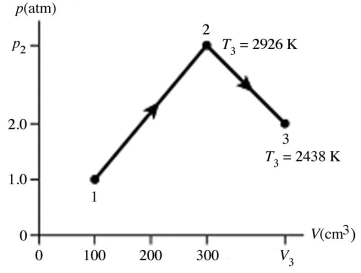
(Multiple Choice)
4.9/5 (80)
(80) 
Filters
- Essay(0)
- Multiple Choice(0)
- Short Answer(0)
- True False(0)
- Matching(0)