



 Chat with AI
Exam 19: Work, heat, and the First Law of Thermodynamics

Exam 1: Concepts of Motion52 Questions
Exam 2: Kinematics in One Dimension59 Questions
Exam 3: Vectors and Coordinate Systems33 Questions
Exam 4: Kinematics in Two Dimensions49 Questions
Exam 5: Force and Motion30 Questions
Exam 6: Dynamics I: Motion Along a Line46 Questions
Exam 7: Newtons Third Law43 Questions
Exam 8: Dynamics II: Motion in a Plane20 Questions
Exam 9: Work and Kinetic Energy66 Questions
Exam 10: Interactions and Potential Energy55 Questions
Exam 11: Impulse and Momentum43 Questions
Exam 12: Rotation of a Rigid Body116 Questions
Exam 13: Newtons Theory of Gravity50 Questions
Exam 14: Fluids and Elasticity72 Questions
Exam 15: Oscillations49 Questions
Exam 16: Traveling Waves51 Questions
Exam 17: Superposition51 Questions
Exam 18: A Macroscopic Description of Matter46 Questions
Exam 19: Work, heat, and the First Law of Thermodynamics96 Questions
Exam 20: The Micromacro Connection41 Questions
Exam 21: Heat Engines and Refrigerators44 Questions
Exam 22: Electric Charges and Forces26 Questions
Exam 23: The Electric Field32 Questions
Exam 24: Gausss Law41 Questions
Exam 25: The Electric Potential40 Questions
Exam 26: Potential and Field57 Questions
Exam 27: Current and Resistance32 Questions
Exam 28: Fundamentals of Circuits68 Questions
Exam 29: The Magnetic Field83 Questions
Exam 30: Electromagnetic Induction66 Questions
Exam 31: Electromagnetic Fields and Waves52 Questions
Exam 32: Ac Circuits44 Questions
Exam 33: Wave Optics51 Questions
Exam 34: Ray Optics60 Questions
Exam 35: Optical Instruments52 Questions
Exam 36: Relativity49 Questions
Exam 37: The Foundations of Modern Physics7 Questions
Exam 38: Quantization45 Questions
Exam 39: Wave Functions and Uncertainty18 Questions
Exam 40: One-Dimensional Quantum Mechanics32 Questions
Exam 41: Atomic Physics38 Questions
Exam 42: Nuclear Physics64 Questions
Select questions type


When a fixed amount of ideal gas goes through an isochoric process,
(Multiple Choice)
4.7/5  (64)
(64) How many grams of ice at -13°C must be added to 711 grams of water that is initially at a temperature of  to produce water at a final temperature of
 Assume that no heat is lost to the surroundings and that the container has negligible mass.The specific heat of liquid water is 4190 J/kg ∙ °C and of ice is 2050 J/kg · °C.For water the normal melting point is 0.00°C and the heat of fusion is 334 × 103 J/kg.The normal boiling point is 100°C and the heat of vaporization is 2.26 × 10⁶ J/kg.
to produce water at a final temperature of Assume that no heat is lost to the surroundings and that the container has negligible mass.The specific heat of liquid water is 4190 J/kg ∙ °C and of ice is 2050 J/kg · °C.For water the normal melting point is 0.00°C and the heat of fusion is 334 × 103 J/kg.The normal boiling point is 100°C and the heat of vaporization is 2.26 × 10⁶ J/kg. (Short Answer)
4.8/5 (85)
(85) A heat conducting rod,0.90 m long,is made of an aluminum section that is 0.10 m long,and a copper section that is  long.Both sections have cross-sectional areas of
 The aluminum end is maintained at a temperature of
 and the copper end is at
 The thermal conductivity of aluminum is 205 W/m ∙ K and of copper is 385 W/m ∙ K.Steady state has been reached,and no heat is lost through the well-insulated sides of the rod.The temperature of the aluminum-copper junction in the rod is closest to
long.Both sections have cross-sectional areas of The aluminum end is maintained at a temperature of and the copper end is at The thermal conductivity of aluminum is 205 W/m ∙ K and of copper is 385 W/m ∙ K.Steady state has been reached,and no heat is lost through the well-insulated sides of the rod.The temperature of the aluminum-copper junction in the rod is closest to (Multiple Choice)
4.9/5 (72)
(72) The figure shows the pV diagram for a certain thermodynamic process.In this process,
1500 J of heat flows into a system,and at the same time the system expands against a constant external pressure of  If the volume of the system increases from
 to
 calculate the change in internal (thermal)energy of the system.If the internal (thermal)energy change is nonzero,be sure to indicate whether this energy change is positive or negative.
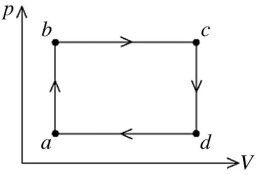
If the volume of the system increases from to calculate the change in internal (thermal)energy of the system.If the internal (thermal)energy change is nonzero,be sure to indicate whether this energy change is positive or negative. (Short Answer)
4.9/5 (73)
(73) When a fixed amount of ideal gas goes through an isothermal expansion,
(Multiple Choice)
4.9/5 (78)
(78) A spherical object 25.0 cm in diameter having an emissivity of 0.800 is held at a temperature of 275°C by an internal heater.This object is embedded in a very large vat of water at 100.0°C and atmospheric pressure.At what maximum rate (in g/min)is the water evaporating in the vat due to the radiated heat it receives from the object? You can ignore any heat radiated by the water.The latent heat of fusion for water is 33,400 J/kg,its latent heat of vaporization is
2.26 × 10⁶ J/kg,and the Stefan-Boltzmann constant is 5.670 × 10⁻⁸ W/m2 · K4.
(Short Answer)
5.0/5 (77)
(77) An expansion process on an ideal diatomic gas has a linear path between the initial and final states on a pV diagram.The initial pressure is  the initial volume is
 and the initial temperature is
 The final pressure is
 and the final temperature is
 The change in the internal (thermal)energy of the gas is closest to
the initial volume is and the initial temperature is The final pressure is and the final temperature is The change in the internal (thermal)energy of the gas is closest to (Multiple Choice)
4.7/5 (87)
(87) The temperature of an ideal gas in a sealed 0.40-  rigid container is reduced from 350 K to
 The final pressure of the gas is
 The molar heat capacity at constant volume of the gas is 28.0 J/mol · K.The heat absorbed by the gas is closest to
rigid container is reduced from 350 K to The final pressure of the gas is The molar heat capacity at constant volume of the gas is 28.0 J/mol · K.The heat absorbed by the gas is closest to (Multiple Choice)
4.7/5 (94)
(94) A container with rigid walls is filled with 4 mol of air with CV = 2.5R.How much does the internal (thermal)energy change if the temperature of the air rises from 16°C to 437°C? The ideal gas constant is R = 8.314 J/mol ∙ K.
(Multiple Choice)
4.8/5 (92)
(92) A cylindrical bar that us well insulated around its sides connects hot and cold reservoirs and conducts heat at a rate of 10.0 J/s under steady state conditions.If all of its linear dimensions (diameter and length)are reduced by half,the rate at which it will now conduct heat between the same reservoirs is closest to
(Multiple Choice)
4.8/5 (96)
(96) It is a well-known fact that water has a higher specific heat than iron.Now,consider equal masses of water and iron that are initially in thermal equilibrium.The same amount of heat, 30 calories,is added to each one.Which statement is true?
(Multiple Choice)
4.9/5 (77)
(77) An ideal gas is compressed in a well-insulated chamber using a well-insulated piston.This process is
(Multiple Choice)
4.7/5 (83)
(83) In an isochoric process,the internal (thermal)energy of an ideal gas decreases by 50 J.How much work does the gas do during this process?
(Multiple Choice)
4.8/5 (88)
(88) A substance has a melting point of 20°C and a heat of fusion of 3.5 × 10⁴ J/kg.The boiling point is 150°C and the heat of vaporization is 7.0 × 10⁴ J/kg at a pressure of 1.0 atm.The specific heats for the solid,liquid,and gaseous phases are 600 J/(kg ∙ K),1000 J/(kg ∙ K),and 400 J/(kg ∙ K),respectively.The quantity of heat given up by 0.50 kg of the substance when it is cooled from 170°C to 88°C,at a pressure of 1.0 atmosphere,is closest to
(Multiple Choice)
4.9/5 (78)
(78) Heat is added to a 2.0 kg piece of ice at a rate of  How long will it take for the ice to melt if it was initially at 0.00°C? (The latent heat of fusion for water is 334 kJ/kg and its latent heat of vaporization is 2260 kJ/kg.)
 (Multiple Choice)
4.8/5 (76)
(76) Some properties of glass are listed here. Density: 2300 kg/m3
Specific heat: 840 J/kg ∙ °C
Coefficient of linear thermal expansion: 8.5 × 10⁻⁶ (°C)-1
Thermal conductivity: 0.80 W/(m · °C)
A glass window pane is 2.7 m high,2.4 m wide,and 2.0 mm thick.The temperature at the inner surface of the glass is  and at the outer surface 4.0°C.How much heat is lost each hour through the window under steady state conditions?
 (Multiple Choice)
4.9/5 (83)
(83) Two metal rods,one silver and the other copper,are both attached to a steam chamber as shown in the figure,with a temperature of 100°C,at one end,and an ice water bath,with a temperature of 0°C,at the other.The rods are 5.0 cm long and have a square cross-section, 2.0 cm on a side.When steady state has been reached,how much heat flows through the two rods in 1.0 min? The thermal conductivity of silver is 417 W/(m ∙ K),and that of copper is
395 W/(m ∙ K).No heat is exchanged between the rods and the surroundings,except at their ends. 
(Multiple Choice)
4.9/5 (76)
(76) The figure (not to scale)shows a pV diagram for 1.8 g of helium gas (He)that undergoes the process 1 → 2 → 3.Find the value of V3.The ideal gas constant is R = 8.314 J/mol ∙ K = 0.0821 L ∙ atm/mol ∙ K,and the atomic weight of helium is 4.0 g/mol. 
(Multiple Choice)
4.8/5 (89)
(89) A steel container,equipped with a piston,contains 21 mol of an ideal gas at 465 K.The container is compressed isothermally to 90% of its original volume.How much work is done on the gas? The ideal gas constant is R = 8.314 J/mol ∙ K.
(Multiple Choice)
4.7/5 (72)
(72) An ideal gas in a balloon is kept in thermal equilibrium with its constant-temperature surroundings.How much work is done by the gas if the outside pressure is slowly reduced,allowing the balloon to expand to 6.0 times its original size? The balloon initially has a pressure of  and a volume of
 The ideal gas constant is R = 8.314 J/mol ∙ K.
and a volume of The ideal gas constant is R = 8.314 J/mol ∙ K. (Multiple Choice)
4.8/5 (76)
(76) 
Filters
- Essay(0)
- Multiple Choice(0)
- Short Answer(0)
- True False(0)
- Matching(0)