



 Chat with AI
Exam 18: A Macroscopic Description of Matter

Exam 1: Concepts of Motion52 Questions
Exam 2: Kinematics in One Dimension59 Questions
Exam 3: Vectors and Coordinate Systems33 Questions
Exam 4: Kinematics in Two Dimensions49 Questions
Exam 5: Force and Motion30 Questions
Exam 6: Dynamics I: Motion Along a Line46 Questions
Exam 7: Newtons Third Law43 Questions
Exam 8: Dynamics II: Motion in a Plane20 Questions
Exam 9: Work and Kinetic Energy66 Questions
Exam 10: Interactions and Potential Energy55 Questions
Exam 11: Impulse and Momentum43 Questions
Exam 12: Rotation of a Rigid Body116 Questions
Exam 13: Newtons Theory of Gravity50 Questions
Exam 14: Fluids and Elasticity72 Questions
Exam 15: Oscillations49 Questions
Exam 16: Traveling Waves51 Questions
Exam 17: Superposition51 Questions
Exam 18: A Macroscopic Description of Matter46 Questions
Exam 19: Work, heat, and the First Law of Thermodynamics96 Questions
Exam 20: The Micromacro Connection41 Questions
Exam 21: Heat Engines and Refrigerators44 Questions
Exam 22: Electric Charges and Forces26 Questions
Exam 23: The Electric Field32 Questions
Exam 24: Gausss Law41 Questions
Exam 25: The Electric Potential40 Questions
Exam 26: Potential and Field57 Questions
Exam 27: Current and Resistance32 Questions
Exam 28: Fundamentals of Circuits68 Questions
Exam 29: The Magnetic Field83 Questions
Exam 30: Electromagnetic Induction66 Questions
Exam 31: Electromagnetic Fields and Waves52 Questions
Exam 32: Ac Circuits44 Questions
Exam 33: Wave Optics51 Questions
Exam 34: Ray Optics60 Questions
Exam 35: Optical Instruments52 Questions
Exam 36: Relativity49 Questions
Exam 37: The Foundations of Modern Physics7 Questions
Exam 38: Quantization45 Questions
Exam 39: Wave Functions and Uncertainty18 Questions
Exam 40: One-Dimensional Quantum Mechanics32 Questions
Exam 41: Atomic Physics38 Questions
Exam 42: Nuclear Physics64 Questions
Select questions type


The hole for a bolt in a brass plate has a diameter of 1.200 cm at 20°C.What is the diameter of the hole when the plate is heated to 220°C? The coefficient of linear thermal expansion for brass is 19 × 10-6/°C.(Express your answer to 4 significant figures.)

Free
(Multiple Choice)
4.9/5  (75)
(75) Correct Answer: Verified
A
Two identical concrete slabs lie flat and in contact with each other as shown in the figure.If the temperature increases by 40°C,the lower edges opposite the contact edges remained fixed in position,and the lower edges of the contact side remain in contact,at what angle will the slabs be tilted? The coefficient of thermal expansion of the concrete is 10 × 10-6/K. 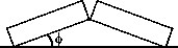
Free
(Multiple Choice)
4.7/5 (85)
(85) Correct Answer:Verified
VerifiedD
A fixed amount of ideal gas is held in a rigid container that expands negligibly when heated.At 20°C the gas pressure is p.If we add enough heat to increase the temperature from 20°C to 40°C,the pressure will be
Free
(Multiple Choice)
5.0/5 (81)
(81) Correct Answer:Verified
VerifiedC
Suppose that a steel bridge,1000 m long,was built without any expansion joints and that only one end of the bridge was held fixed.What would the difference in the length of the bridge be between winter and summer,taking a typical winter temperature as 0.00°C,and a typical summer temperature as 40°C? The coefficient of thermal expansion of steel is 10.5 × 10⁻⁶ K-1.
(Multiple Choice)
4.9/5 (86)
(86) A hot air balloon has a volume of 2.00 × 10³ m3 when fully inflated,and the air inside the balloon is always at atmospheric pressure of 1.01 × 10⁵ Pa because of the large opening used to fill the balloon and heat the air inside it.What is the mass of hot air inside the balloon if its temperature is 120°C? The universal gas constant is 8.314 J/mol ∙ K.(Assume a molecular weight of 28.8 g/mol for air.)
(Multiple Choice)
4.7/5 (89)
(89) Which contains more moles of material: 80 grams of helium gas (He,having atomic weight 4.0 g/mol)or 400 grams of argon gas (Ar,having atomic weight 40 g/mol)?
(Multiple Choice)
4.7/5 (73)
(73) The figure shows a 50-kg frictionless cylindrical piston that floats on 0.68 mol of compressed air at 30°C.How far does the piston move if the temperature is increased to 300°C? 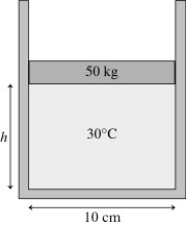
(Multiple Choice)
4.9/5 (67)
(67) How many moles of water (H2O)molecules are in a 4.00 m3 container at a pressure 8.00 × 10⁵ N/m2 and temperature 600°C? The ideal gas constant is R = 8.314 J/mol ∙ K
= 0.0821 L ∙ atm/mol ∙ K.
(Multiple Choice)
4.9/5 (66)
(66) A vertical tube that is closed at the upper end and open at the lower end contains an air pocket.The open end of the tube is under the water of a lake,as shown in the figure.When the lower end of the tube is just under the surface of the lake,where the temperature is 37°C and the pressure is 1.0 × 10⁵ Pa,the air pocket occupies a volume of  .Suppose now that the lower end of the tube is at a depth of 86 m in the lake,where the temperature is 7.0°C.What is the volume of the air pocket under these conditions? The density of the water in the lake is 1000 kg/m3.
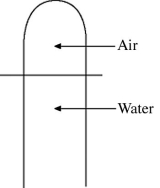
.Suppose now that the lower end of the tube is at a depth of 86 m in the lake,where the temperature is 7.0°C.What is the volume of the air pocket under these conditions? The density of the water in the lake is 1000 kg/m3. (Essay)
4.9/5 (77)
(77) A cold trap is set up to cause molecules to linger near the suction in a vacuum system.If the cold trap has an effective volume of 0.200 L and is maintained at  how many molecules are in it at 10.0 Pa of pressure? (Avogadro's number is 6.022 × 10²³ molecules/mol,and the universal gas constant is 8.314 J/mol ∙ K.Assume the behavior of an ideal gas.)
 (Multiple Choice)
4.8/5 (84)
(84) A weather balloon contains 12.0 m3 of hydrogen gas when the balloon is released from a location at which the temperature is 22.0°C and the pressure is 101 kPa.The balloon rises to a location where the temperature is -30.0°C and the pressure is 20.0 kPa.If the balloon is free to expand so that the pressure of the gas inside is equal to the ambient pressure,what is the new volume of the balloon? Assume that in both cases the hydrogen gas is in thermal equilibrium with the outside air.
(Multiple Choice)
4.9/5 (94)
(94) A glass flask has a volume of 500 mL at a temperature of 20°C.The flask contains  of mercury at
 The temperature of the mercury and flask is raised until the mercury reaches the
 reference mark.The coefficients of volume expansion of mercury and glass are 18 × 10-5 K-1 and 2.0 × 10⁻⁵ K-1,respectively.The temperature at which this occurs is closest to
of mercury at The temperature of the mercury and flask is raised until the mercury reaches the reference mark.The coefficients of volume expansion of mercury and glass are 18 × 10-5 K-1 and 2.0 × 10⁻⁵ K-1,respectively.The temperature at which this occurs is closest to (Multiple Choice)
4.8/5 (80)
(80) The figure shows a pV diagram for 0.0066 mol of gas that undergoes the process 1 → 2 → 3.What is the pressure p2.The ideal gas constant is R = 8.314 J/mol ∙ K = 0.0821 L ∙ atm/mol ∙ K. 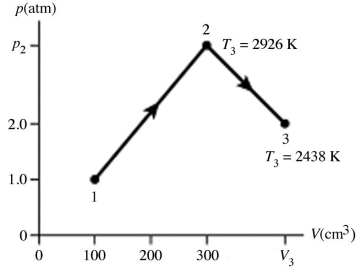
(Multiple Choice)
4.8/5 (80)
(80) A sealed 26-  tank is filled with 2000 moles of oxygen gas (O2)at an initial temperature of 270 K.The gas is heated to a final temperature of 460 K.The ATOMIC mass of oxygen is 16.0 g/mol,and the ideal gas constant is R = 8.314 J/mol · K = 0.0821 L · atm/mol · K.The final pressure of the gas is closest to
 (Multiple Choice)
4.9/5 (79)
(79) A machinist needs to remove a tight fitting pin of material A from a hole in a block made of material B.The machinist heats both the pin and the block to the same high temperature and removes the pin easily.What statement relates the coefficient of thermal expansion of material A to that of material B?
(Multiple Choice)
4.8/5 (69)
(69) The coefficient of linear expansion of aluminum is 24 × 10-6 K-1 and the coefficient of volume expansion of olive oil is 0.68 × 10⁻³ K-1.A novice cook,in preparation for deep-frying some potatoes,fills a 1.00-L aluminum pot to the brim and heats the oil and the pot from an initial temperature of 15°C to 190°C.To his consternation some olive oil spills over the top.How much?
(Multiple Choice)
4.8/5 (76)
(76) A 3.2-L volume of neon gas (Ne)is at a pressure of 3.3 atm and a temperature of 330 K.The atomic mass of neon is 20.2 g/mol,Avogadro's number is 6.022 × 10²³ molecules/mol,and the ideal gas constant is R = 8.314 J/mol · K = 0.0821 L · atm/mol · K.The mass of the neon gas is closest to
(Multiple Choice)
4.8/5 (86)
(86) A brass rod is 40.1 cm long and an aluminum rod is 79.3 cm long when both rods are at an initial temperature of 0°C.The rods are placed in line with a gap of 0.60 cm between them,as shown in the figure.The distance between the far ends of the rods is maintained at 120.0 cm throughout.The temperature of both rods is raised until the two rods are barely in contact.The coefficients of linear expansion of brass and aluminum are 2.0 × 10⁻⁵ K-1 and 2.4 × 10⁻⁵ K-1,respectively.The temperature at which contact of the rods barely occurs is closest to 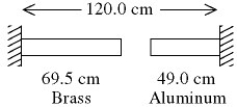
(Multiple Choice)
4.8/5 (77)
(77) The figure shows a pV diagram for 0.95 mol of gas that undergoes the process 1 → 2.The gas then undergoes an isochoric heating from point 2 until the pressure is restored to the value it had at point 1.What is the final temperature of the gas? The ideal gas constant is R = 8.314 J/mol ∙ K =  .
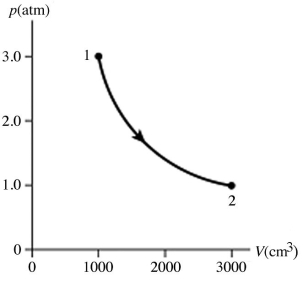
. (Multiple Choice)
4.8/5 (74)
(74) Sometimes an experiment requires a certain pure gas to be used at reduced pressure.One way to achieve this is to purchase a sealed glass container filled with the gas,and to introduce the gas into a vacuum by attaching the glass container to the vacuum chamber and breaking the tip of the glass container using a metallic bean and a magnet.If the volume of the glass container is 1.0 L and it is at a pressure of 1.0 × 10⁵ Pa and if the vacuum chamber has a volume of 2.0 L,what will the pressure be after the gas,which is to be assumed to be an ideal gas,is released into the vacuum chamber and the temperature has returned to its original value? (Note that the glass container remains part of the system.)
(Multiple Choice)
4.9/5 (92)
(92) 
Filters
- Essay(0)
- Multiple Choice(0)
- Short Answer(0)
- True False(0)
- Matching(0)