



 Chat with AI
Exam 22: Electric Charges and Forces

Exam 1: Concepts of Motion52 Questions
Exam 2: Kinematics in One Dimension59 Questions
Exam 3: Vectors and Coordinate Systems33 Questions
Exam 4: Kinematics in Two Dimensions49 Questions
Exam 5: Force and Motion30 Questions
Exam 6: Dynamics I: Motion Along a Line46 Questions
Exam 7: Newtons Third Law43 Questions
Exam 8: Dynamics II: Motion in a Plane20 Questions
Exam 9: Work and Kinetic Energy66 Questions
Exam 10: Interactions and Potential Energy55 Questions
Exam 11: Impulse and Momentum43 Questions
Exam 12: Rotation of a Rigid Body116 Questions
Exam 13: Newtons Theory of Gravity50 Questions
Exam 14: Fluids and Elasticity72 Questions
Exam 15: Oscillations49 Questions
Exam 16: Traveling Waves51 Questions
Exam 17: Superposition51 Questions
Exam 18: A Macroscopic Description of Matter46 Questions
Exam 19: Work, heat, and the First Law of Thermodynamics96 Questions
Exam 20: The Micromacro Connection41 Questions
Exam 21: Heat Engines and Refrigerators44 Questions
Exam 22: Electric Charges and Forces26 Questions
Exam 23: The Electric Field32 Questions
Exam 24: Gausss Law41 Questions
Exam 25: The Electric Potential40 Questions
Exam 26: Potential and Field57 Questions
Exam 27: Current and Resistance32 Questions
Exam 28: Fundamentals of Circuits68 Questions
Exam 29: The Magnetic Field83 Questions
Exam 30: Electromagnetic Induction66 Questions
Exam 31: Electromagnetic Fields and Waves52 Questions
Exam 32: Ac Circuits44 Questions
Exam 33: Wave Optics51 Questions
Exam 34: Ray Optics60 Questions
Exam 35: Optical Instruments52 Questions
Exam 36: Relativity49 Questions
Exam 37: The Foundations of Modern Physics7 Questions
Exam 38: Quantization45 Questions
Exam 39: Wave Functions and Uncertainty18 Questions
Exam 40: One-Dimensional Quantum Mechanics32 Questions
Exam 41: Atomic Physics38 Questions
Exam 42: Nuclear Physics64 Questions
Select questions type


A 1.0-C point charge is 15 m from a second point charge,and the electric force on one of them due to the other is 1.0 N.What is the magnitude of the second charge? (k = 1/4πε0 = 8.99 × 10⁹ N ∙ m2/C2)

Free
(Multiple Choice)
4.8/5  (73)
(73) Correct Answer: Verified
E
Two identical small charged spheres are a certain distance apart,and each one initially experiences an electrostatic force of magnitude F due to the other.With time,charge gradually leaks off of both spheres.When each of the spheres has lost half its initial charge,the magnitude of the electrostatic force will be
Free
(Multiple Choice)
4.9/5 (81)
(81) Correct Answer:Verified
VerifiedC
In the figure,a small spherical insulator of mass 6.00 × 10⁻² kg and charge +0.400 μC is hung by a thin wire of negligible mass.A charge of -0.220 μC is held 0.290 m away from the sphere and directly to the right of it,so the wire makes an angle θ with the vertical,as shown.What is the angle θ? (k = 1/4πε0 = 8.99 × 10⁹ N ∙ m2/C2) 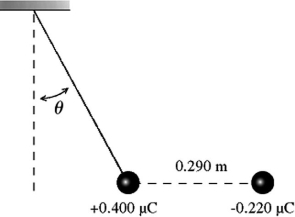
Free
(Multiple Choice)
4.8/5 (77)
(77) Correct Answer:Verified
VerifiedA
In the figure,all the charges are point charges and the charge in the middle is  For what charge q1 will charge q2 be in static equilibrium?
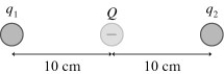
For what charge q1 will charge q2 be in static equilibrium? (Multiple Choice)
5.0/5 (76)
(76) A +7.00 μC point charge and -9.00 μC point charge are placed along the x-axis at x = 0.000 cm and  ,respectively.Where must a third charge,q,be placed along the x-axis so that it does not experience any net electric force due to the other two charges?
 (Multiple Choice)
4.8/5 (69)
(69) The point charge at the bottom of the figure is Q = +17 nC,and the curve is a circular arc.What is the magnitude of the force on the charge Q due to the other point charges shown? (k = 1/4πε0 = 8.99 × 10⁹ N ∙ m2/C2) 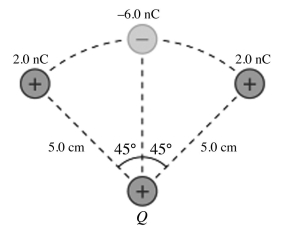
(Multiple Choice)
4.9/5 (88)
(88) One very small uniformly charged plastic ball is located directly above another such charge in a test tube as shown in the figure.The balls are in equilibrium a distance d apart.If the charge on each ball is doubled,the distance between the balls in the test tube would become 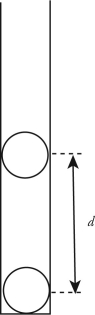
(Multiple Choice)
4.9/5 (71)
(71) Three point charges are placed on the x-axis.A charge of +2.0 μC is placed at the origin,
-2.0 μC to the right at x = 50 cm,and +4.0 μC at the 100 cm mark.What are the magnitude and direction of the electrostatic force that acts on the charge at the origin? (k = 1/4πε0 =
8.99 × 10⁹ N ∙ m2/C2)
(Short Answer)
5.0/5 (88)
(88) A metal sphere of radius 10 cm carries a charge of +2.0 μC uniformly distributed over its surface.What is the magnitude of the electric field due to this sphere at a point 5.0 cm outside the sphere's surface? (k = 1/4πε0 = 8.99 × 10⁹ N ∙ m2/C2)
(Multiple Choice)
4.9/5 (81)
(81) Charge Q1 = 6.0 nC is at (0.30 m,0),charge Q2 = -1.0 nC is at (0,0.10 m),and charge
Q3 = 5.0 nC is at (0,0).What are the magnitude and direction of the net electrostatic force on the 5.0-nC charge due to the other charges? (k = 1/4πε0 = 8.99 × 10⁹ N ∙ m2/C2)
(Essay)
4.9/5 (67)
(67) When two point charges are 2.0 cm apart,each one experiences a 1.0-N electric force due to the other charge.If they are moved to a new separation of 8.0 cm,the electric force on each of them is closest to
(Multiple Choice)
4.8/5 (88)
(88) A small sphere with a mass of 441 g is moving upward along the vertical +y-axis when it encounters an electric field of 5.00 N/C  .If,due to this field,the sphere suddenly acquires a horizontal acceleration of 13.0 m/s2
 ,what is the charge that it carries?
.If,due to this field,the sphere suddenly acquires a horizontal acceleration of 13.0 m/s2 ,what is the charge that it carries? (Multiple Choice)
4.7/5 (82)
(82) The figure shows two tiny 5.0-g spheres suspended from two very thin 1.0-m-long threads.The spheres repel each other after being charged to  and hang at rest as shown.What is the angle θ? (k = 1/4πε0 = 8.99 × 10⁹ N ∙ m2/C2)
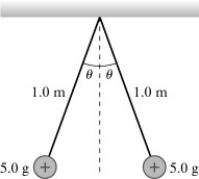
and hang at rest as shown.What is the angle θ? (k = 1/4πε0 = 8.99 × 10⁹ N ∙ m2/C2) (Multiple Choice)
4.8/5 (88)
(88) A positive point charge Q is fixed on a very large horizontal frictionless tabletop.A second positive point charge q is released from rest near the stationary charge and is free to move.Which statement best describes the motion of q after it is released?
(Multiple Choice)
4.8/5 (64)
(64) A point charge Q is located a short distance from a point charge 3Q,and no other charges are present.If the electrical force on Q is F,what is the electrical force on 3Q?
(Multiple Choice)
5.0/5 (67)
(67) A point charge Q of mass 8.50 g hangs from the horizontal ceiling by a light 25.0-cm thread.When a horizontal electric field of magnitude 1750 N/C is turned on,the charge hangs away from the vertical as shown in the figure.The magnitude of Q is closest to 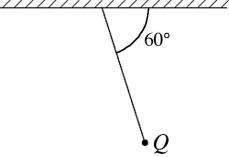
(Multiple Choice)
4.9/5 (81)
(81) When two point charges are a distance d part,the electric force that each one feels from the other has magnitude F.In order to make this force twice as strong,the distance would have to be changed to
(Multiple Choice)
4.8/5 (71)
(71) Two small insulating spheres are attached to silk threads and aligned vertically as shown in the figure.These spheres have equal masses of 40 g,and carry charges q1 and q2 of equal magnitude 2.0 μC but opposite sign. The spheres are brought into the positions shown in the figure,with a vertical separation of 15 cm between them.Note that you cannot neglect gravity. (k = 1/4πε0 = 8.99 × 10⁹ N ∙ m2/C2)The tension in the lower thread is closest to 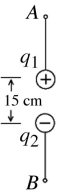
(Multiple Choice)
4.9/5 (90)
(90) In the figure,charge  = 3.1 ×
 C is placed at the origin and charge
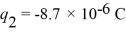 is placed on the x-axis,at x = -0.20 m.Where along the x-axis can a third charge Q = -8.3 µC be placed such that the resultant force on this third charge is zero?
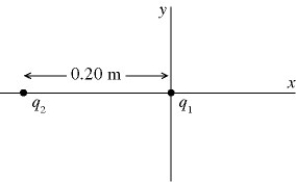
= 3.1 × C is placed at the origin and charge is placed on the x-axis,at x = -0.20 m.Where along the x-axis can a third charge Q = -8.3 µC be placed such that the resultant force on this third charge is zero? (Short Answer)
4.8/5 (76)
(76) What is the minimum magnitude of an electric field that balances the weight of a plastic sphere of mass  that has been charged to

that has been charged to (Multiple Choice)
4.9/5 (86)
(86) 
Filters
- Essay(0)
- Multiple Choice(0)
- Short Answer(0)
- True False(0)
- Matching(0)