



 Chat with AI
Exam 9: A--Monopoly

Exam 1: The Art and Science of Economic Analysis162 Questions
Exam 1: Appendix--Understanding Graphs71 Questions
Exam 2: Economic Tools and Economics Systems211 Questions
Exam 3: Economic Decision Makers207 Questions
Exam 4: Demand, Supply, and Markets245 Questions
Exam 5: Elasticity of Demand and Supply244 Questions
Exam 5: Appendix--Price Elasticity and Tax Incidence32 Questions
Exam 6: Consumer Choice and Demand171 Questions
Exam 6: Appendix--Indifference Curves and Utility Maximization107 Questions
Exam 7: Production and Cost in the Firm218 Questions
Exam 8: A--Perfect Competition250 Questions
Exam 8: B--Perfect Competition25 Questions
Exam 9: A--Monopoly249 Questions
Exam 9: B--Monopoly18 Questions
Exam 10: Monopolistic Competition and Oligopoly233 Questions
Exam 11: Resource Markets219 Questions
Exam 12: Labor Markets and Labor Unions218 Questions
Exam 13: Capital, Interest, and Corporate Finance190 Questions
Exam 14: Transaction Costs, Imperfect Information, and Behavioral Economics187 Questions
Exam 15: Economic Regulation and Antitrust Policy179 Questions
Exam 16: Public Goods and Public Choice143 Questions
Exam 17: Externalities and the Environment203 Questions
Exam 18: Income Distribution and Poverty130 Questions
Exam 19: International Trade172 Questions
Exam 20: International Finance226 Questions
Exam 21: Economic Development97 Questions
Select questions type


Exhibit 9-12 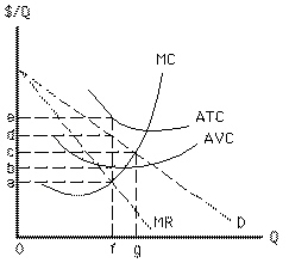 The nondiscriminating monopolist in Exhibit 9-12 will produce where
 (Multiple Choice)
4.8/5  (67)
(67) Which of the following describes the market structure of monopoly?
(Multiple Choice)
4.8/5 (91)
(91) If a nondiscriminating monopolist is operating at an output level where price equals average total cost, we can conclude that
(Multiple Choice)
4.7/5 (89)
(89) Average revenue equals the change in total revenue divided by the change in the quantity of output produced.
(True/False)
4.8/5 (87)
(87) Suppose Arf n' Barf restaurant has a monopoly on restaurant food in a certain small town.Their rent, which is one of several fixed costs they pay whether they sell food or not, has gone up.In the short run, the Arf n' Barf should
(Multiple Choice)
4.7/5 (77)
(77) If the marginal cost curve shifts upward, a profit-maximizing, nondiscriminating monopolist is likely to respond in the short run by
(Multiple Choice)
4.9/5 (83)
(83) Which of the following prevents potential competitors from entering a monopolist's market?
(Multiple Choice)
4.9/5 (81)
(81) Exhibit 9-18 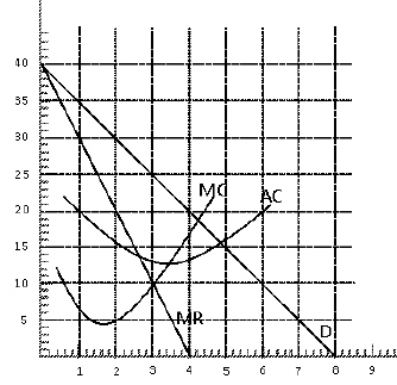 The firm in Exhibit 9-18, who charges the same price to all customers, will earn how much revenue?
 (Multiple Choice)
4.8/5 (82)
(82) Exhibit 9-3  At the profit-maximizing quantity, the demand curve facing the firm in Exhibit 9-3 is
 (Multiple Choice)
4.9/5 (86)
(86) For a monopolist that produces in the short run and does not price discriminate, price always has to be
(Multiple Choice)
4.8/5 (79)
(79) Compared to a perfectly competitive market, a monopoly tends to produce
(Multiple Choice)
4.9/5 (78)
(78) You are hired as a production analyst at Monopoly-R-Us and you estimate that, at current output, demand is inelastic and marginal cost is positive.You advise your superiors that they can increase profit by
(Multiple Choice)
4.9/5 (82)
(82) Exhibit 9-5 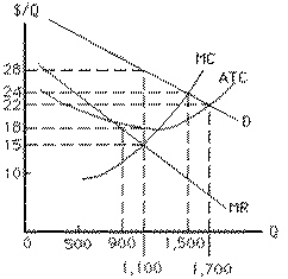 The nondiscriminating monopolist at its profit-maximizing quantity in Exhibit 9-5 is making a profit of
 (Multiple Choice)
4.9/5 (79)
(79) Which of the following would not be considered price discrimination?
(Multiple Choice)
4.8/5 (79)
(79) Exhibit 9-11 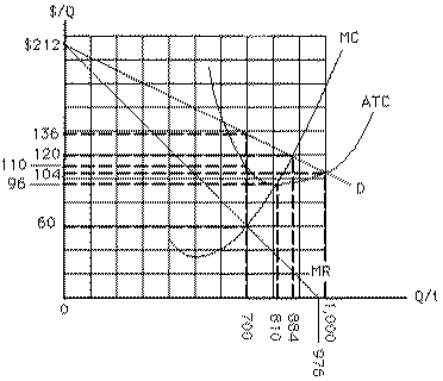 If the monopolist in Exhibit 9-11 engages in perfect price discrimination, price would be
 (Multiple Choice)
4.9/5 (78)
(78) Exhibit 9-11 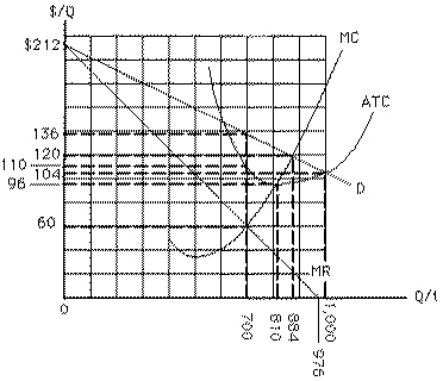 If the monopolist in Exhibit 9-11 engages in perfect price discrimination, price would
 (Multiple Choice)
5.0/5 (85)
(85) Suppose that a price-discriminating monopolist divides its market into two segments.In each market segment, price is determined by finding the level of output where that market's
(Multiple Choice)
4.8/5 (93)
(93) 
Filters
- Essay(0)
- Multiple Choice(0)
- Short Answer(0)
- True False(0)
- Matching(0)