



 Chat with AI
Exam 9: A--Monopoly

Exam 1: The Art and Science of Economic Analysis162 Questions
Exam 1: Appendix--Understanding Graphs71 Questions
Exam 2: Economic Tools and Economics Systems211 Questions
Exam 3: Economic Decision Makers207 Questions
Exam 4: Demand, Supply, and Markets245 Questions
Exam 5: Elasticity of Demand and Supply244 Questions
Exam 5: Appendix--Price Elasticity and Tax Incidence32 Questions
Exam 6: Consumer Choice and Demand171 Questions
Exam 6: Appendix--Indifference Curves and Utility Maximization107 Questions
Exam 7: Production and Cost in the Firm218 Questions
Exam 8: A--Perfect Competition250 Questions
Exam 8: B--Perfect Competition25 Questions
Exam 9: A--Monopoly249 Questions
Exam 9: B--Monopoly18 Questions
Exam 10: Monopolistic Competition and Oligopoly233 Questions
Exam 11: Resource Markets219 Questions
Exam 12: Labor Markets and Labor Unions218 Questions
Exam 13: Capital, Interest, and Corporate Finance190 Questions
Exam 14: Transaction Costs, Imperfect Information, and Behavioral Economics187 Questions
Exam 15: Economic Regulation and Antitrust Policy179 Questions
Exam 16: Public Goods and Public Choice143 Questions
Exam 17: Externalities and the Environment203 Questions
Exam 18: Income Distribution and Poverty130 Questions
Exam 19: International Trade172 Questions
Exam 20: International Finance226 Questions
Exam 21: Economic Development97 Questions
Select questions type


Relative to a perfectly competitive market, as long as the monopolist does not benefit from substantial economies of scale,
(Multiple Choice)
4.9/5  (80)
(80) Exhibit 9-10 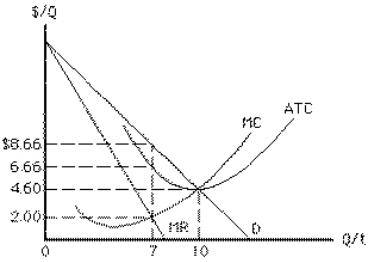 What price would maximize the profit of the nondiscriminating monopolist in Exhibit 9-10?
 (Multiple Choice)
4.9/5 (81)
(81) Exhibit 9-14 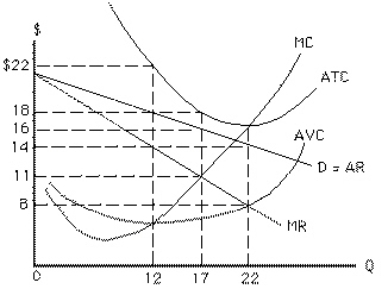 The production level that will maximize the profit (or minimize loss)for the monopoly in Exhibit 9-14 is
 (Multiple Choice)
4.9/5 (81)
(81) Suppose that at an output of 1, 000 units, a monopolist has marginal cost of $40, marginal revenue of $30, average variable cost of $30, and average total cost of $50.In order to maximize profit or minimize loss in the short run, the firm should
(Multiple Choice)
4.9/5 (76)
(76) Which of the following would not be considered price discrimination?
(Multiple Choice)
4.9/5 (87)
(87) Exhibit 9-17 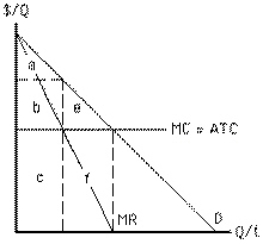 In Exhibit 9-17, which area represents monopoly profit with perfect price discrimination?
 (Multiple Choice)
4.8/5 (77)
(77) Exhibit 9-18 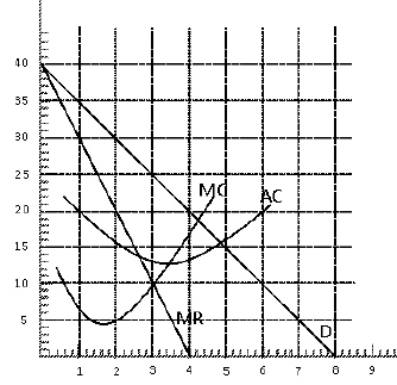 The firm in Exhibit 9-18, the monopolist who charges the same price to all customers, will charge what price?
 (Multiple Choice)
5.0/5 (69)
(69) Exhibit 9-17 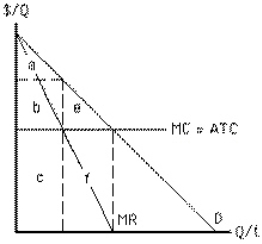 In Exhibit 9-17, which area represents the amount of consumer surplus received by consumers under perfect price discrimination?
 (Multiple Choice)
4.9/5 (79)
(79) Exhibit 9-19 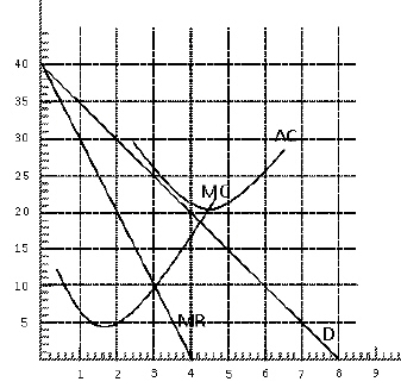 The firm in Exhibit 9-19, who charges the same price to all customers, will earn how much profit?
 (Multiple Choice)
5.0/5 (75)
(75) Which of the following conditions would distinguish a competitive firm from a monopolist?
(Multiple Choice)
4.9/5 (83)
(83) Exhibit 9-11 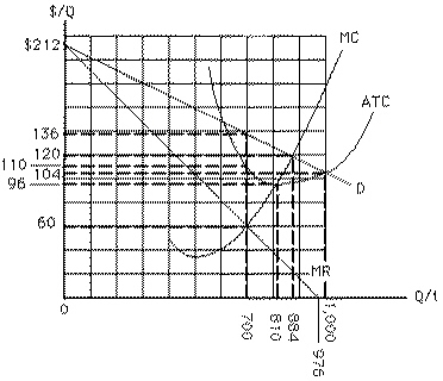 If the monopolist in Exhibit 9-11 engages in perfect price discrimination, profit-maximizing output would be
 (Multiple Choice)
4.9/5 (89)
(89) Anything that prevents new firms from competing on an equal basis with existing firms in an industry is called a barrier to entry.
(True/False)
4.8/5 (66)
(66) With perfect price discrimination, the firm faces a constant marginal revenue.
(True/False)
4.8/5 (65)
(65) Rent-seeking activities are socially wasteful because they use scarce resources but do not add to society's output.
(True/False)
4.8/5 (80)
(80) A profit-maximizing monopolist that produces in the short run will
(Multiple Choice)
5.0/5 (75)
(75) Which of following is true of monopoly and not of perfect competition?
(Multiple Choice)
4.9/5 (74)
(74) Suppose that a price-discriminating monopolist divides its market into two segments.If the firm sells its product for a price of $42 in the market segment where demand is relatively less elastic, the price in the market segment whose customers' demand is more elastic will be
(Multiple Choice)
4.9/5 (69)
(69) Exhibit 9-11 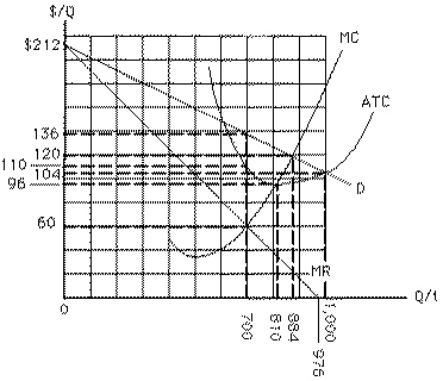 In Exhibit 9-11, which level of output maximizes profit for this nondiscriminating monopolist?
 (Multiple Choice)
4.7/5 (80)
(80) For a monopolist, if marginal revenue is $40, total revenue is
(Multiple Choice)
4.9/5 (85)
(85) 
Filters
- Essay(0)
- Multiple Choice(0)
- Short Answer(0)
- True False(0)
- Matching(0)