



 Chat with AI
Exam 9: A--Monopoly

Exam 1: The Art and Science of Economic Analysis162 Questions
Exam 1: Appendix--Understanding Graphs71 Questions
Exam 2: Economic Tools and Economics Systems211 Questions
Exam 3: Economic Decision Makers207 Questions
Exam 4: Demand, Supply, and Markets245 Questions
Exam 5: Elasticity of Demand and Supply244 Questions
Exam 5: Appendix--Price Elasticity and Tax Incidence32 Questions
Exam 6: Consumer Choice and Demand171 Questions
Exam 6: Appendix--Indifference Curves and Utility Maximization107 Questions
Exam 7: Production and Cost in the Firm218 Questions
Exam 8: A--Perfect Competition250 Questions
Exam 8: B--Perfect Competition25 Questions
Exam 9: A--Monopoly249 Questions
Exam 9: B--Monopoly18 Questions
Exam 10: Monopolistic Competition and Oligopoly233 Questions
Exam 11: Resource Markets219 Questions
Exam 12: Labor Markets and Labor Unions218 Questions
Exam 13: Capital, Interest, and Corporate Finance190 Questions
Exam 14: Transaction Costs, Imperfect Information, and Behavioral Economics187 Questions
Exam 15: Economic Regulation and Antitrust Policy179 Questions
Exam 16: Public Goods and Public Choice143 Questions
Exam 17: Externalities and the Environment203 Questions
Exam 18: Income Distribution and Poverty130 Questions
Exam 19: International Trade172 Questions
Exam 20: International Finance226 Questions
Exam 21: Economic Development97 Questions
Select questions type


Total deadweight loss in society is reduced through rent seeking by monopolists.
(True/False)
4.9/5  (74)
(74) For a monopolist that does not price discriminate, economic profit is maximized in the short run at a price of $140.Marginal revenue at that output level is
(Multiple Choice)
4.9/5 (74)
(74) For a monopolist, as output expands, price and marginal revenue become more divergent (i.e., are farther apart).
(True/False)
4.8/5 (60)
(60) For which of the following products would price discrimination be easiest?
(Multiple Choice)
4.9/5 (92)
(92) Exhibit 9-6 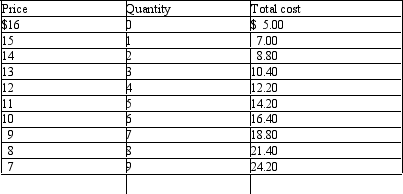 What is the profit-maximizing price for the monopolist in Exhibit 9-6?
 (Multiple Choice)
4.7/5 (64)
(64) Which of the following would probably not be considered a natural monopoly?
(Multiple Choice)
4.9/5 (83)
(83) Exhibit 9-11 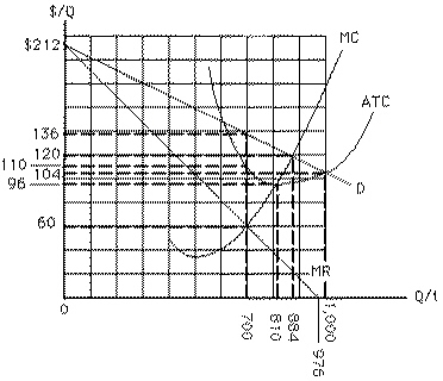 Total revenue for the profit-maximizing monopoly in Exhibit 9-11 that does not price discriminate will be
 (Multiple Choice)
4.9/5 (82)
(82) Which of the following is not considered a barrier to entry?
(Multiple Choice)
4.9/5 (81)
(81) Which of the following could not bar entry into an industry?
(Multiple Choice)
4.7/5 (75)
(75) A price searcher is any firm that has no control over price and must accept the market price as given.
(True/False)
4.8/5 (82)
(82) A firm facing a downward-sloping demand curve sells 50 units of output at $10 each.The firm's marginal revenue is
(Multiple Choice)
4.8/5 (87)
(87) A monopolist maximizes profit at the quantity where the slope of its total revenue curve equals the slope of its total cost curve.
(True/False)
4.9/5 (92)
(92) Exhibit 9-10 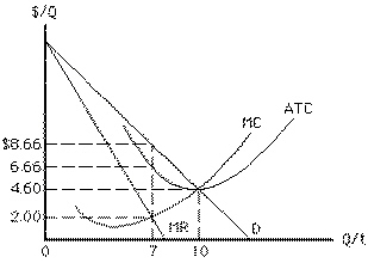 What output would maximize the profit of the nondiscriminating monopolist in Exhibit 9-10?
 (Multiple Choice)
5.0/5 (94)
(94) Exhibit 9-7 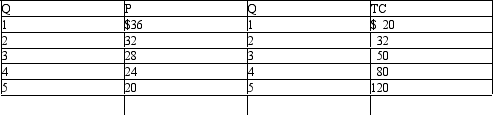 Consider Exhibit 9-7.What is the profit-maximizing output for a monopolist that does not price discriminate?
 (Multiple Choice)
4.8/5 (72)
(72) Willie Stand obtains a patent on his new invention, the bipod.After twenty years,
(Multiple Choice)
4.9/5 (74)
(74) Which of the following is a major criticism of a monopoly as a cause of allocative inefficiency?
(Multiple Choice)
5.0/5 (78)
(78) A monopolist's marginal revenue curve is flatter than its demand curve.
(True/False)
5.0/5 (74)
(74) 
Filters
- Essay(0)
- Multiple Choice(0)
- Short Answer(0)
- True False(0)
- Matching(0)