



 Chat with AI
Exam 9: A--Monopoly

Exam 1: The Art and Science of Economic Analysis162 Questions
Exam 1: Appendix--Understanding Graphs71 Questions
Exam 2: Economic Tools and Economics Systems211 Questions
Exam 3: Economic Decision Makers207 Questions
Exam 4: Demand, Supply, and Markets245 Questions
Exam 5: Elasticity of Demand and Supply244 Questions
Exam 5: Appendix--Price Elasticity and Tax Incidence32 Questions
Exam 6: Consumer Choice and Demand171 Questions
Exam 6: Appendix--Indifference Curves and Utility Maximization107 Questions
Exam 7: Production and Cost in the Firm218 Questions
Exam 8: A--Perfect Competition250 Questions
Exam 8: B--Perfect Competition25 Questions
Exam 9: A--Monopoly249 Questions
Exam 9: B--Monopoly18 Questions
Exam 10: Monopolistic Competition and Oligopoly233 Questions
Exam 11: Resource Markets219 Questions
Exam 12: Labor Markets and Labor Unions218 Questions
Exam 13: Capital, Interest, and Corporate Finance190 Questions
Exam 14: Transaction Costs, Imperfect Information, and Behavioral Economics187 Questions
Exam 15: Economic Regulation and Antitrust Policy179 Questions
Exam 16: Public Goods and Public Choice143 Questions
Exam 17: Externalities and the Environment203 Questions
Exam 18: Income Distribution and Poverty130 Questions
Exam 19: International Trade172 Questions
Exam 20: International Finance226 Questions
Exam 21: Economic Development97 Questions
Select questions type


Suppose it costs Minnie's Mini-Golf (a monopolist)not a penny more to let another person on the course.If Minnie's faces a linear (downward-sloping)market demand curve, it will maximize profit by choosing the point on the demand curve at which
(Multiple Choice)
4.9/5  (68)
(68) As a monopolist increases the quantity of output produced, what happens to price (P)and marginal revenue (MR)?
(Multiple Choice)
4.8/5 (71)
(71) Exhibit 9-5 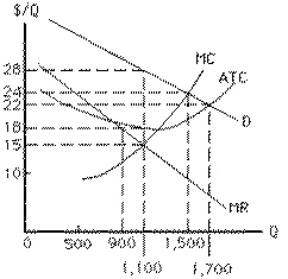 The total cost for the nondiscriminating monopolist at its profit-maximizing quantity in Exhibit 9-5
 (Multiple Choice)
4.9/5 (98)
(98) If all of a monopolist's costs are fixed costs, it will produce where demand is unit elastic.
(True/False)
4.8/5 (87)
(87) Which of the following could be true of perfect competition but not of monopoly?
(Multiple Choice)
4.8/5 (84)
(84) A profit-maximizing monopolist produces an output level that is allocatively inefficient because
(Multiple Choice)
4.7/5 (78)
(78) A monopolist faces an upward-sloping marginal cost curve.Its profit-maximizing quantity will be
(Multiple Choice)
4.9/5 (64)
(64) For a nondiscriminating monopolist, describe the relationship between market price (P), average revenue (AR), and marginal revenue (MR).
(Multiple Choice)
4.9/5 (82)
(82) Exhibit 9-15 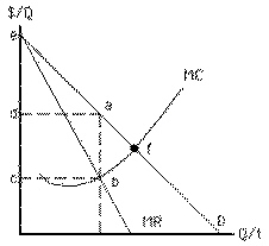 Why might the true deadweight loss from a nondiscriminating monopolist be lower than the loss indicated in Exhibit 9-15
 (Multiple Choice)
4.9/5 (85)
(85) 
Filters
- Essay(0)
- Multiple Choice(0)
- Short Answer(0)
- True False(0)
- Matching(0)