



 Chat with AI
Exam 9: A--Monopoly

Exam 1: The Art and Science of Economic Analysis162 Questions
Exam 1: Appendix--Understanding Graphs71 Questions
Exam 2: Economic Tools and Economics Systems211 Questions
Exam 3: Economic Decision Makers207 Questions
Exam 4: Demand, Supply, and Markets245 Questions
Exam 5: Elasticity of Demand and Supply244 Questions
Exam 5: Appendix--Price Elasticity and Tax Incidence32 Questions
Exam 6: Consumer Choice and Demand171 Questions
Exam 6: Appendix--Indifference Curves and Utility Maximization107 Questions
Exam 7: Production and Cost in the Firm218 Questions
Exam 8: A--Perfect Competition250 Questions
Exam 8: B--Perfect Competition25 Questions
Exam 9: A--Monopoly249 Questions
Exam 9: B--Monopoly18 Questions
Exam 10: Monopolistic Competition and Oligopoly233 Questions
Exam 11: Resource Markets219 Questions
Exam 12: Labor Markets and Labor Unions218 Questions
Exam 13: Capital, Interest, and Corporate Finance190 Questions
Exam 14: Transaction Costs, Imperfect Information, and Behavioral Economics187 Questions
Exam 15: Economic Regulation and Antitrust Policy179 Questions
Exam 16: Public Goods and Public Choice143 Questions
Exam 17: Externalities and the Environment203 Questions
Exam 18: Income Distribution and Poverty130 Questions
Exam 19: International Trade172 Questions
Exam 20: International Finance226 Questions
Exam 21: Economic Development97 Questions
Select questions type


Sam Edison obtains a patent on his new invention: trinoculars.In the long run,
(Multiple Choice)
4.9/5  (90)
(90) Exhibit 9-11 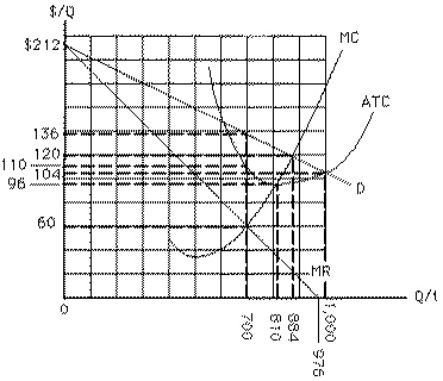 If the monopolist in Exhibit 9-11 engages in perfect price discrimination, total revenue would be
 (Multiple Choice)
4.9/5 (86)
(86) A profit-maximizing monopolist produces an output level at which
(Multiple Choice)
4.9/5 (72)
(72) Exhibit 9-4  What is the profit-maximizing or loss-minimizing output for the monopolist represented in Exhibit 9-4, assuming it does not price discriminate?
 (Multiple Choice)
4.9/5 (70)
(70) Exhibit 9-12 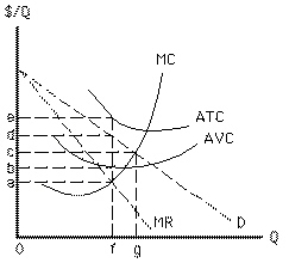 The total revenue for the nondiscriminating monopolist in Exhibit 9-12 is
 (Multiple Choice)
4.9/5 (85)
(85) Exhibit 9-1  In Exhibit 9-1, the marginal revenue of the third unit is
 (Multiple Choice)
4.8/5 (68)
(68) Exhibit 9-12 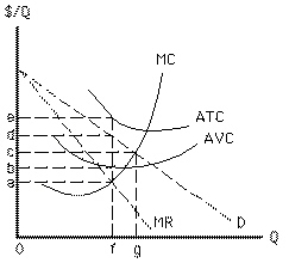 The profit-maximizing level of output and price for the nondiscriminating monopolist in Exhibit 9-12 are
 (Multiple Choice)
4.9/5 (93)
(93) Exhibit 9-3  The firm in Exhibit 9-3, which charges the same price to all customers, will produce where
 (Multiple Choice)
4.9/5 (76)
(76) Patent laws promote technical progress in all of the following ways except one.Which is the exception?
(Multiple Choice)
4.9/5 (73)
(73) Innovation is the process of turning an invention into a marketable product.
(True/False)
4.9/5 (89)
(89) A profit-maximizing monopolist will always operate where demand is unit elastic.
(True/False)
4.9/5 (84)
(84) Suppose a single firm supplies all the ceramic windlasses in the U.S.The demand curve that firm faces is
(Multiple Choice)
4.7/5 (77)
(77) Exhibit 9-3  The profit-maximizing output and price for the firm in Exhibit 9-3, which charges the same price to all customers, are
 (Multiple Choice)
4.9/5 (74)
(74) Exhibit 9-3  At the profit-maximizing output for the firm in Exhibit 9-3, the single price monopolist will earn a profit of ______ per unit of output?
 (Multiple Choice)
4.8/5 (85)
(85) If a monopolist must lower the price on all units in order to sell an additional unit,
(Multiple Choice)
4.8/5 (73)
(73) Exhibit 9-15 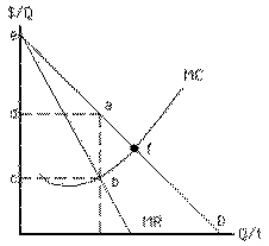 In Exhibit 9-15, deadweight loss to consumers from a monopolist that does not price discriminate is represented by area
 (Multiple Choice)
4.9/5 (79)
(79) 
Filters
- Essay(0)
- Multiple Choice(0)
- Short Answer(0)
- True False(0)
- Matching(0)