



 Chat with AI
Exam 9: A--Monopoly

Exam 1: The Art and Science of Economic Analysis162 Questions
Exam 1: Appendix--Understanding Graphs71 Questions
Exam 2: Economic Tools and Economics Systems211 Questions
Exam 3: Economic Decision Makers207 Questions
Exam 4: Demand, Supply, and Markets245 Questions
Exam 5: Elasticity of Demand and Supply244 Questions
Exam 5: Appendix--Price Elasticity and Tax Incidence32 Questions
Exam 6: Consumer Choice and Demand171 Questions
Exam 6: Appendix--Indifference Curves and Utility Maximization107 Questions
Exam 7: Production and Cost in the Firm218 Questions
Exam 8: A--Perfect Competition250 Questions
Exam 8: B--Perfect Competition25 Questions
Exam 9: A--Monopoly249 Questions
Exam 9: B--Monopoly18 Questions
Exam 10: Monopolistic Competition and Oligopoly233 Questions
Exam 11: Resource Markets219 Questions
Exam 12: Labor Markets and Labor Unions218 Questions
Exam 13: Capital, Interest, and Corporate Finance190 Questions
Exam 14: Transaction Costs, Imperfect Information, and Behavioral Economics187 Questions
Exam 15: Economic Regulation and Antitrust Policy179 Questions
Exam 16: Public Goods and Public Choice143 Questions
Exam 17: Externalities and the Environment203 Questions
Exam 18: Income Distribution and Poverty130 Questions
Exam 19: International Trade172 Questions
Exam 20: International Finance226 Questions
Exam 21: Economic Development97 Questions
Select questions type


Exhibit 9-3  At the profit-maximizing output for the firm in Exhibit 9-3, the single price monopolist will charge _____ per unit of output.
 (Multiple Choice)
4.8/5  (65)
(65) Exhibit 9-18 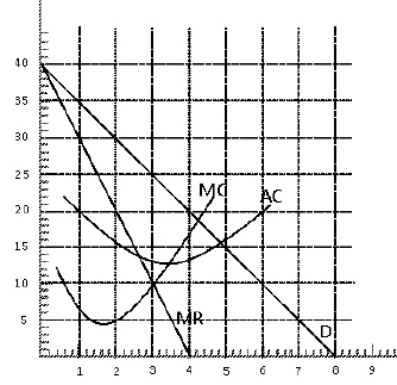 The firm in Exhibit 9-18, the monopolist who charges the same price to all customers, will produce how many units of output?
 (Multiple Choice)
4.8/5 (86)
(86) Exhibit 9-2  In Exhibit 9-2, the average revenue of the fourth unit is
 (Multiple Choice)
4.8/5 (80)
(80) Suppose that the only maker of a particular type of horse hair clothing exits the industry because demand is too low.The correct analysis of this situation is that
(Multiple Choice)
4.9/5 (85)
(85) On a graph, to determine the price a profit-maximizing monopolist would charge, find the quantity at which MC and MR intersect and read up to the demand curve.
(True/False)
4.9/5 (84)
(84) Exhibit 9-11 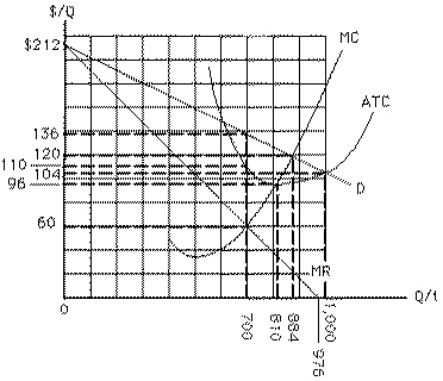 If the monopolist in Exhibit 9-11 chooses to produce 1, 000 units and does not price discriminate, its profit will be
 (Multiple Choice)
4.7/5 (79)
(79) Exhibit 9-5 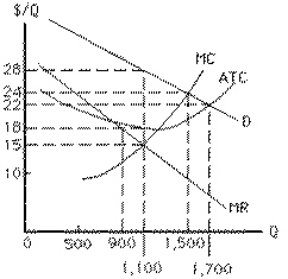 The total revenue for the nondiscriminating monopolist at its profit-maximizing quantity in Exhibit 9-5 is
 (Multiple Choice)
5.0/5 (91)
(91) Unlike firms in a perfectly competitive industry, monopolists have control over
(Multiple Choice)
4.8/5 (83)
(83) The practice of charging different prices to different consumers of the same product is called
(Multiple Choice)
4.8/5 (76)
(76) Average revenue, demand, and price are all depicted by the same curve for a monopoly.
(True/False)
4.8/5 (85)
(85) Exhibit 9-3  The total cost for the firm in Exhibit 9-3, a monopolist that maximizes profit while charging all customers the same price, is
 (Multiple Choice)
4.9/5 (79)
(79) Price discrimination will occur whenever a firm faces a downward-sloping demand curve.
(True/False)
4.8/5 (87)
(87) A profit-maximizing monopolist never produces along the __________ portion of the demand curve because marginal revenue is __________ there.
(Multiple Choice)
4.9/5 (81)
(81) Perfectly competitive firms and monopolist firms both maximize profit where
(Multiple Choice)
4.9/5 (77)
(77) A monopolist has complete control over both price and quantity of output.
(True/False)
4.8/5 (71)
(71) With perfect price discrimination, each consumer is charged the marginal value of each unit consumed.
(True/False)
4.8/5 (59)
(59) Exhibit 9-4  What is the revenue-maximizing output for the monopolist represented in Exhibit 9-4, assuming it does not price discriminate?
 (Multiple Choice)
4.8/5 (73)
(73) 
Filters
- Essay(0)
- Multiple Choice(0)
- Short Answer(0)
- True False(0)
- Matching(0)