Multiple Choice
Passage
The alkaline-earth metals are a highly reactive family of metals occupying Group 2 (IIA) of the periodic table. In their elemental form, the alkaline-earth metals have a shiny, silvery-white to slightly yellowish appearance. The alkaline-earth metals exhibit some similarities to the chemistry of the alkali metals (Group 1) but are a little less reactive.Atoms of the alkaline-earth metals (M) have only two valence electrons and a low first and second ionization energy. Consequently, these metals readily lose both electrons to produce cations with a +2 charge (M+2) during reactions with nonmetals. As a result, the alkaline-earth metals do not exist in their elemental metallic form in nature. Instead, the Group 2 elements are found primarily as metal oxides, which form by reacting oxygen (Reaction 1) .

Similarly, elemental samples of alkaline-earth metals will react with elemental halogens (X2) to form metal halides (Reaction 2) , all of which are ionic except for BeCl2.

Except for beryllium, the alkaline-earth metals react with water to produce very basic metal hydroxide solutions and hydrogen gas (Reaction 3) .

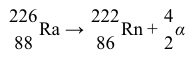
The most difficult alkaline-earth metal to study is radium, because it is a rare radioactive element that is produced from the nuclear decay of uranium. The most common natural isotope, radium-226, has a half-life of 1,600 years and decays by alpha emission into radon-222 (Reaction 4) .
-Which of the following diagrams correctly labels the position of the transition state (‡) for the first step of the reaction shown in Figure 1?
A) 
B) 
C) 
D) 
Correct Answer:

Verified
Correct Answer:
Verified
Q241: Passage<br>Heme is found in several proteins, including
Q242: Passage<br>Combustion occurs when an oxidation-reduction reaction takes
Q243: Passage<br>Magnetic resonance imaging (MRI) interprets the nuclear
Q244: Passage<br>Depending on the active compound's specific method
Q245: Passage<br>Heme is found in several proteins, including
Q247: Passage<br>Household cleaners commonly contain either ammonia (NH<sub>3</sub>)
Q248: Passage<br>Within the renal system, two buffers operate
Q249: Passage<br>Water is unique in that all three
Q250: Passage<br>The primary structure of a protein is
Q251: Passage<br>The radiopharmaceutical 2-deoxy-2-(<sup>18</sup>F)fluoro-D-glucose (abbreviated as <sup>18</sup>F-FDG) is