Multiple Choice
Passage
Household cleaners commonly contain either ammonia (NH3) or bleach (NaOCl) as the principal active ingredient. Mixing ammonia-based and bleach-based cleaners can be hazardous, as the resulting reactions can form several toxic products. One of these reactions forms the irritant dichloramine (NHCl2) as follows:
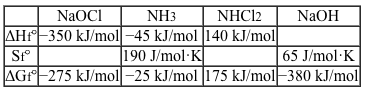
 Reaction 1The overall reaction has a standard enthalpy change of −55 kJ/mol and a standard entropy change of −150 J/mol·K. Partial thermodynamic data for formation of Reaction 1 reagents from their elements are shown in Table 1.Table 1 Partial Data for Enthalpies, Entropies, and Free Energies of Formation of Several Compounds at 25 °C
 After it is formed, dichloramine readily enters the gas phase, where it may be inhaled. In the lungs, dichloramine reacts with water to produce hydrochloric acid and ammonia, as well as reactive oxygen species. In small doses, these products cause mild irritation, but inhalation of large amounts of chloramines can lead to pneumonitis (inflammation of the lungs) and may require medical intervention.
Adapted from Trogolo D, Arey JS. Benchmark thermochemistry of chloramines, bromamines, and bromochloramines: halogen oxidants stabilized by electron correlation. Phys Chem Chem Phys. 2015;17(5) :3584-98.
-Based on the information given in the passage, which of the following is the standard molar enthalpy of formation for sodium hydroxide?
A) −590 kJ/mol
B) −470 kJ/mol
C) −940 kJ/mol
D) 275 kJ/mol
Correct Answer:

Verified
Correct Answer:
Verified
Q242: Passage<br>Combustion occurs when an oxidation-reduction reaction takes
Q243: Passage<br>Magnetic resonance imaging (MRI) interprets the nuclear
Q244: Passage<br>Depending on the active compound's specific method
Q245: Passage<br>Heme is found in several proteins, including
Q246: Passage<br>The alkaline-earth metals are a highly reactive
Q248: Passage<br>Within the renal system, two buffers operate
Q249: Passage<br>Water is unique in that all three
Q250: Passage<br>The primary structure of a protein is
Q251: Passage<br>The radiopharmaceutical 2-deoxy-2-(<sup>18</sup>F)fluoro-D-glucose (abbreviated as <sup>18</sup>F-FDG) is
Q252: The graph below shows the redox titration