Multiple Choice
Passage
Magnetic resonance imaging (MRI) interprets the nuclear relaxation or relaxivity of hydrogen nuclei in resident water molecules. Hydrogen nuclei in water have two magnetic spin states: alpha and beta. In the presence of an applied magnetic field, these spins will align with the field in an "excited" state and then relax back to the "ground" state, producing a signal with intensity proportional to relaxivity. Frequently, an MRI contrast agent is used to increase the relaxation time in coordinated molecules, resulting in a more intense signal.Commonly used contrast agents include gadolinium-based agents. Depending on its environment, gadolinium (Gd) can have eight or nine sites in its coordination sphere, allowing Gd3+ to interact with eight water molecules as in Gd(H2O) 83+. The electronic configuration of gadolinium is shown in Figure 1.
 Figure 1 Electronic configuration of gadoliniumGd3+ alone is toxic to cells because its ionic radius is similar to that of Ca2+, allowing Gd3+ to displace Ca2+ in biologically important settings. Therefore, Gd3+ must be coordinated to an organic ligand such as 1,4,7,10-tetraazacyclododecane-1,4,7,10-tetraacetic acid (DOTA) to allow it to pass through the body safely. When chelated, DOTA displaces the water around gadolinium and leaves only one coordination site for a water molecule (Figure 2) .
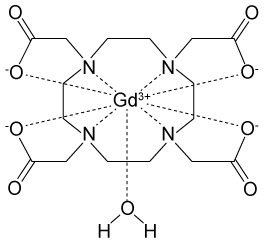 Figure 2 Gd-DOTA with a water coordinated to Gd3+Zinc ions (Zn2+) are required to store insulin and are co-released when insulin is secreted by the pancreas. To detect zinc ions in the body, researchers have designed a variation of Gd-DOTA called Gd-daa3 with two diaminoacetate (daa) arms that preferentially bind to Zn2+ ions (Figure 3) . When Zn2+ is absent, these arms coordinate to Gd3+ and create a nine-coordinate complex that prohibits water from binding to Gd3+. Binding of diaminoacetate arms to Zn2+ frees Gd3+ to coordinate with water molecules. This configuration results in increased signal intensity in the parts of the cell where Zn2+ is located.
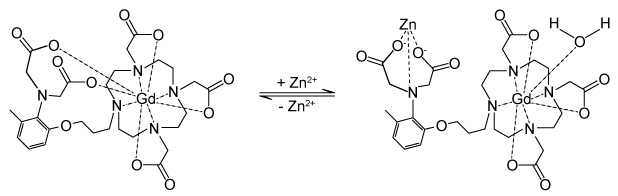 Figure 3 Gd-daa3 when Zn2+ is present
Adapted from Louie A. MRI biosensors: a short primer. J Magn Reson Imaging. 2013;38(3) :530-9.
-To determine whether Gd-daa3 is selective for Zn2+, researchers compared relaxivity measurements of Gd-daa3 in the presence of different cations. Varying amounts of XCl2 (where X is Zn, Ca, or Mg) were added to a 0.1 mM solution of Gd-daa3 plus 10 mM KCl/10 mM HEPES buffer at pH 7.4. What is the most appropriate control for this experiment?
A) Relaxivity measurements without XCl2
B) Relaxivity measurements with ZnCl2
C) Relaxivity measurements with BeCl2
D) Relaxivity measurements without Gd-daa3
Correct Answer:

Verified
Correct Answer:
Verified
Q238: Passage<br>Dmitri Mendeleev is credited with grouping the
Q239: Shiny nickel metal granules added to orange
Q240: If the hydroxide concentration in common duct
Q241: Passage<br>Heme is found in several proteins, including
Q242: Passage<br>Combustion occurs when an oxidation-reduction reaction takes
Q244: Passage<br>Depending on the active compound's specific method
Q245: Passage<br>Heme is found in several proteins, including
Q246: Passage<br>The alkaline-earth metals are a highly reactive
Q247: Passage<br>Household cleaners commonly contain either ammonia (NH<sub>3</sub>)
Q248: Passage<br>Within the renal system, two buffers operate