Passage Combustion Occurs When an Oxidation-Reduction Reaction Takes Place Between a a Reduced
Multiple Choice
Passage
Combustion occurs when an oxidation-reduction reaction takes place between a reduced fuel source and an oxidizer, most frequently oxygen. The reaction between hydrogen and oxygen forms water (Reaction 1) and is highly exothermic and thermodynamically favorable. At the completion of hydrogen combustion, essentially all H2 molecules have been converted to water. Nevertheless, at room temperature and atmospheric pressure, molecular hydrogen and oxygen can coexist quite stably.2 H2 + O2 → 2 H2OReaction 1A group of researchers designed two prototype internal combustion engines, each of which could inject a hydrogen/oxygen mixture into a 5-mL combustion chamber at a total pressure of 1 atm and could repeat this process for several cycles. In one engine design, a spark was generated to initiate combustion as hydrogen and oxygen were injected. In another method, the combustion chamber was coated with a small amount of platinum powder. Platinum dramatically increases the reaction rate at room temperature without the need for a spark. The platinum itself is not altered by the reaction and can be reused. Researchers measured the maximum power output of both engine designs under identical injection and temperature conditions (Figure 1) .
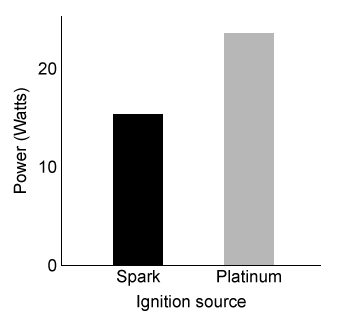 Figure 1 Relative power outputs of hydrogen engines with different ignition sources at 298 KThe power output of an engine is directly related to the rate of combustion. In the presence of platinum, researchers measured the engine's rate of water production at various temperatures and H2/O2 mixture compositions. The results are shown in Figure 2.
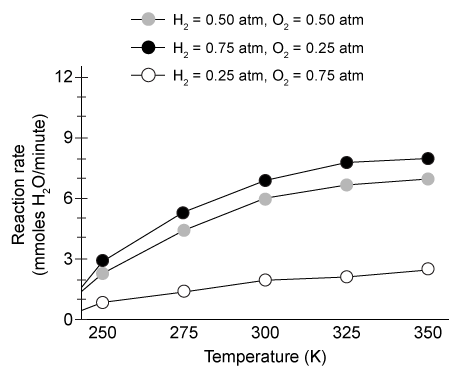 Figure 2 Rate of combustion in platinum-coated engines under various conditions
Adapted from Schultze M, Mantzaras J. Hetero-/homogeneous combustion of hydrogen/air mixtures over platinum: Fuel-lean versus fuel-rich combustion modes doi: 10.1016/j.ijhydene.2013.06.069
-Which of the following would most likely improve the power output of a platinum-coated combustion chamber?
A) Coating the chamber with finer platinum powder
B) Lining the chamber with larger platinum particles
C) Polishing the platinum on the chamber wall to make it smooth
D) Decreasing the amount of platinum to make more room for reactants
Correct Answer:

Verified
Correct Answer:
Verified
Q237: The boiling point of CH<sub>3</sub>CH<sub>2</sub>Br (bromoethane) is
Q238: Passage<br>Dmitri Mendeleev is credited with grouping the
Q239: Shiny nickel metal granules added to orange
Q240: If the hydroxide concentration in common duct
Q241: Passage<br>Heme is found in several proteins, including
Q243: Passage<br>Magnetic resonance imaging (MRI) interprets the nuclear
Q244: Passage<br>Depending on the active compound's specific method
Q245: Passage<br>Heme is found in several proteins, including
Q246: Passage<br>The alkaline-earth metals are a highly reactive
Q247: Passage<br>Household cleaners commonly contain either ammonia (NH<sub>3</sub>)