Multiple Choice
Passage
Heme is found in several proteins, including hemoglobin in blood and myoglobin in muscle. It has a four-coordinate iron-bound porphyrin structure where ferrous iron (Fe2+) is bound to four nitrogen atoms through coordinate covalent bonds. The most common heme found in the body is heme b in hemoglobin (Figure 1) .
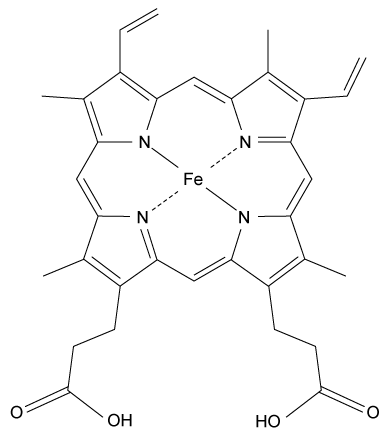 Figure 1 Structure of heme b found in hemoglobinAlong with the four nitrogen ligands in the porphyrin structure, His F8 also binds to Fe2+ in the axial position, leaving the other axial position available to bind oxygen. In this setting, iron's atomic d orbitals are no longer degenerate. The energetic difference between the d orbitals depends on the ligands.In deoxygenated heme, iron sits out of the plane formed by the nitrogen ligands in the porphyrin because its d orbitals make it slightly too large to fit in the porphyrin ring. However, when O2 binds to heme, iron's electrons re-arrange themselves. The d orbitals become smaller, and iron sits within the plane of the nitrogen atoms.When iron is scarce in the body, Zn2+ will coordinate to the ligands in the protoporphyrin structure through a nonenzymatic process, forming Zn-protoporphyrin IX (ZPP) . ZPP and protoporphyrin IX (PPIX) have distinct emission spectra when excited in the blue range whereas heme does not. Hematofluorometry can be used as a simple, inexpensive indicator for iron deficiency in whole blood by placing a blood sample in a fluorometer and measuring the amount of ZPP relative to the amount of heme. Figure 2 illustrates the fluorescence emission spectra for ZPP and protoporphyrin IX measured from a blood sample when ZPP is excited at 425 nm and PPIX is excited at 407 nm.
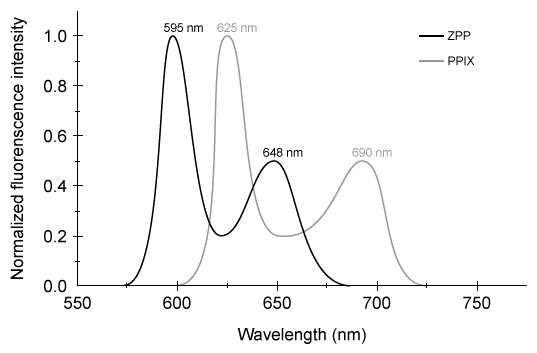 Figure 2 ZPP and PPIX fluorescence emission spectra
Adapted from Hennig G, Gruber C, Vogeser M, et al. Dual-wavelength excitation for fluorescence-based quantification of zinc protoporphyrin IX and protoporphyrin IX in whole blood. J Biophotonics. 2014;7(7) :514-24.
-For the electron configuration of iron, Fe(0) , do electrons fill the 4s orbitals before the 3d orbitals are filled?
A) Yes, because electrons fill the s and p orbitals before they fill the d orbitals, even if they are in different energy levels.
B) No, because 3d orbitals are lower in energy than 4s orbitals.
C) Yes, because according to the Aufbau principle, electrons fill lower energy levels first.
D) No, because orbitals are filled based on the order of the principal quantum number, and 3d comes before 4s.
Correct Answer:

Verified
Correct Answer:
Verified
Q236: Passage<br>Hyperbaric oxygenation therapy involves placing a patient
Q237: The boiling point of CH<sub>3</sub>CH<sub>2</sub>Br (bromoethane) is
Q238: Passage<br>Dmitri Mendeleev is credited with grouping the
Q239: Shiny nickel metal granules added to orange
Q240: If the hydroxide concentration in common duct
Q242: Passage<br>Combustion occurs when an oxidation-reduction reaction takes
Q243: Passage<br>Magnetic resonance imaging (MRI) interprets the nuclear
Q244: Passage<br>Depending on the active compound's specific method
Q245: Passage<br>Heme is found in several proteins, including
Q246: Passage<br>The alkaline-earth metals are a highly reactive