Multiple Choice
Passage
The primary structure of a protein is a series of amino acids that are connected in a long chain via C−N peptide bonds (Figure 1) .
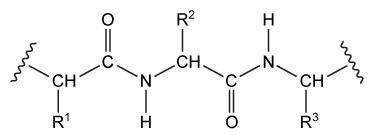 Figure 1 Peptide bonds within a protein segment (Note: Rn = amino acid side chains) Protein chain folding is guided by multiple intramolecular interactions that can occur between two peptide bonds, between a peptide bond and a side chain, or between two side chains, as shown in the protein in Figure 2. Although these interactions are intramolecular because they are within the same molecule, they act effectively like intermolecular interactions because proteins are such large molecules.
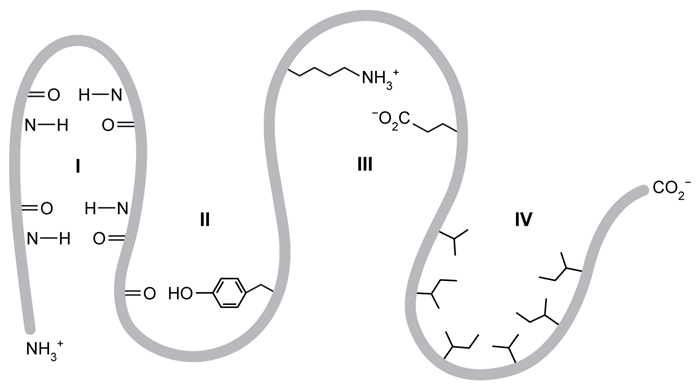 Figure 2 Intramolecular interactions between the peptide chain and amino acid side chains within a hypothetical proteinBecause intramolecular interactions play a significant role in maintaining the three-dimensional folded structure of a protein, having a greater number of interactions or stronger interactions will result in increased protein stability. The energy required to break these interactions within a protein is related to free energy, ΔG. The greater the ΔG value, the more stable the protein.To find the overall contribution of particular intramolecular interactions to protein stability, researchers made several protein variants in which one amino acid is replaced by another to change the noncovalent interactions between the side chains. The difference in free energy between the variant and the original protein, Δ(ΔG) , indicates the change in overall stability of the protein. A negative Δ(ΔG) means the variant protein is less stable than the original.Table 1 shows the results of the amino acid substitution experiments for a protein with the approximate energy difference when each amino acid is changed.Table 1 Change in Free Energy Based on Changing Intramolecular Interactions Caused by Amino Acid Substitutions
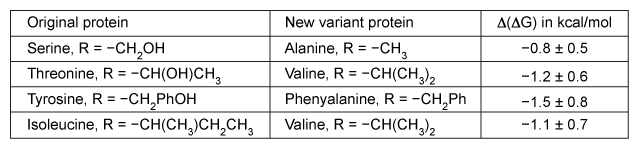 Adapted from: C. N. Pace, J. M. Scholtz, G. R. Grimsley, "Forces stabilizing proteins." FEBS Lett. ©2014 Wiley.
-Which statement about the side chains of threonine and valine is true?
A) Both threonine and valine have side chains that can participate in dipole-dipole interactions.
B) Threonine has a side chain that can participate in dipole-dipole interactions, but valine does not.
C) Valine has a side chain that can participate in dipole-dipole interactions, but threonine does not.
D) Neither threonine nor valine has side chains that can participate in dipole-dipole interactions.
Correct Answer:

Verified
Correct Answer:
Verified
Q245: Passage<br>Heme is found in several proteins, including
Q246: Passage<br>The alkaline-earth metals are a highly reactive
Q247: Passage<br>Household cleaners commonly contain either ammonia (NH<sub>3</sub>)
Q248: Passage<br>Within the renal system, two buffers operate
Q249: Passage<br>Water is unique in that all three
Q251: Passage<br>The radiopharmaceutical 2-deoxy-2-(<sup>18</sup>F)fluoro-D-glucose (abbreviated as <sup>18</sup>F-FDG) is
Q252: The graph below shows the redox titration
Q253: Passage<br>Amino acids and copper both serve vital
Q254: Passage<br>Gastric acid is one of many acids
Q255: Passage<br>Kidney stones are a common ailment affecting