Multiple Choice
Passage
Leptin signaling is vital for maintaining adequate body mass and preventing insulin resistance. When energy stores are abundant, adipocytes produce leptin to stimulate fatty acid oxidation and glucose utilization. One result of leptin signaling in skeletal muscle cells is the phosphorylation and activation of adenosine monophosphate-activated protein kinase (AMPK) . AMPK facilitates the breakdown of triglycerides by decreasing the activity of acetyl-coenzyme A carboxylase (ACC) ; this leads to downregulation of fatty acid synthesis and upregulation of β-oxidation.Fatty acid oxidation has been studied by analyzing the effect of leptin on activation of AMPK and ACC in soleus muscles. To identify leptin's mode of action, injections were administered to transgenic mice via the intravenous (1 mg/kg i.v.) and intrahypothalamic (1 ng i.h.p [faster drug delivery]) routes. Phentolamine (PH) , an α-adrenergic receptor ligand that binds to the same receptor as leptin, was administered concurrently in some of the mice. Signaling to ACC from the citric acid cycle was also examined through the addition of citrate.
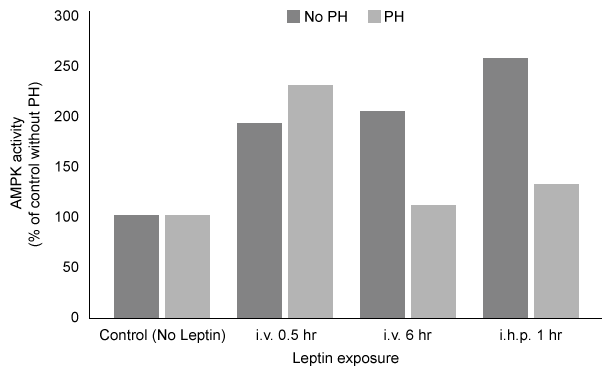 Figure 1 AMPK activity measured in soleus muscle injected with leptin and PH via i.v. and i.h.p.Table 1 ACC Activity in Soleus Muscle Exposed to Leptin Delivered via i.v. and i.h.p Injections in vivo
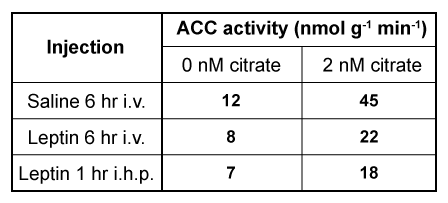 Adapted from Minokoshi Y, Kim YB, Peroni OD, et al. Leptin stimulates fatty-acid oxidation by activating AMP-activated protein kinase. Nature. 2002;415(6869) :339-43.
-What best describes the action of PH on AMPK activity?
A) Long-term agonist
B) Immediate antagonist
C) Time-dependent antagonist
D) Rapid agonist
Correct Answer:

Verified
Correct Answer:
Verified
Q25: Passage<br>Nerve cells must maintain the composition of
Q26: Passage<br>Physical activity produces an increased energy requirement
Q27: Passage<br>The ABO blood groups are determined by
Q28: Passage<br>Upon entering muscle cells, glucose is immediately
Q29: Passage<br>NDPK is an enzyme in budding yeast
Q31: Passage<br>Diabetic nephropathy (kidney disease) is characterized in
Q32: In the electron transport chain, four electrons
Q33: Passage<br>The innate immune system relies heavily on
Q34: Passage<br>Mitochondria are double membrane-bound cellular organelles that
Q35: Passage<br>DNA polymerization is one of the most