Multiple Choice
Passage
DNA polymerization is one of the most conserved mechanisms of genome replication. Synthesis of a complete DNA strand requires a template, primers, a polymerase enzyme, and sufficient deoxyribonucleotide triphosphates (dNTPs) . The DNA polymerase enzyme binds consecutive base pairs on the template strand and extends the double helix by adding dNTPs to the primer. The amino acid residues in the active site of DNA polymerase form hydrogen bonds with Watson-Crick donors and acceptors on incoming DNA nucleotides to facilitate base pairing.The formation of the DNA double helix creates opposing changes in entropy and enthalpy. Favorable bonding interactions via hydrogen bonds during Watson-Crick base pairing results in negative enthalpy, and restricted rotation and flexibility of the DNA backbone generates negative entropy. Scientists hypothesize that hydrogen bonding between bases not only stabilizes the double helix but is also crucial for selective and efficient replication.Analogs that are similar in size and shape to naturally occurring bases can be used to determine the influence of hydrogen bonding on base pair selectivity. To mimic the structure of deoxythymidine triphosphate (dTTP) , researchers synthesized dNTP derivatives of difluorotoluene (dFTP) , a nonpolar analog that lacks Watson-Crick hydrogen bonding. Klenow fragment (KF) polymerase, which has 3′-5′ but not 5′-3′ exonuclease activity, was incubated with a mixture of DNA template, primers, and dNTPs, including dFTP derivatives. The efficiency of dFTP and natural dTTP nucleotide incorporation into a growing primer strand by KF is shown in Figure 1.
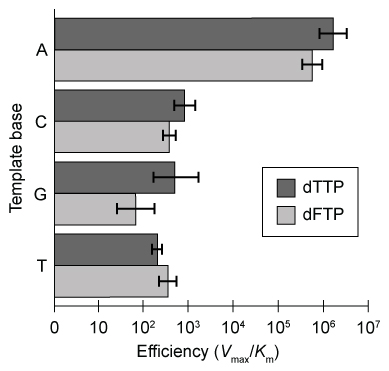 Figure 1 Template-specific selection of dFTP and dTTP by the KF enzyme
Adapted from Moran S, Ren RX, Kool ET. A thymidine triphosphate shape analog lacking Watson-Crick pairing ability is replicated with high sequence selectivity. Proc Natl Acad Sci USA. 1997;94(20) :10506-11.
-Based on the information in the passage, what effect would incorporation of dFTP in place of dTTP most likely have on the melting temperature of a DNA molecule of a fixed length?
A) The melting temperature would increase due to reduced base stacking.
B) The melting temperature would decrease due to decreased hydrogen bonding.
C) The melting temperature would not change because dFTP is similar to dTTP.
D) The effect on melting temperature depends on the number of nucleotides in the DNA strand.
Correct Answer:

Verified
Correct Answer:
Verified
Q30: Passage<br>Leptin signaling is vital for maintaining adequate
Q31: Passage<br>Diabetic nephropathy (kidney disease) is characterized in
Q32: In the electron transport chain, four electrons
Q33: Passage<br>The innate immune system relies heavily on
Q34: Passage<br>Mitochondria are double membrane-bound cellular organelles that
Q36: Passage<br>Many cephalopods can change color to blend
Q37: Passage<br>Aldehyde dehydrogenase 2 (ALDH2) is essential for
Q38: Which of the following peptides would exhibit
Q39: Passage<br>Destabilase, an enzyme found in the saliva
Q40: The K<sub>m</sub> of an enzyme is always