Passage Mitochondria Are Double Membrane-Bound Cellular Organelles That House Several Connected
Multiple Choice
Passage
Mitochondria are double membrane-bound cellular organelles that house several connected metabolic reactions. The citric acid cycle takes place inside the mitochondrial matrix and produces two reduced electron carriers, NADH and FADH2. These two carriers then pass their electrons to ubiquinone (UQ) , which is reduced to ubiquinol (UQH2) . UQH2 passes its electrons to oxidized cytochrome C (cyt-Cox) , regenerating UQ and forming reduced cytochrome C (cyt-Cred) . Finally, cyt-Cred transfers electrons to oxygen, regenerating cyt-Cox and forming water. Each reaction is facilitated by one of four protein complexes that are collectively known as the electron transport chain (ETC) .Researchers isolated mitochondria and treated them with a novel ETC inhibitor, "drug X." After an overnight incubation, they measured levels of several ETC-reduced electron carriers in the presence of drug X relative to untreated mitochondria. Their results are shown in Figure 1.
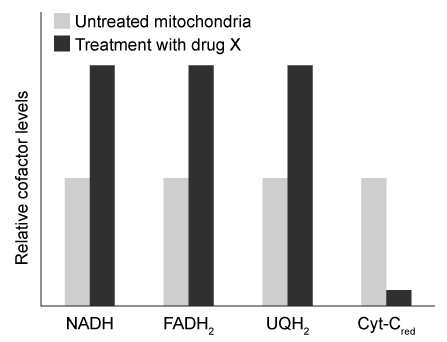 Figure 1 Relative levels of reduced electron carriers in the presence and absence of drug XNext, the researchers exposed mitochondria to FCCP, a chemical that can transport protons across membranes. They observed that in the presence of FCCP, the citric acid cycle was fully active, and all reduced cofactors were present at the same levels as in untreated mitochondria. However, the rate of ATP synthesis was significantly reduced. ATP synthesis was immediately restored when FCCP was washed away.
-Based on the information in the passage, FCCP most likely causes a decrease in energy production by:
A) decoupling the movement of protons down their concentration gradient from ATP synthase.
B) carrying more protons into the intermembrane space than are pumped by the ETC alone.
C) shifting the proton gradient further away from equilibrium than is achieved by the ETC alone.
D) causing a decrease in ETC activity, resulting in fewer available protons for ATP synthase.
Correct Answer:

Verified
Correct Answer:
Verified
Q29: Passage<br>NDPK is an enzyme in budding yeast
Q30: Passage<br>Leptin signaling is vital for maintaining adequate
Q31: Passage<br>Diabetic nephropathy (kidney disease) is characterized in
Q32: In the electron transport chain, four electrons
Q33: Passage<br>The innate immune system relies heavily on
Q35: Passage<br>DNA polymerization is one of the most
Q36: Passage<br>Many cephalopods can change color to blend
Q37: Passage<br>Aldehyde dehydrogenase 2 (ALDH2) is essential for
Q38: Which of the following peptides would exhibit
Q39: Passage<br>Destabilase, an enzyme found in the saliva