Multiple Choice
Passage
Physical activity produces an increased energy requirement in the muscles as well as in the brain. During periods of intense exercise, glycogenolysis is activated in muscles to provide them with the energy needed for contractions, and research indicates that astrocytes also consume glycogen at increased levels during exercise. It is hypothesized that during periods of physical exertion, astrocytes convert glycogen to lactate, which is then used as a fuel source in neurons.Monocarboxylate transporters (MCTs) are responsible for the movement of lactate across membranes, and MCT2 is expressed at increased levels in neuronal cells during exercise. Scientists proposed that lactate is secreted from astrocytes and taken up by neurons through MCT2. Lactate is then converted to pyruvate and enters the mitochondria, where it is further metabolized. To test their predictions, scientists examined the effect of exercise on glycogen metabolism in rodents.Experiment 1Rats were either allowed to rest or exercised to exhaustion. The levels of several metabolites were then quantified in both the plantaris muscle and the hippocampus.
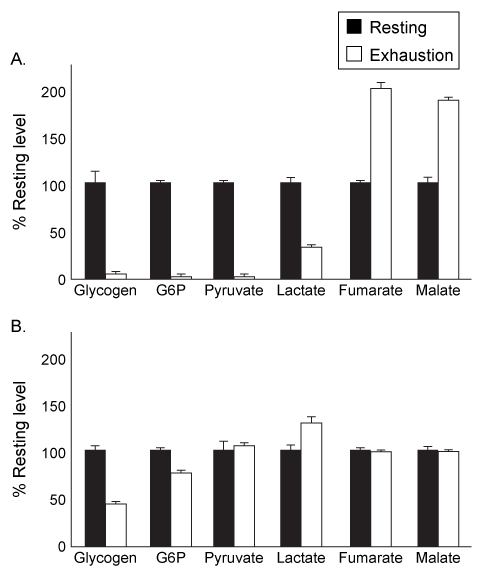 Figure 1 Levels of several metabolites in plantaris muscle (A) and hippocampus (B) from rats at rest or after exercising to exhaustionExperiment 2Rats were injected with 1,4-dideoxy-1,4-imino-D-arabinitol (DAB) or saline, and glycogen and lactate levels were measured in the hippocampus of rats at rest or after exercise to exhaustion.
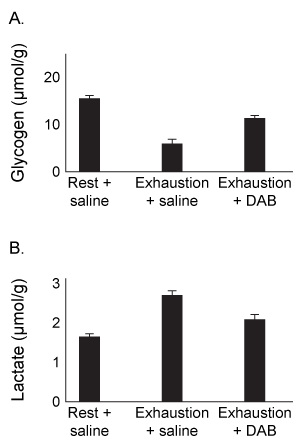 Figure 2 Levels of glycogen (A) and lactate (B) in rats injected with DAB or saline, after rest or upon exhaustion
Adapted from Matsui T, Omuro H, Liu Y-F, et al. Astrocytic glycogen-derived lactate fuels the brain during exhaustive exercise to maintain endurance capacity. Proceedings of the National Academy of Sciences. 2017;114(24) :6358-6363.
-If the proposed mechanism in the passage is correct, which of the following metabolic reactions must occur for astrocytes to convert glycogen into a fuel for neurons?Glucose-1-phosphate to glucose-6-phosphateGlucose to glucose-6-phosphate3-phosphoglycerate to 2-phosphoglyceratePyruvate to acetyl-CoAPyruvate to lactate
A) I, II, and III only
B) II, III, and V only
C) I, IV, and V only
D) I, III, and V only
Correct Answer:

Verified
Correct Answer:
Verified
Q21: Passage<br>Leukocyte common antigen (LCA) enzymes play several
Q22: Passage<br>Leptin signaling is vital for maintaining adequate
Q23: Passage<br>NDPK is an enzyme in budding yeast
Q24: Passage<br>Myalgic encephalopathy (ME), or chronic fatigue syndrome
Q25: Passage<br>Nerve cells must maintain the composition of
Q27: Passage<br>The ABO blood groups are determined by
Q28: Passage<br>Upon entering muscle cells, glucose is immediately
Q29: Passage<br>NDPK is an enzyme in budding yeast
Q30: Passage<br>Leptin signaling is vital for maintaining adequate
Q31: Passage<br>Diabetic nephropathy (kidney disease) is characterized in