Multiple Choice
Passage
The ABO blood groups are determined by the polysaccharide antigens linked to sphingolipids on red blood cell membranes. The polysaccharide known as the H-antigen (O-type blood) consists of a polysaccharide (R-group) glycosidically linked to D-galactose, which is connected to L-fucose in an α-1,2 linkage. Type A and type B blood express the A- and B-antigens, respectively (Figure 1) . These antigens are modified forms of the H-antigen, in which D-galactose (B-antigen) or a derivative of D-galactose called GalNAc (A-antigen) is added in an α-1,3 linkage to the D-galactose moiety of the H-antigen.
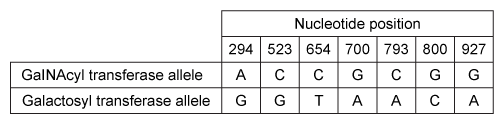
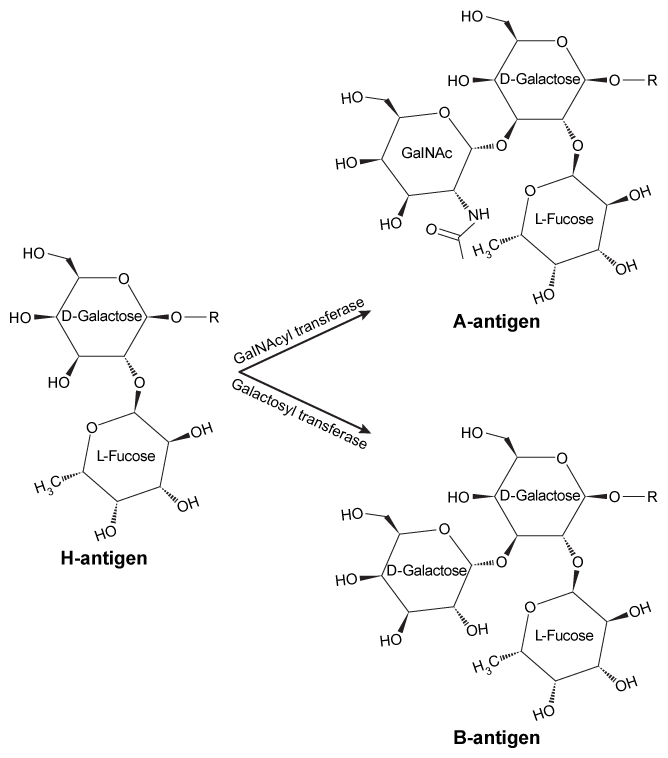 Figure 1 Structures of the H-, A-, and B-antigens. The R-group represents additional carbohydrates.The addition of GalNAc or galactose to the H-antigen is catalyzed by an enzyme encoded by the ABO gene. One allele of the gene encodes GalNAcyl transferase and produces the A-antigen, while another allele encodes galactosyl-transferase and yields the B-antigen (Figure 1) . The two alleles differ at seven nucleotide positions, summarized in Table 1.Table 1 Nucleotide Positions Where the Alleles Encoding GalNAcyl Transferase and Galactosyl Transferase Differ
 Individuals with both alleles express both antigens and have type AB blood. Those with type O blood have a third allele that encodes an inactive form of the enzyme. A study of blood type abundance was conducted, and the number of participants with each type is shown in Table 2. Table 3 shows several fatty-acyl chains found in the sphingolipids to which the antigens were attached.Table 2 Number of Participants That Express Each Blood Type in a Study of 10,000 Individuals
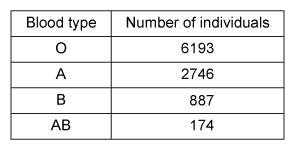 Table 3 Types of Sphingolipids to Which Polysaccharide Antigens Were Bound, as Determined by Mass Spectrometry (Note: For fatty acid chains, the numbers on the left and right of the colon indicate number of carbons and number of C=C double bonds, respectively)
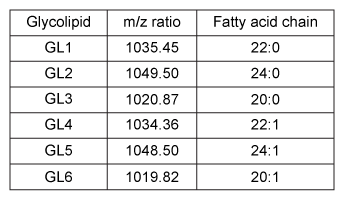
-Which lipid in Table 3 would make the greatest contribution to membrane fluidity?
A) GL2
B) GL3
C) GL5
D) GL6
Correct Answer:

Verified
Correct Answer:
Verified
Q22: Passage<br>Leptin signaling is vital for maintaining adequate
Q23: Passage<br>NDPK is an enzyme in budding yeast
Q24: Passage<br>Myalgic encephalopathy (ME), or chronic fatigue syndrome
Q25: Passage<br>Nerve cells must maintain the composition of
Q26: Passage<br>Physical activity produces an increased energy requirement
Q28: Passage<br>Upon entering muscle cells, glucose is immediately
Q29: Passage<br>NDPK is an enzyme in budding yeast
Q30: Passage<br>Leptin signaling is vital for maintaining adequate
Q31: Passage<br>Diabetic nephropathy (kidney disease) is characterized in
Q32: In the electron transport chain, four electrons