Multiple Choice
Passage
Almost 70% of Americans today are either overweight or obese, but only 34% think they weigh too much. This is in contrast to 1990, when 54% of Americans were overweight or obese and 46% reported being at least somewhat overweight. In other words, the gap between what we weigh and what we think we weigh is getting bigger.Epidemiologists argue that this discrepancy can be partly explained by the widespread resetting of norms regarding "normal weight" and "obesity." As close friends, coworkers, and family members gain weight, one's concept of what a body of acceptable weight looks like becomes modified. What was once considered overweight is now considered the norm, if only because it is so common (Figure 1) .
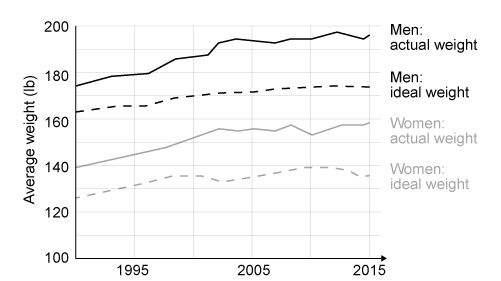 Figure 1 Actual vs. ideal weight (in pounds) for Americans, 1990-2015This sheds new light on recent efforts to stop the obesity epidemic in America. Experts have long contended that awareness efforts don't work because overweight individuals are already aware that they are overweight and that obesity causes health problems. These latest data suggest that many overweight Americans don't even realize that they are overweight. Epidemiologists are now suggesting that a more successful strategy to get Americans to lose weight might be to first succeed at convincing them that being overweight is not normal.
-The second paragraph describes:
A) cultural diffusion within in-groups.
B) cultural transmission between in-groups and out-groups.
C) peer pressure caused by reference groups.
D) socialization by primary and secondary groups.
Correct Answer:

Verified
Correct Answer:
Verified
Q270: Passage<br>Twenty-two adults (mean age 49.5) were recruited
Q271: A researcher is testing a patient's neurological
Q272: Passage<br>Health psychologists interested in studying the influence
Q273: Passage<br>Studies suggest that health outcomes for preventable
Q274: Passage<br>A common misconception in medicine is that
Q276: Passage<br>The term "health disparities" describes a systematic
Q277: Passage<br>Numerous studies suggest that physicians make both
Q278: Passage<br>Research suggests that cognitive changes occur with
Q279: Passage<br>Trait theorists believe that all people have
Q280: Which of the following population pyramids depicts