Multiple Choice
Passage
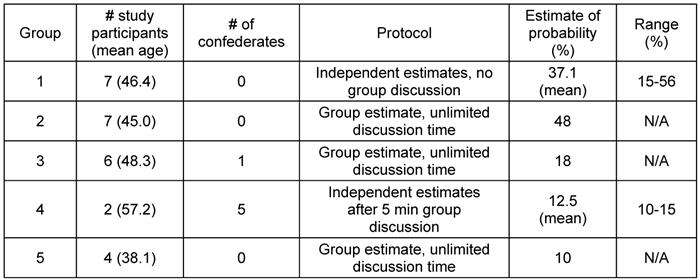
Twenty-two adults (mean age 49.5) were recruited to participate in a study they were told was to assess beliefs about cancer risk. All participants were in good health; neither they nor any first-degree relatives had been diagnosed with cancer.In the first phase of the study, participants viewed a brief video about the epidemiology and prevalence of cancer in the United States, and then were randomly assigned to one of four groups and asked to estimate the probability that they would develop cancer in their lifetimes. Group 1 consisted of seven study participants who each arrived at their estimates independently and without discussion. Group 2 consisted of seven study participants who were asked to agree on a group estimate after discussion (with unlimited time) . Group 3 contained seven members who were also asked to arrive at a consensus estimate after discussion (with unlimited time) : Six were study participants and the seventh was a confederate who suggested a very low estimate. Group 4 likewise contained seven members: Two were study participants and the other five were confederates who each suggested low estimates. Group 4 members were limited to 5 minutes of discussion and then asked to arrive at individual estimates.For the second phase of the study, four members of Group 1 who arrived at independent estimates of 20% or lower were put into a new group (Group 5) , then were given unlimited time to discuss their initial estimates and arrive at a group estimate (Table 1) .Table 1 Group Composition, Protocol, and Estimate of Developing Cancer in One's Lifetime
 S. E. Asch ©1956 American Psychological Association.
-This study appears to have been actually assessing which of the following?
A) Conformity
B) Peer pressure
C) Compliance
D) Obedience
Correct Answer:

Verified
Correct Answer:
Verified
Q265: Passage<br>The highly addictive nature of cigarettes can
Q266: Passage<br>Korsakoff syndrome (KS) is caused by a
Q267: Passage<br>On the way home from a routine
Q268: Standardized protocols, patient checklists, and clinical guidelines
Q269: A social psychologist employs a confederate to
Q271: A researcher is testing a patient's neurological
Q272: Passage<br>Health psychologists interested in studying the influence
Q273: Passage<br>Studies suggest that health outcomes for preventable
Q274: Passage<br>A common misconception in medicine is that
Q275: Passage<br>Almost 70% of Americans today are either