Multiple Choice
Passage
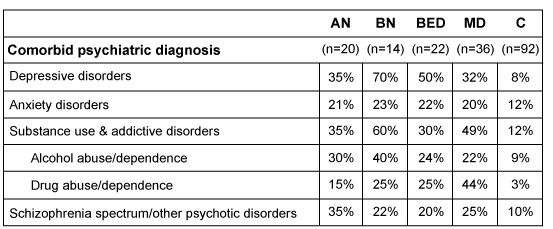
A common misconception in medicine is that eating disorders present similarly in males and females. Research suggests that this is untrue: males meeting diagnostic criteria for eating disorders are more likely than females to have another psychiatric illness, demonstrate a later age of onset, and engage in excessive exercise. They are less likely to engage in purging behaviors, be diagnosed by clinicians, or seek treatment. When males do enter treatment, they are generally further along in the course of the illness.The classification of eating disorders in males according to the Diagnostic and Statistical Manual of Mental Disorders, Fifth Edition (DSM-5) has recently been debated. Research suggests that one very common manifestation of eating disorder etiology in males, called muscle dysmorphia (MD) , includes an obsession with a larger and more muscular body, which contrasts with the thin, idealized body for females with eating disorders. Characterized as a subset of body dysmorphic disorder, MD is more recently conceptualized as part of a spectrum of eating disorders; however, it is still classified under the obsessive-compulsive and related disorders umbrella in the DSM-5.One study applied the latest DSM-5 diagnostic criteria for anorexia nervosa (AN) , bulimia nervosa (BN) , binge eating disorder (BED) , and MD to the medical records of male veterans treated in Veterans Administration (VA) hospitals across the United States from 2000 to 2015. The study (Table 1) found a significant increase in psychiatric comorbidity compared to controls (C) .Table 1 Prevalence of Psychiatric Disorders for Eating Disorder and MD Cases and Controls in a National Sample of Male Veterans Treated at VA Hospitals from 2000 to 2015
-A physician suspects that a young woman seen in the clinic displays symptoms of an eating disorder. Which of the following responses best demonstrates the ego defense mechanism of rationalization in the patient?
A) The patient states that she writes in her journal or calls a friend whenever she gets the urge to binge and purge.
B) The patient states that she sometimes skips breakfast and lunch but only when she is planning a big dinner.
C) The patient insists that she does not recall any binging or purging episodes, although her mother states that they occur frequently.
D) The patient expresses concern that several of her classmates engage in unhealthy eating patterns and purging behaviors.
Correct Answer:

Verified
Correct Answer:
Verified
Q269: A social psychologist employs a confederate to
Q270: Passage<br>Twenty-two adults (mean age 49.5) were recruited
Q271: A researcher is testing a patient's neurological
Q272: Passage<br>Health psychologists interested in studying the influence
Q273: Passage<br>Studies suggest that health outcomes for preventable
Q275: Passage<br>Almost 70% of Americans today are either
Q276: Passage<br>The term "health disparities" describes a systematic
Q277: Passage<br>Numerous studies suggest that physicians make both
Q278: Passage<br>Research suggests that cognitive changes occur with
Q279: Passage<br>Trait theorists believe that all people have