Multiple Choice
Passage
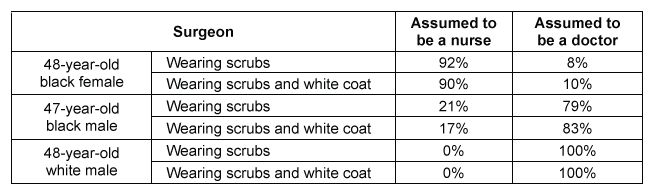
Numerous studies suggest that physicians make both conscious and unconscious assumptions about their patients, and these assumptions often impact patient care and outcomes. However, little research has focused on the assumptions patients make about their physicians.Researchers designed an observational study to investigate assumptions made by patients in health care settings. For this study, three different surgeons were asked to interact with pre-surgery patients whom they had never met using a standardized script. Each surgeon participated in 30 total interactions over the course of two weeks. The purpose of the study was to assess how the patient's assumptions regarding the surgeon's status were impacted by the surgeon's race, gender, and attire.According to the script, the surgeon did not introduce him- or herself upon entering the room. All three surgeons were in their late 40s; one surgeon was a black woman, one was a black man, and one was a white man. The surgeons wore either surgical scrubs alone or a white coat over their surgical scrubs. Researchers analyzed how patients addressed or referred to the surgeon to assess assumptions about the surgeon's role as a doctor or a nurse. The results are presented in Table 1.Table 1 Percentage of Patients Who Assumed the Surgeon Was a Doctor or a Nurse
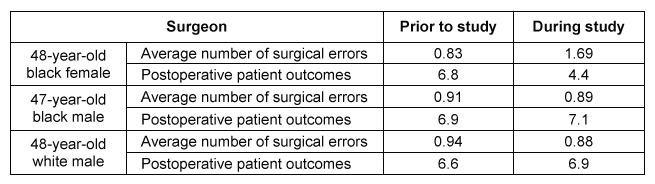
 The researchers also retrospectively analyzed minor (non-life-threatening) surgical errors and postoperative patient outcomes for one month prior to the study and during the study timeframe for each surgeon. The number of minor errors was averaged per surgery, and postoperative patient outcomes were quantified using a multifactor (eg, pain, infection, bleeding, other complications) assessment scale of 1 (worst outcome) to 12 (best outcome) .Table 2 Average Number of Minor Surgical Errors (Per Surgery) and Aggregated Postoperative Patient Outcome Scores
-Which of the following is best supported by the data in Table 1 and Table 2?
A) Changes in postoperative outcomes for the two black surgeons suggest a stereotype boost effect.
B) Changes in surgical errors for the female surgeon suggest a stereotype threat effect.
C) Changes in postoperative patient outcomes for the two male surgeons suggest a social facilitation effect.
D) Changes in surgical errors for the white surgeon suggest a halo effect.
Correct Answer:

Verified
Correct Answer:
Verified
Q272: Passage<br>Health psychologists interested in studying the influence
Q273: Passage<br>Studies suggest that health outcomes for preventable
Q274: Passage<br>A common misconception in medicine is that
Q275: Passage<br>Almost 70% of Americans today are either
Q276: Passage<br>The term "health disparities" describes a systematic
Q278: Passage<br>Research suggests that cognitive changes occur with
Q279: Passage<br>Trait theorists believe that all people have
Q280: Which of the following population pyramids depicts
Q281: According to world systems theory, which of
Q282: Passage<br>Research suggests that cognitive changes occur with