Multiple Choice
Passage
The highly addictive nature of cigarettes can be partly explained by how nicotine, the primary addictive ingredient, is administered. The fastest route of administration for most drugs is through inhalation; cigarette smoking results in the transmission of nicotine to the brain in about 15 seconds. In the brain, nicotine activates the nicotinic acetylcholine receptors, which stimulate the brain's reward pathway and produce mild feelings of euphoria. Those who quit smoking often relapse due to stress, weight gain, and withdrawal symptoms such as cravings and irritability. Of those who attempt to quit without formal treatment, only 3%-5% remain abstinent after a year.Research suggests that mindfulness meditation-based programs can be an effective strategy to quit smoking. Mindfulness is an aspect of meditation that involves cultivating a nonjudgmental awareness of the thoughts, emotions, and sensations arising in the present moment.For one study, researchers randomly assigned 88 smokers to either Mindfulness Training (MT) or the Freedom From Smoking (FFS) intervention developed by the American Lung Association. Both groups participated in 90-minute group training sessions twice a week for four weeks. The FFS intervention educated participants on the negative health consequences of smoking, coping strategies for cravings, and the development of healthy lifestyle habits. The MT intervention taught mindfulness meditation techniques as a way of gaining awareness and acceptance of the cognitive, emotional, and physical components of cravings. The number of cigarettes smoked per day and self-reported abstinence, as verified by exhaled carbon monoxide, were measured at the end of treatment and at a 17-week follow-up for participants in each group (Figure 1) .
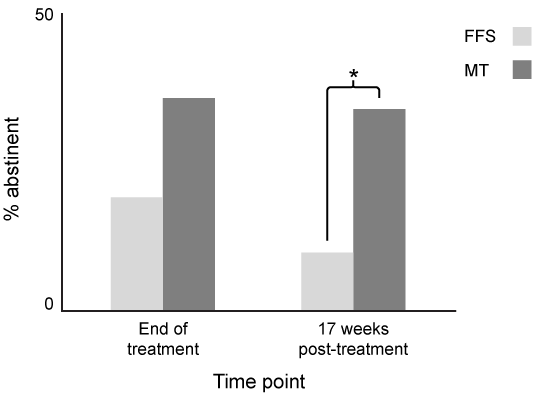 Figure 1 Percentage of participants in each group abstinent at the end of treatment and at 17-week follow-up (* indicates p < 0.05)
-The data in Figure 1 suggest which of the following relationships is statistically significant?
A) At the end of treatment, MT was more effective than FFS.
B) At 17 weeks post-treatment, MT was more effective than FFS.
C) MT was more effective at the end of treatment than at 17 weeks post-treatment.
D) The difference between MT and FFS was greater at 17 weeks post-treatment than at the end of treatment.
Correct Answer:

Verified
Correct Answer:
Verified
Q260: Some studies have found an association between
Q261: Passage<br>Although the terms sex, sex category, and
Q262: Passage<br>Prominent theories of emotion have long held
Q263: Passage<br>Major depression is a mood disorder that
Q264: Passage<br>Both institutional and interpersonal factors contribute to
Q266: Passage<br>Korsakoff syndrome (KS) is caused by a
Q267: Passage<br>On the way home from a routine
Q268: Standardized protocols, patient checklists, and clinical guidelines
Q269: A social psychologist employs a confederate to
Q270: Passage<br>Twenty-two adults (mean age 49.5) were recruited