



 Chat with AI
Exam 24: Scheduling

Exam 1: Introduction to Operations and Supply Chain Management79 Questions
Exam 2: Supplement Operational Decision-Making Tools: Decision Analysis43 Questions
Exam 3: Quality Management91 Questions
Exam 4: Statistical Process Control103 Questions
Exam 5: Supplement Operational Decision-Making Tools: Acceptance Sampling28 Questions
Exam 6: Product Design86 Questions
Exam 7: Service Design77 Questions
Exam 8: Processes and Technology47 Questions
Exam 9: Capacity and Facilities90 Questions
Exam 10: Supplement Operational Decision-Making Tools: Facility Location Models22 Questions
Exam 11: Human Resources90 Questions
Exam 12: Supplement Operational Decision-Making Tools: Work Measurement26 Questions
Exam 13: Project Management98 Questions
Exam 14: Supply Chain Management Strategy and Design73 Questions
Exam 15: Global Supply Chain Procurement and Distribution86 Questions
Exam 16: Supplement Operational Decision-Making Tools: Transportation and Transshipment Models28 Questions
Exam 17: Forecasting94 Questions
Exam 18: Inventory Management93 Questions
Exam 19: Supplement Operational Decision-Making Tools: Simulation25 Questions
Exam 20: Sales and Operations Planning85 Questions
Exam 21: Supplement Operational Decision-Making Tools: Linear Programming38 Questions
Exam 22: Enterprise Resource Planning92 Questions
Exam 23: Lean Systems86 Questions
Exam 24: Scheduling99 Questions
Select questions type


If the following jobs are sequenced according to the DDATE rule then the mean completion time (in days)for all jobs is (assume zero for today's date) 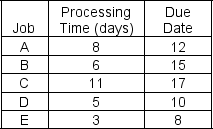
(Multiple Choice)
4.9/5  (83)
(83) ______________ are based on natural selection properties of genetics.
(Multiple Choice)
4.8/5 (93)
(93) Employee scheduling has _____________ options compared to work scheduling because labor is a ______________ resource.
(Multiple Choice)
4.8/5 (84)
(84) Sequencing involves determining the order in which jobs are released to the shop floor.
(True/False)
4.8/5 (79)
(79) If the following jobs are sequenced according to the FCFS rule then job C is completed on day (assume zero for today's date) 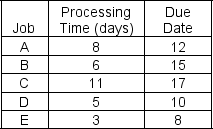
(Multiple Choice)
4.8/5 (81)
(81) Input/output control provides the information necessary to regulate work flow in a job shop environment.
(True/False)
4.8/5 (80)
(80) If the following jobs are sequenced according to the first-come-first-served (FCFS)rule then the mean completion time in days for all jobs is (assume zero for today's date) 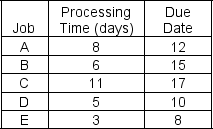
(Multiple Choice)
4.9/5 (87)
(87) The dispatch list contains the order in which work is assigned to a productive resource.
(True/False)
4.8/5 (84)
(84) If the following jobs are sequenced according to the LPT rule then the total number of jobs that would be late is (assume zero for today's date) 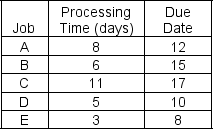
(Multiple Choice)
4.9/5 (67)
(67) If the following jobs are sequenced according to the SLACK rule then the total number of jobs that would be late is (assume zero for today's date) 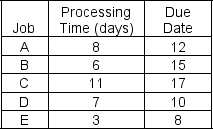
(Multiple Choice)
4.7/5 (80)
(80) A ________________ shows both planned and completed activities against a time scale.
(Multiple Choice)
4.9/5 (80)
(80) The longest processing time (LPT)rule tends to complete larger jobs in-house when subcontracting is anticipated.
(True/False)
4.8/5 (81)
(81) The process of prioritizing jobs that have been assigned to a resource is called
(Multiple Choice)
4.9/5 (81)
(81) The sequencing rule that minimizes average tardiness for a set of jobs to be processed on one machine is
(Multiple Choice)
4.8/5 (69)
(69) The following set of jobs must be processed serially through a two-step system.The times at each process are in hours.If Johnson's Rule is used to sequence the jobs then Job A would complete processing on operation 2 at 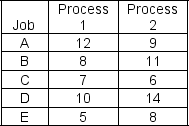
(Multiple Choice)
4.9/5 (85)
(85) Finite scheduling will not load a resource beyond its fixed capacity.
(True/False)
4.8/5 (83)
(83) If a job is ahead of schedule,then its critical ratio (CR)will be
(Multiple Choice)
4.9/5 (68)
(68) If the following jobs are sequenced according to the SPT rule then the mean completion time (in days)for all jobs is (assume zero for today's date) 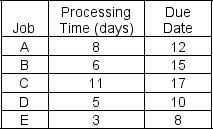
(Multiple Choice)
4.8/5 (71)
(71) 
Filters
- Essay(0)
- Multiple Choice(0)
- Short Answer(0)
- True False(0)
- Matching(0)