



 Chat with AI
Exam 10: Standard Costs for Control: Direct Material and Direct Labour

Exam 1: Management Accounting: Information for Creating Value and Managing Resources67 Questions
Exam 2: Management Accounting: Cost Terms and Concepts87 Questions
Exam 3: Cost Behaviour, Cost Drivers and Cost Estimation93 Questions
Exam 4: Product Costing Systems88 Questions
Exam 5: Process Costing and Operation Costing87 Questions
Exam 6: Service Costing91 Questions
Exam 7: A Closer Look at Overhead Costs99 Questions
Exam 8: Activity-Based Costing91 Questions
Exam 9: Budgeting Systems92 Questions
Exam 10: Standard Costs for Control: Direct Material and Direct Labour105 Questions
Exam 11: Standard Costs for Control: Flexible Budgets and Manufacturing Overhead109 Questions
Exam 12: Managing and Reporting Performance102 Questions
Exam 13: Financial Performance Measures and Incentive Schemes93 Questions
Exam 14: Strategic Performance Measurement Systems80 Questions
Exam 15: Managing Suppliers and Customers90 Questions
Exam 16: Managing Costs and Quality92 Questions
Exam 17: Sustainability and Management Accounting76 Questions
Exam 18: Cost Volume Profit Analysis111 Questions
Exam 19: Information for Decisions: Relevant Costs and Benefits116 Questions
Exam 20: Pricing and Product Mix Decisions113 Questions
Exam 21: Information for Capital Expenditure Decisions125 Questions
Select questions type


Jasmine Morron is examining a statistical control chart on the recent cost report of her manufacturing company. Jasmine is focusing on one specific process, the labour efficiency variance of polishing. She determines that the critical values for this process are $1000. The labour efficiency variances for the last 6 months were all favourable: $500F (July), $600F (August), $750F (September), $880F (October), $900F (November) and $990F (December). Jasmine decides not to investigate these variances. Do you agree with her decision?
(Multiple Choice)
4.8/5  (87)
(87) Dexter Surgical Tools has set the following direct labour standard: 0.5 hours at $20 per hour, for each unit of Tool #11. The company plans to produce 1200 units of Tool #11 in July; however, the actual production was 1000 units and only 900 units were actually sold. The actual labour cost for July was $22 per hour.
Which of the following is a likely explanation for the July labour efficiency variance?
(Multiple Choice)
4.8/5 (85)
(85) Motivational effects of standard cost systems
Standard cost systems can have motivational effects; some are desirable, some are not. Consider the following situation:
The materials purchasing manager is paid a salary plus a bonus based on the net favourable materials price variance. Generally, this bonus amounts to 30 to 40 per cent of the manager's total compensation. Due to the bankruptcy of a company in a related field, there is an opportunity to buy a key raw material. The standards for this material call for grade AA, usually purchased for $56 per tonne. Because of the bankruptcy, the company can obtain grade AAAA for $62 per tonne. While the quality of the final product will be the same regardless of the grade of raw material used, there will be substantial savings in production if the grade AAAA material is used. These savings are expected to be two to three times the additional cost of $6 per tonne.
i. How would an unfavourable price variance on a particular purchase affect the overall price variance for the year?
ii. Will the use of the materials price variance to provide a bonus to the purchasing manager lead to a desirable or undesirable behavioural outcome? Explain.
(Essay)
4.7/5 (69)
(69) Which of the following could not be an explanation of the labour efficiency variance for a firm whose variances for the period included an unfavourable material price variance and a favourable labour efficiency variance?
(Multiple Choice)
4.9/5 (84)
(84) Variance analysis is used to evaluate actual performance by analysing the differences between standard and actual costs.
(True/False)
4.9/5 (87)
(87) When using the statistical control chart to investigate variances
(Multiple Choice)
4.9/5 (81)
(81) When estimating the cost of an economic quantity of a raw materials, any discounts for the bulk order are included in the estimated price.
(True/False)
4.9/5 (68)
(68) Flexer Company Ltd has set the following standards for the production of one unit of product. Normal production each month is 500 units.  During June, actual production amounted to 420 units. All direct material was purchased and used this month. Actual cost amounted to:
 Determine the direct material quantity variance for June production.
During June, actual production amounted to 420 units. All direct material was purchased and used this month. Actual cost amounted to:
Determine the direct material quantity variance for June production. (Multiple Choice)
4.9/5 (83)
(83) Which of the following statements is false regarding perfection standards?
(Multiple Choice)
4.9/5 (75)
(75) Given the following information, calculate the direct labour rate variance. 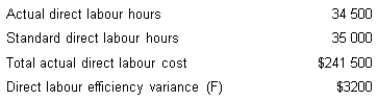
(Multiple Choice)
5.0/5 (76)
(76) I Wear Optometry determined the following variances had occurred during the month of September:  The company made 1600 pairs of eyeglasses during the month using 2000 direct labour hours. The standard wage rate per hour is $14.50. Determine the standard wages for September's output.
 (Multiple Choice)
4.8/5 (76)
(76) Flexer Company Ltd has set the following standards for the production of one unit of product. Normal production each month is 500 units.  During June, actual production amounted to 420 units. All direct material was purchased and used this month. Actual cost amounted to:
 Determine the standard direct labour hours allowed for June production.
During June, actual production amounted to 420 units. All direct material was purchased and used this month. Actual cost amounted to:
Determine the standard direct labour hours allowed for June production. (Multiple Choice)
4.8/5 (86)
(86) Twister Pty Ltd has set direct labour standards of 3 hours per unit and $5 per hour. During the month 2900 hours at a total cost of $17 400 were used to produce 1000 units. Determine the direct labour price variance.
(Multiple Choice)
4.8/5 (71)
(71) Which of the following statements about perfection standards is false?
(Multiple Choice)
4.8/5 (80)
(80) The following data relates to QA firm.
Cost standards:  Actual results:
7800 units were produced.
 Calculate the direct material quantity variance.
Actual results:
7800 units were produced.
Calculate the direct material quantity variance. (Multiple Choice)
4.8/5 (82)
(82) Which of the following statements regarding variances is/are true?
The actions that create a favourable direct material price variance
i. can result in an unfavourable direct material quantity variance
ii. are likely to create an unfavourable direct labour rate variance
iii. can result in an unfavourable direct labour efficiency variance
(Multiple Choice)
4.8/5 (77)
(77) Given the following information, calculate the materials price variance: 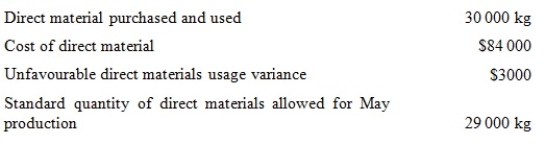
(Multiple Choice)
4.9/5 (75)
(75) 
Filters
- Essay(0)
- Multiple Choice(0)
- Short Answer(0)
- True False(0)
- Matching(0)