



 Chat with AI
Exam 18: Cost Volume Profit Analysis

Exam 1: Management Accounting: Information for Creating Value and Managing Resources67 Questions
Exam 2: Management Accounting: Cost Terms and Concepts87 Questions
Exam 3: Cost Behaviour, Cost Drivers and Cost Estimation93 Questions
Exam 4: Product Costing Systems88 Questions
Exam 5: Process Costing and Operation Costing87 Questions
Exam 6: Service Costing91 Questions
Exam 7: A Closer Look at Overhead Costs99 Questions
Exam 8: Activity-Based Costing91 Questions
Exam 9: Budgeting Systems92 Questions
Exam 10: Standard Costs for Control: Direct Material and Direct Labour105 Questions
Exam 11: Standard Costs for Control: Flexible Budgets and Manufacturing Overhead109 Questions
Exam 12: Managing and Reporting Performance102 Questions
Exam 13: Financial Performance Measures and Incentive Schemes93 Questions
Exam 14: Strategic Performance Measurement Systems80 Questions
Exam 15: Managing Suppliers and Customers90 Questions
Exam 16: Managing Costs and Quality92 Questions
Exam 17: Sustainability and Management Accounting76 Questions
Exam 18: Cost Volume Profit Analysis111 Questions
Exam 19: Information for Decisions: Relevant Costs and Benefits116 Questions
Exam 20: Pricing and Product Mix Decisions113 Questions
Exam 21: Information for Capital Expenditure Decisions125 Questions
Select questions type


Econ Pty Ltd produced and sold 45 000 units of a single product last year. Data concerning the year's profit and loss statement is as follows: 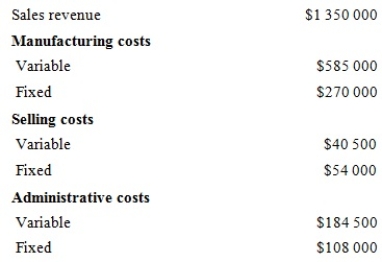 What was Econ's break-even point in dollar sales?
 (Multiple Choice)
4.9/5  (83)
(83) When doing cost volume profit analysis, the starting point is always to analyse the cost behaviours in relation to activity levels.
(True/False)
4.8/5 (73)
(73) Maxie Pty Ltd makes and sells two types of shoes, Plain and Fancy. Product data is as follows: 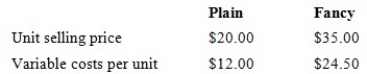 Sixty per cent of the sales in units are Plain and annual fixed expenses are $45 000 and the sales mix remains constant. Assume an income tax rate of 20 per cent.
The break-even point for this data is 5000 units in total. How will the calculation of the break-even point change (if at all) if the relative percentages of the products in the mix change from 60 per cent Plain shoes to 40 per cent Fancy shoes?
Sixty per cent of the sales in units are Plain and annual fixed expenses are $45 000 and the sales mix remains constant. Assume an income tax rate of 20 per cent.
The break-even point for this data is 5000 units in total. How will the calculation of the break-even point change (if at all) if the relative percentages of the products in the mix change from 60 per cent Plain shoes to 40 per cent Fancy shoes? (Multiple Choice)
4.9/5 (71)
(71) i. 'Cost driver' is a widely used term in activity-based costing. What is a cost driver? What is the cost driver in conventional cost volume profit (CVP) analysis? How is the cost driver measured in conventional CVP analysis?
ii. In activity-based costing, costs are classified into unit level, batch level, product level and facility level. How are these categories typically handled in CVP analysis, where there are only two categories available: fixed or variable?
iii. In an environment where activity-based costing is necessary and appropriate, is the relevance of conventional CVP analysis enhanced or diminished? Explain.
iv. Explain the additional limiting assumption of using CVP analysis under activity-based costing.
(Essay)
4.9/5 (78)
(78) A firm is reorganising and reclassifying its cost structure. What is the effect on the break-even point (if any) if direct labour costs are reduced and fixed indirect labour costs are increased, provided all other items remain unchanged?
(Multiple Choice)
4.8/5 (67)
(67) Cost volume profit applied to the service industry
A nursing home has the following annual budget: 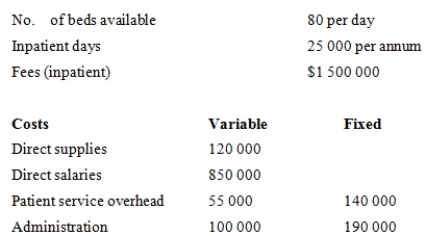 Calculate the budgeted break-even point in inpatient days.
 (Multiple Choice)
4.9/5 (82)
(82) Suppose variable expenses were to decrease by $3.00 per unit. What effect would this have on the cost volume profit analysis?
(Multiple Choice)
4.7/5 (73)
(73) A firm is reorganising and reclassifying its cost structure. The firm previously classified the item 'glue and nails' as indirect material. The firm is considering now tracing this cost directly to products and treating 'glue and nails' as direct material. What is the effect on the break-even point (if any) of that change, provided all other items remain unchanged?
(Multiple Choice)
4.8/5 (90)
(90) One of the biggest criticisms of cost volume profit (CVP) analysis is that it is merely a simplified model that needs to be used with a lot of caution.
(True/False)
4.9/5 (82)
(82) i. Explain how the traditional profit and loss statement differs from the format used in cost volume profit (CVP) analysis.
ii. One of the assumptions underlying CVP analysis is a constant variable cost per unit and fixed costs in total over the relevant range of activity. What are the other assumptions underlying CVP analysis?
iii. The Beetle Company Ltd is experiencing considerable growth and now is able to consider buying raw materials in far larger quantities than a few years ago. For example, one of their primary raw materials may be obtained in bulk purchase lots consisting of three railway wagons as a purchasing unit. The advantage of purchasing in this quantity is that the per-litre cost of this raw material is much cheaper than obtained through purchases of single semitrailer truckloads. In planning for next year, the lower end of possible levels of activity is sufficiently small that the purchase of single semitrailer truckloads would be appropriate. However, at the higher end of the possible levels of activity, purchase in three railway wagons units would be preferable. How could the situation described above be reflected in the CVP analysis? Which of the lines (total revenue, total costs, total fixed costs) would have to be changed and how?
(Essay)
4.7/5 (76)
(76) Under an activity-based costing system, the break-even point in units is calculated by
(Multiple Choice)
4.8/5 (88)
(88) A firm makes and sells three standard products in a specific product mix. All three products are made using the same production facilities. The following budgeted data for the coming year is available. 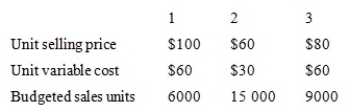 Total annual fixed costs $348 000
Tax rate 40%
The break-even sales units for products 1, 2 and 3 are
Total annual fixed costs $348 000
Tax rate 40%
The break-even sales units for products 1, 2 and 3 are (Multiple Choice)
4.8/5 (61)
(61) Which of the following statements is most correct with respect to the assumptions of the cost volume profit model?
(Multiple Choice)
4.8/5 (60)
(60) The firm's fixed costs are $60 000, variable cost per unit is $15 and selling price per unit is $20. The contribution margin percentage is
(Multiple Choice)
4.9/5 (86)
(86) Which of the following approaches enables management to apply specific changes in assumptions and data and then to examine the effect of those changes on the output?
(Multiple Choice)
4.8/5 (75)
(75) The break-even point in units can be seen on a CVP graph at the intersection of
(Multiple Choice)
4.9/5 (82)
(82) Maxie Pty Ltd makes and sells two types of shoes: Plain and Fancy. Product data is as follows: 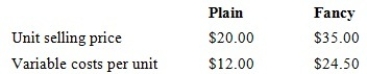 Sixty per cent of the sales in units are Plain and annual fixed expenses are $45 000 and the sales mix remains constant.
Determine the total number of units Maxie Pty Ltd must sell to break even.
Sixty per cent of the sales in units are Plain and annual fixed expenses are $45 000 and the sales mix remains constant.
Determine the total number of units Maxie Pty Ltd must sell to break even. (Multiple Choice)
4.9/5 (79)
(79) The firm's fixed costs are $60 000, variable cost per unit is $15 and selling price per unit is $20. The contribution margin per unit is
(Multiple Choice)
4.8/5 (84)
(84) 
Filters
- Essay(0)
- Multiple Choice(0)
- Short Answer(0)
- True False(0)
- Matching(0)