



 Chat with AI
Exam 20: Pricing and Product Mix Decisions

Exam 1: Management Accounting: Information for Creating Value and Managing Resources67 Questions
Exam 2: Management Accounting: Cost Terms and Concepts87 Questions
Exam 3: Cost Behaviour, Cost Drivers and Cost Estimation93 Questions
Exam 4: Product Costing Systems88 Questions
Exam 5: Process Costing and Operation Costing87 Questions
Exam 6: Service Costing91 Questions
Exam 7: A Closer Look at Overhead Costs99 Questions
Exam 8: Activity-Based Costing91 Questions
Exam 9: Budgeting Systems92 Questions
Exam 10: Standard Costs for Control: Direct Material and Direct Labour105 Questions
Exam 11: Standard Costs for Control: Flexible Budgets and Manufacturing Overhead109 Questions
Exam 12: Managing and Reporting Performance102 Questions
Exam 13: Financial Performance Measures and Incentive Schemes93 Questions
Exam 14: Strategic Performance Measurement Systems80 Questions
Exam 15: Managing Suppliers and Customers90 Questions
Exam 16: Managing Costs and Quality92 Questions
Exam 17: Sustainability and Management Accounting76 Questions
Exam 18: Cost Volume Profit Analysis111 Questions
Exam 19: Information for Decisions: Relevant Costs and Benefits116 Questions
Exam 20: Pricing and Product Mix Decisions113 Questions
Exam 21: Information for Capital Expenditure Decisions125 Questions
Select questions type


Avocado Ltd produces small electronic components for kitchen appliances. This year it expects to produce 10 000 units of component X. The variable manufacturing cost of component X is $2 per unit and the variable selling and administrative cost of component X is $3 per unit. In addition, to produce component X Avocado Ltd incurs annual fixed manufacturing cost of $50 000 and annual fixed selling and administrative cost of $60 000. If the target profit is $2 per unit, and using cost plus pricing approach, the mark up percentage based on total variable costs is:
(Multiple Choice)
4.8/5  (85)
(85) A company that caries hundreds or thousands of product lines that require regular price updates is likely to implement:
(Multiple Choice)
4.8/5 (75)
(75) Cost volume profit (CVP) compared to the economic profit maximising pricing model
The questions below explore the differences between the economic profit maximising pricing (EPM) model and the CVP model discussed earlier.
i. How does the total revenue function in the EPM model differ from that in the CVP model?
ii. How does the total cost function in the EPM model differ from that in the CVP model?
iii. How is volume related to profit maximisation in the CVP model? How does this compare to the EPM model?
(Essay)
4.9/5 (83)
(83) Balance of market forces and cost-based pricing
i. 'Product costs are critical in setting prices, for all costs must be covered in order to make a profit.' Evaluate this statement.
ii. 'Product costs set a ceiling and prices of competitors set a floor for the prices of our products.' Evaluate this statement.
(Essay)
4.7/5 (81)
(81) Cost-plus pricing formulas can only be used with full cost models.
(True/False)
4.9/5 (75)
(75) Tots N Style Pty Ltd has the following data concerning a decorator playpen it manufactures:  If the company uses cost-plus pricing based on variable manufacturing costs, determine the mark-up percentage used by the company to obtain a price of $105.
 (Multiple Choice)
5.0/5 (77)
(77) Strategic pricing of new products
i. Distinguish between skimming pricing and penetration pricing.
ii. Are these two pricing strategies viable alternatives for most products? Explain.
(Essay)
4.9/5 (63)
(63) Which of the following statements is not correct? Linear programming is a technique designed to recognise specifically that:
(Multiple Choice)
4.9/5 (62)
(62) The Houston Company manufactures office equipment. They are ready to introduce a new line of desktop copiers. The following data concerns the copiers:  If the company uses cost-plus pricing based on full cost, what price must the company charge when the mark-up percentage is 40 per cent?
 (Multiple Choice)
4.9/5 (80)
(80) Under competitive bidding when a company has no excess capacity, the bid price would normally include:
(Multiple Choice)
4.7/5 (80)
(80) Avocado Ltd produces small electronic components for kitchen appliances. Two of its products are Component Y and Component Z. The selling price of Component Y is $15, and the selling price of Component Z is $20. The variable cost per unit for Component Y is $8 and the variable cost per unit of Component Z is $11. The machine hour requirement and demand for the two products are: 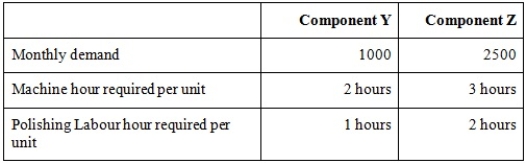 Both Component Y and Component X have to undergo the machining process first, followed by a manual polishing labour process. Avocado Ltd's capacity is 6500 machine hours and 6500 labour hours. The top priority of Avocado Ltd in terms of managing constraints is to:
 (Multiple Choice)
4.9/5 (88)
(88) Legal restrictions
i. Define predatory pricing.
ii. Assume a firm has been charged with predatory pricing. What is the role of product-cost information in defending the firm's pricing practices?
(Essay)
4.7/5 (76)
(76) Managers base prices on product costs due to many reasons. Which of the following is not one of the reasons?
(Multiple Choice)
4.9/5 (85)
(85) Karl's Kitchens is experimenting with different vinegars for sale on the domestic market. The contribution margins per carton for three types V1, V2 and V3 are $120, $100 and $150 respectively. The firm is constrained in terms of labour hours, and the labour hours required per carton of each type of vinegar is 2 hours, 1.5 hours and 3 hours respectively. Assume the firm has 2240 available labour hours per month, and the monthly demand is 1200 cartons of V1, 800 cartons of V2 and 300 cartons of V3. What is the product mix that will maximise profit?
(Multiple Choice)
4.9/5 (82)
(82) Silco Pty Ltd manufactures various lines of computer equipment. They are planning to introduce a line of laptop computers in January 2008. Current plans call for the production and sale of 1000 computers with estimated production costs as follows.  The average amount of capital invested in the laptop computer line is $900 000 and Silco's target return on investment for the line is 18 per cent. What price must Silco charge if the company uses cost-plus pricing based on total variable cost?
 (Multiple Choice)
4.9/5 (82)
(82) Waverly Ltd produces commercial grade washing machines. The Karewasher is currently selling for $2000 per unit. The company wants to introduce a new model, Supawasher, which uses less water per load. The comparative life-time costs of the two models are as follow:  The economic value of a Supawasher (ignore time value of money) is:
 (Multiple Choice)
4.8/5 (85)
(85) One of the consequences of traditional methods of overhead allocation combined with cost-based pricing is that:
(Multiple Choice)
4.8/5 (73)
(73) Tots N Style Pty Ltd has the following data concerning a decorator playpen it manufactures:  If the company uses cost-plus pricing based on absorption costs, determine the mark-up percentage used by the company to obtain a price of $120.
 (Multiple Choice)
4.8/5 (91)
(91) Which of the following statements is false regarding price elasticity?
(Multiple Choice)
4.8/5 (75)
(75) 
Filters
- Essay(0)
- Multiple Choice(0)
- Short Answer(0)
- True False(0)
- Matching(0)