



 Chat with AI
Exam 9: The Government and Fiscal Policy

Exam 1: The Scope and Method of Economics238 Questions
Exam 2: The Economic Problem: Scarcity and Choice220 Questions
Exam 3: Demand, Supply, and Market Equilibrium298 Questions
Exam 4: Demand and Supply Applications173 Questions
Exam 5: Introduction to Macroeconomics241 Questions
Exam 6: Measuring National Output and National Income292 Questions
Exam 7: Unemployment, Inflation, and Long-Run Growth297 Questions
Exam 8: Aggregate Expenditure and Equilibrium Output355 Questions
Exam 9: The Government and Fiscal Policy362 Questions
Exam 10: Money, the Federal Reserve, and the Interest Rate358 Questions
Exam 11: The Determination of Aggregate Output, the Price Level, and the Interest Rate243 Questions
Exam 12: Policy Effects and Cost Shocks in the Asad Model200 Questions
Exam 13: The Labor Market in the Macroeconomy287 Questions
Exam 14: Financial Crises, Stabilization, and Deficits260 Questions
Exam 15: Household and Firm Behavior in the Macroeconomy: a Further Look364 Questions
Exam 16: Long-Run Growth196 Questions
Exam 17: Alternative Views in Macroeconomics294 Questions
Exam 18: International Trade, Comparative Advantage, and Protectionism301 Questions
Exam 19: Open-Economy Macroeconomics: the Balance of Payments and Exchange Rates308 Questions
Exam 20: Economic Growth in Developing Economies133 Questions
Exam 21: Critical Thinking About Research105 Questions
Select questions type


Refer to the information provided in Table 9.5 below to answer the questions that follow.
Table 9.5
All Numbers are in $ Million  -Refer to Table 9.5. Assuming constant MPC, at income of $1,000 million, consumption is $________ million, and at income of $1,300 million, consumption is $________ million.
 (Multiple Choice)
4.9/5  (80)
(80) Taxes are reduced by $15 billion and income increases by $75 billion. The value of the tax multiplier is
(Multiple Choice)
4.8/5 (85)
(85) As a percentage of government receipts, corporate income taxes are larger than personal income taxes and Social Security taxes combined.
(True/False)
4.8/5 (73)
(73) As the tax rate increases, the absolute value of the tax multiplier
(Multiple Choice)
4.8/5 (71)
(71) Refer to the information provided in Table 9.7 below to answer the questions that follow.
Table 9.7
All Numbers are in $ Million  -Refer to Table 9.7. The government spending multiplier in this economy is
 (Multiple Choice)
4.8/5 (78)
(78) If taxes depend on income and the MPC is 0.6 and t is 0.3, the tax multiplier is
(Multiple Choice)
4.9/5 (72)
(72) The Peruvian economy can be characterized by Equation 9.4.
EQUATION 9.4:
C = 400 + 0.6Yd
Taxes = 600
Equilibrium Output = $4,000
-Refer to Equation 9.4. At equilibrium, saving in Peru equals
(Multiple Choice)
4.8/5 (73)
(73) Federal government consumption expenditures as a percentage of GDP declined during a majority of the
(Multiple Choice)
4.8/5 (93)
(93) Refer to the information provided in Table 9.3 below to answer the questions that follow.
Table 9.3 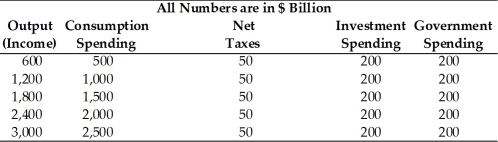 -Refer to Table 9.3. At an output level of $2,400 billion, the level of aggregate expenditure is
 (Multiple Choice)
4.7/5 (93)
(93) Planned aggregate expenditure increases when ________ in the income-expenditure model.
(Multiple Choice)
4.9/5 (83)
(83) As the size of the MPC decreases, the value of the balanced-budget multiplier
(Multiple Choice)
5.0/5 (75)
(75) Assume an economy is in equilibrium at an output level of $1,600 billion. If government purchases increase by $200 billion, then at the output level of $1,600 billion, there is
(Multiple Choice)
4.8/5 (77)
(77) Refer to the information provided in Table 9.3 below to answer the questions that follow.
Table 9.3
-Refer to Table 9.3. At an output level of $2,400 billion, there is an unplanned inventory change of
-Refer to Table 9.3. At an output level of $2,400 billion, there is an unplanned inventory change of (Multiple Choice)
4.8/5 (77)
(77) The aggregate consumption function is C = 200 + 0.9Yd. If income is $1,500 and net taxes are $300, consumption equals
(Multiple Choice)
4.8/5 (70)
(70) If the government spending multiplier is 6 and government spending increases by $30 billion, output will ________ by $________ billion.
(Multiple Choice)
4.9/5 (77)
(77) The balanced-budget multiplier works whenever the government increases spending and increases taxes by the same amount.
(True/False)
5.0/5 (91)
(91) Federal government receipts minus expenditures is the federal surplus or deficit.
(True/False)
4.8/5 (81)
(81) 
Filters
- Essay(0)
- Multiple Choice(0)
- Short Answer(0)
- True False(0)
- Matching(0)