



 Chat with AI
Exam 9: The Government and Fiscal Policy

Exam 1: The Scope and Method of Economics238 Questions
Exam 2: The Economic Problem: Scarcity and Choice220 Questions
Exam 3: Demand, Supply, and Market Equilibrium298 Questions
Exam 4: Demand and Supply Applications173 Questions
Exam 5: Introduction to Macroeconomics241 Questions
Exam 6: Measuring National Output and National Income292 Questions
Exam 7: Unemployment, Inflation, and Long-Run Growth297 Questions
Exam 8: Aggregate Expenditure and Equilibrium Output355 Questions
Exam 9: The Government and Fiscal Policy362 Questions
Exam 10: Money, the Federal Reserve, and the Interest Rate358 Questions
Exam 11: The Determination of Aggregate Output, the Price Level, and the Interest Rate243 Questions
Exam 12: Policy Effects and Cost Shocks in the Asad Model200 Questions
Exam 13: The Labor Market in the Macroeconomy287 Questions
Exam 14: Financial Crises, Stabilization, and Deficits260 Questions
Exam 15: Household and Firm Behavior in the Macroeconomy: a Further Look364 Questions
Exam 16: Long-Run Growth196 Questions
Exam 17: Alternative Views in Macroeconomics294 Questions
Exam 18: International Trade, Comparative Advantage, and Protectionism301 Questions
Exam 19: Open-Economy Macroeconomics: the Balance of Payments and Exchange Rates308 Questions
Exam 20: Economic Growth in Developing Economies133 Questions
Exam 21: Critical Thinking About Research105 Questions
Select questions type


Refer to the information provided in Table 9.7 below to answer the questions that follow.
Table 9.7
All Numbers are in $ Million  -Refer to Table 9.7. The equilibrium level of aggregate income is $________ million.
 (Multiple Choice)
4.8/5  (82)
(82) Government spending increases by $80 billion and the equilibrium level of output increases by $320 billion. The government spending multiplier
(Multiple Choice)
4.8/5 (74)
(74) The economy is in equilibrium when [I + G = S + T], assuming there is
(Multiple Choice)
4.7/5 (80)
(80) The Italian economy can be characterized by Equation 9.1.
EQUATION 9.1:
C = 300 + 0.8Yd
G = 400
T = 200
I = 200
-Refer to Equation 9.1. At the equilibrium level of output in Italy, saving equals
(Multiple Choice)
5.0/5 (87)
(87) If output is less than planned aggregate expenditure, there will be
(Multiple Choice)
4.9/5 (78)
(78) You are hired by the Council of Economic Advisors (CEA) as an economic consultant. The Chairperson of the CEA tells you that she believes the current unemployment rate is too high. The unemployment rate can be reduced if aggregate output increases. She wants to know what policy to pursue to increase aggregate output by $500 billion. The best estimate she has for the MPC is 0.5. Which of the following policies should you recommend?
(Multiple Choice)
4.9/5 (76)
(76) If the tax multiplier is -15 and taxes are increased by $150 billion, output
(Multiple Choice)
4.7/5 (83)
(83) In which case will the government collect more tax revenue?
(Multiple Choice)
5.0/5 (88)
(88) If the government spending multiplier is 10, then the tax multiplier
(Multiple Choice)
4.8/5 (91)
(91) The total amount owed by the federal government to the public is the
(Multiple Choice)
4.8/5 (88)
(88) Refer to the information provided in Figure 9.5 below to answer the questions that follow. 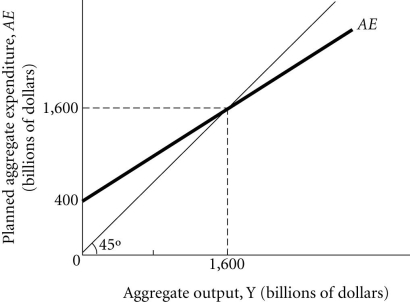 Figure 9.5
-Refer to Figure 9.5. If the economy is in equilibrium and the government increases taxes by $100 billion, equilibrium aggregate output ________ to $________ billion.
Figure 9.5
-Refer to Figure 9.5. If the economy is in equilibrium and the government increases taxes by $100 billion, equilibrium aggregate output ________ to $________ billion. (Multiple Choice)
4.7/5 (80)
(80) Assuming there is no foreign trade in the economy, the economy is in equilibrium when
(Multiple Choice)
4.8/5 (85)
(85) Personal income tax rates being tied to the overall price level leads to fiscal drag.
(True/False)
4.8/5 (76)
(76) The aggregate consumption function is C = 100 + 0.5Yd. If income is $2,000 and net taxes are $400, consumption equals
(Multiple Choice)
4.8/5 (79)
(79) For the economy to be in equilibrium, the following condition must be satisfied: G + I = S + T.
(True/False)
4.8/5 (83)
(83) Refer to the information provided in Figure 9.4 below to answer the questions that follow.  Figure 9.4
-Refer to Figure 9.4. If aggregate expenditures are represented by AE2 and government spending increases by $100 billion, equilibrium aggregate output increases by $________ billion.
Figure 9.4
-Refer to Figure 9.4. If aggregate expenditures are represented by AE2 and government spending increases by $100 billion, equilibrium aggregate output increases by $________ billion. (Multiple Choice)
5.0/5 (83)
(83) 
Filters
- Essay(0)
- Multiple Choice(0)
- Short Answer(0)
- True False(0)
- Matching(0)