



 Chat with AI
Exam 9: The Government and Fiscal Policy

Exam 1: The Scope and Method of Economics238 Questions
Exam 2: The Economic Problem: Scarcity and Choice220 Questions
Exam 3: Demand, Supply, and Market Equilibrium298 Questions
Exam 4: Demand and Supply Applications173 Questions
Exam 5: Introduction to Macroeconomics241 Questions
Exam 6: Measuring National Output and National Income292 Questions
Exam 7: Unemployment, Inflation, and Long-Run Growth297 Questions
Exam 8: Aggregate Expenditure and Equilibrium Output355 Questions
Exam 9: The Government and Fiscal Policy362 Questions
Exam 10: Money, the Federal Reserve, and the Interest Rate358 Questions
Exam 11: The Determination of Aggregate Output, the Price Level, and the Interest Rate243 Questions
Exam 12: Policy Effects and Cost Shocks in the Asad Model200 Questions
Exam 13: The Labor Market in the Macroeconomy287 Questions
Exam 14: Financial Crises, Stabilization, and Deficits260 Questions
Exam 15: Household and Firm Behavior in the Macroeconomy: a Further Look364 Questions
Exam 16: Long-Run Growth196 Questions
Exam 17: Alternative Views in Macroeconomics294 Questions
Exam 18: International Trade, Comparative Advantage, and Protectionism301 Questions
Exam 19: Open-Economy Macroeconomics: the Balance of Payments and Exchange Rates308 Questions
Exam 20: Economic Growth in Developing Economies133 Questions
Exam 21: Critical Thinking About Research105 Questions
Select questions type


In the circular flow of income, both saving and net taxes flow into government.
(True/False)
4.9/5  (84)
(84) When the tax rate increases, the absolute value of the tax multiplier falls.
(True/False)
4.9/5 (83)
(83) Assume that taxes depend on income. The MPC is 0.75 and t is 0.2. If government spending increases by $10 billion, the equilibrium level of output will increase by
(Multiple Choice)
4.9/5 (78)
(78) As the size of the MPC increases, the value of the balanced-budget multiplier
(Multiple Choice)
4.8/5 (73)
(73) Refer to the information provided in Figure 9.5 below to answer the questions that follow.  Figure 9.5
-Refer to Figure 9.5. The MPC equals ________ and the MPS equals ________.
Figure 9.5
-Refer to Figure 9.5. The MPC equals ________ and the MPS equals ________. (Multiple Choice)
4.9/5 (82)
(82) In 2016, the city of Sylvester collected $800,000 in taxes and spent $200,000. In 2016, the city of Sylvester had a
(Multiple Choice)
5.0/5 (93)
(93) The ratio of the change in the equilibrium level of output to the change in taxes is the
(Multiple Choice)
5.0/5 (87)
(87) Refer to the information provided in Figure 9.3 below to answer the questions that follow.  Figure 9.3
-Refer to Figure 9.3. If autonomous planned expenditure increases by $________ billion, equilibrium aggregate output increases to $750 billion.
Figure 9.3
-Refer to Figure 9.3. If autonomous planned expenditure increases by $________ billion, equilibrium aggregate output increases to $750 billion. (Multiple Choice)
4.9/5 (78)
(78) As the MPC increases, the absolute value of the tax multiplier increases.
(True/False)
4.9/5 (81)
(81) If government spending is increased by $1,000 and taxes are increased by $1,000, the equilibrium level of income will
(Multiple Choice)
4.7/5 (75)
(75) The aggregate consumption function is C = 1,000 + 0.9Yd. If income is $3,600 and net taxes are $600, consumption equals
(Multiple Choice)
4.8/5 (66)
(66) Assume an economy is in equilibrium at an output level of $600 billion. If government purchases decrease by $75 billion, then at the output level of $600 billion, there is
(Multiple Choice)
4.8/5 (82)
(82) Refer to the information provided in Table 9.2 below to answer the questions that follow.
Table 9.2 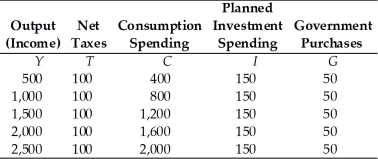 -Refer to Table 9.2. At an output level of $2,500, the level for saving
 (Multiple Choice)
4.8/5 (70)
(70) A tax cut of $5 billion will have a greater effect on the economy than an increase in government purchases of $5 billion.
(True/False)
4.9/5 (78)
(78) Personal taxes are the ________ in the government's budget.
(Multiple Choice)
4.8/5 (85)
(85) Refer to the information provided in Figure 9.5 below to answer the questions that follow. Figure 9.5
-Refer to Figure 9.5. If the economy is in equilibrium and the government increases spending by $200 billion and increases taxes by $200 billion, equilibrium aggregate output
Figure 9.5
-Refer to Figure 9.5. If the economy is in equilibrium and the government increases spending by $200 billion and increases taxes by $200 billion, equilibrium aggregate output (Multiple Choice)
4.9/5 (92)
(92) If government spending is increased by $300, taxes are reduced by $300, and the MPS is 0.5, equilibrium output will change by
(Multiple Choice)
4.7/5 (74)
(74) 
Filters
- Essay(0)
- Multiple Choice(0)
- Short Answer(0)
- True False(0)
- Matching(0)