



 Chat with AI
Exam 9: The Government and Fiscal Policy

Exam 1: The Scope and Method of Economics238 Questions
Exam 2: The Economic Problem: Scarcity and Choice220 Questions
Exam 3: Demand, Supply, and Market Equilibrium298 Questions
Exam 4: Demand and Supply Applications173 Questions
Exam 5: Introduction to Macroeconomics241 Questions
Exam 6: Measuring National Output and National Income292 Questions
Exam 7: Unemployment, Inflation, and Long-Run Growth297 Questions
Exam 8: Aggregate Expenditure and Equilibrium Output355 Questions
Exam 9: The Government and Fiscal Policy362 Questions
Exam 10: Money, the Federal Reserve, and the Interest Rate358 Questions
Exam 11: The Determination of Aggregate Output, the Price Level, and the Interest Rate243 Questions
Exam 12: Policy Effects and Cost Shocks in the Asad Model200 Questions
Exam 13: The Labor Market in the Macroeconomy287 Questions
Exam 14: Financial Crises, Stabilization, and Deficits260 Questions
Exam 15: Household and Firm Behavior in the Macroeconomy: a Further Look364 Questions
Exam 16: Long-Run Growth196 Questions
Exam 17: Alternative Views in Macroeconomics294 Questions
Exam 18: International Trade, Comparative Advantage, and Protectionism301 Questions
Exam 19: Open-Economy Macroeconomics: the Balance of Payments and Exchange Rates308 Questions
Exam 20: Economic Growth in Developing Economies133 Questions
Exam 21: Critical Thinking About Research105 Questions
Select questions type


Discretionary fiscal policy refers to changes in taxes or spending that occur in response to changes in the economy.
(True/False)
4.9/5  (83)
(83) In a recession the U.S. federal government deficit automatically falls.
(True/False)
4.9/5 (80)
(80) Refer to the information provided in Table 9.8 below to answer the questions that follow.
Table 9.8
All Figures in Billions of Dollars
 -Refer to Table 9.8. If taxes are reduced from $100 billion to $50 billion, the new equilibrium level of output is
 (Multiple Choice)
4.8/5 (73)
(73) Assume that taxes depend on income. The MPC is 0.8 and t is 0.25. The government spending multiplier is
(Multiple Choice)
4.8/5 (83)
(83) Government spending increases by $40 billion and the equilibrium level of output increases by $200 billion. The government spending multiplier
(Multiple Choice)
4.8/5 (78)
(78) Refer to the information provided in Table 9.7 below to answer the questions that follow.
Table 9.7
All Numbers are in $ Million  -Refer to Table 9.7. Suppose the economy is in equilibrium and the government increases spending by $100 million, the new equilibrium output is $________ million
 (Multiple Choice)
4.9/5 (76)
(76) Refer to the information provided in Table 9.3 below to answer the questions that follow.
Table 9.3 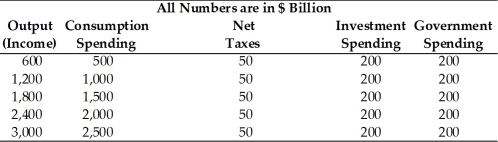 -Refer to Table 9.3. At the equilibrium level of income, leakages equal ________ billion.
 (Multiple Choice)
5.0/5 (76)
(76) If taxes are a function of income, then the AE function is
(Multiple Choice)
4.9/5 (76)
(76) Refer to the information provided in Table 9.2 below to answer the questions that follow.
Table 9.2 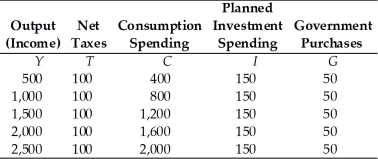 -Refer to Table 9.2. At an output level of $1,500, disposable income
 (Multiple Choice)
4.9/5 (68)
(68) The Norwegian economy can be characterized by Equation 9.3.
EQUATION 9.3:
C = 100 + 0.8Yd
G = 500
T = 200
I = 200
-Refer to Equation 9.3. At the equilibrium level of output in Norway, consumption equals
(Multiple Choice)
4.7/5 (62)
(62) Refer to the information provided in Figure 9.4 below to answer the questions that follow.  Figure 9.4
-Refer to Figure 9.4. Along AE1, ________ when aggregate output equals $2,000 billion.
Figure 9.4
-Refer to Figure 9.4. Along AE1, ________ when aggregate output equals $2,000 billion. (Multiple Choice)
4.9/5 (90)
(90) Refer to the information provided in Figure 9.4 below to answer the questions that follow. Figure 9.4
-Refer to Figure 9.4. Along aggregate expenditure AE1, the MPS will be
Figure 9.4
-Refer to Figure 9.4. Along aggregate expenditure AE1, the MPS will be (Multiple Choice)
4.8/5 (78)
(78) Assume that taxes depend on income and the MPC is 0.6 and t is 0.3. An increase in taxes of $10 billion will decrease equilibrium income by
(Multiple Choice)
4.9/5 (78)
(78) If the government wants to reduce unemployment, government purchases should be ________ and/or taxes should be ________.
(Multiple Choice)
4.8/5 (85)
(85) You are hired by the Bureau of Economic Analogies (BEA) as an economic consultant. The chairperson of the BEA tells you that he believes the current unemployment rate is too high. The unemployment rate can be reduced if aggregate output increases. He wants to know what policy to pursue to increase aggregate output by $200 billion. The best estimate he has for the MPC is 0.6. Which of the following policies should you recommend?
(Multiple Choice)
4.8/5 (74)
(74) Refer to the information provided in Table 9.5 below to answer the questions that follow.
Table 9.5
All Numbers are in $ Million  -Refer to Table 9.5. Which of the following variables is not considered autonomous?
 (Multiple Choice)
4.9/5 (78)
(78) Refer to the information provided in Figure 9.5 below to answer the questions that follow.  Figure 9.5
-Refer to Figure 9.5. If the economy is in equilibrium and the government decreases spending by $200 billion, equilibrium aggregate output decreases to $________ billion.
Figure 9.5
-Refer to Figure 9.5. If the economy is in equilibrium and the government decreases spending by $200 billion, equilibrium aggregate output decreases to $________ billion. (Multiple Choice)
4.7/5 (87)
(87) The average tax rate steadily increased during the 2001-2008 Bush administrations.
(True/False)
4.9/5 (72)
(72) 
Filters
- Essay(0)
- Multiple Choice(0)
- Short Answer(0)
- True False(0)
- Matching(0)