



 Chat with AI
Exam 9: The Government and Fiscal Policy

Exam 1: The Scope and Method of Economics238 Questions
Exam 2: The Economic Problem: Scarcity and Choice220 Questions
Exam 3: Demand, Supply, and Market Equilibrium298 Questions
Exam 4: Demand and Supply Applications173 Questions
Exam 5: Introduction to Macroeconomics241 Questions
Exam 6: Measuring National Output and National Income292 Questions
Exam 7: Unemployment, Inflation, and Long-Run Growth297 Questions
Exam 8: Aggregate Expenditure and Equilibrium Output355 Questions
Exam 9: The Government and Fiscal Policy362 Questions
Exam 10: Money, the Federal Reserve, and the Interest Rate358 Questions
Exam 11: The Determination of Aggregate Output, the Price Level, and the Interest Rate243 Questions
Exam 12: Policy Effects and Cost Shocks in the Asad Model200 Questions
Exam 13: The Labor Market in the Macroeconomy287 Questions
Exam 14: Financial Crises, Stabilization, and Deficits260 Questions
Exam 15: Household and Firm Behavior in the Macroeconomy: a Further Look364 Questions
Exam 16: Long-Run Growth196 Questions
Exam 17: Alternative Views in Macroeconomics294 Questions
Exam 18: International Trade, Comparative Advantage, and Protectionism301 Questions
Exam 19: Open-Economy Macroeconomics: the Balance of Payments and Exchange Rates308 Questions
Exam 20: Economic Growth in Developing Economies133 Questions
Exam 21: Critical Thinking About Research105 Questions
Select questions type


Refer to the information provided in Table 9.8 below to answer the questions that follow.
Table 9.8
All Figures in Billions of Dollars
 -Refer to Table 9.8. The economy is at the equilibrium level of output. If government spending increases by $200 billion, the new equilibrium level of output is
 (Multiple Choice)
4.8/5  (75)
(75) Refer to the information provided in Figure 9.1 below to answer the questions that follow.  Figure 9.1
-Refer to Figure 9.1. The equilibrium level of aggregate expenditure is $________ billion.
Figure 9.1
-Refer to Figure 9.1. The equilibrium level of aggregate expenditure is $________ billion. (Multiple Choice)
4.9/5 (77)
(77) Suppose that in the beginning of 2016 the federal debt was $9 trillion. During 2016, the government balanced its budget. At the end of 2016, the federal debt
(Multiple Choice)
4.8/5 (67)
(67) Refer to the information provided in Table 9.2 below to answer the questions that follow.
Table 9.2 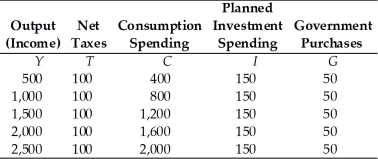 -Refer to Table 9.2 At the equilibrium level of income, leakages equal ________ billion.
 (Multiple Choice)
4.8/5 (82)
(82) Refer to the information provided in Figure 9.5 below to answer the questions that follow.  Figure 9.5
-Refer to Figure 9.5. The government spending multiplier equals ________ and the tax multiplier equals ________.
Figure 9.5
-Refer to Figure 9.5. The government spending multiplier equals ________ and the tax multiplier equals ________. (Multiple Choice)
4.8/5 (80)
(80) Refer to the information provided in Figure 9.4 below to answer the questions that follow.  Figure 9.4
-Refer to Figure 9.4. What is the value of the tax multiplier?
Figure 9.4
-Refer to Figure 9.4. What is the value of the tax multiplier? (Multiple Choice)
4.7/5 (72)
(72) You are hired by the Bureau of Economic Analogies (BEA) as an economic consultant. The Chairperson of the BEA tells you that he believes the current unemployment rate is too low. The unemployment rate can be increased if aggregate output decreases. He wants to know what policy to pursue to decrease aggregate output by $50 billion. The best estimate he has for the MPC is 0.9. Which of the following policies should you recommend?
(Multiple Choice)
4.8/5 (81)
(81) Refer to the information provided in Figure 9.3 below to answer the questions that follow.  Figure 9.3
-Refer to Figure 9.3. The expenditure multiplier is
Figure 9.3
-Refer to Figure 9.3. The expenditure multiplier is (Multiple Choice)
4.8/5 (82)
(82) If the tax multiplier is -4 and taxes are reduced by $35 billion, output
(Multiple Choice)
4.9/5 (90)
(90) The Peruvian economy can be characterized by Equation 9.4.
EQUATION 9.4:
C = 400 + 0.6Yd
Taxes = 600
Equilibrium Output = $4,000
-Refer to Equation 9.4. At equilibrium, government purchases in Peru is
(Multiple Choice)
4.8/5 (67)
(67) Refer to the information provided in Figure 9.1 below to answer the questions that follow. Figure 9.1
-Refer to Figure 9.1. At equilibrium, injections
Figure 9.1
-Refer to Figure 9.1. At equilibrium, injections (Multiple Choice)
4.8/5 (78)
(78) Refer to the information provided in Figure 9.5 below to answer the questions that follow. Figure 9.5
-Refer to Figure 9.5. If the economy is in equilibrium and the government decreases spending by $100 billion, equilibrium aggregate output decreases to $________ billion.
Figure 9.5
-Refer to Figure 9.5. If the economy is in equilibrium and the government decreases spending by $100 billion, equilibrium aggregate output decreases to $________ billion. (Multiple Choice)
4.9/5 (78)
(78) If the economy's full-employment output is $12 trillion, actual output is $10 trillion, and the budget deficit is $2 trillion, the deficit in this case is known as a
(Multiple Choice)
4.9/5 (78)
(78) Refer to the information provided in Figure 9.1 below to answer the questions that follow. Figure 9.1
-Refer to Figure 9.1. Suppose that the consumption function is C = 400 + 0.5Yd and taxes are $200 billion, at equilibrium the value of injections are
Figure 9.1
-Refer to Figure 9.1. Suppose that the consumption function is C = 400 + 0.5Yd and taxes are $200 billion, at equilibrium the value of injections are (Multiple Choice)
4.7/5 (89)
(89) Refer to the information provided in Table 9.6 below to answer the questions that follow.
Table 9.6
All Figures in Billions of Dollars  -Refer to Table 9.6. The MPS
 (Multiple Choice)
4.9/5 (82)
(82) You are hired by the Council of Economic Advisors (CEA) as an economic consultant. The chairperson of the CEA tells you that she believes the current unemployment rate is too high. The unemployment rate can be reduced if aggregate output increases. She wants to know what policy to pursue to increase aggregate output by $800 billion. The best estimate she has for the MPC is 0.8. Which of the following policies should you recommend?
(Multiple Choice)
4.9/5 (83)
(83) Refer to the information provided in Table 9.5 below to answer the questions that follow.
Table 9.5
All Numbers are in $ Million  -Refer to Table 9.5. The equilibrium level of aggregate output is $________ million.
 (Multiple Choice)
4.7/5 (69)
(69) During a recession, automatic stabilizers cause the federal deficit to
(Multiple Choice)
4.8/5 (78)
(78) If the economy is in a recession, the actual deficit is ________ than the full employment deficit.
(Multiple Choice)
4.9/5 (77)
(77) 
Filters
- Essay(0)
- Multiple Choice(0)
- Short Answer(0)
- True False(0)
- Matching(0)