



 Chat with AI
Exam 23: Metabolism and Energy Production

Exam 1: Chemistry and Measurements77 Questions
Exam 2: Energy and Matter100 Questions
Exam 3: Atoms and Elements125 Questions
Exam 4: Nuclear Chemistry92 Questions
Exam 5: Compounds and Their Bonds115 Questions
Exam 6: Chemical Reactions and Quantities115 Questions
Exam 7: Gases100 Questions
Exam 8: Solutions99 Questions
Exam 9: Reaction Rates and Chemical Equilibrium71 Questions
Exam 10: Acids and Bases84 Questions
Exam 11: Introduction to Organic Chemistry: Alkanes117 Questions
Exam 12: Alkenes, Alkynes, and Aromatic Compounds81 Questions
Exam 13: Alcohols, Phenols, Thiols, and Ethers74 Questions
Exam 14: Aldehydes, Ketones, and Chiral Molecules83 Questions
Exam 15: Carbohydrates67 Questions
Exam 16: Carboxylic Acids and Esters85 Questions
Exam 17: Lipids83 Questions
Exam 18: Amines and Amides87 Questions
Exam 19: Amino Acids and Proteins103 Questions
Exam 20: Enzymes and Vitamins100 Questions
Exam 21: Nucleic Acids and Protein Synthesis89 Questions
Exam 22: Metabolic Pathways for Carbohydrates83 Questions
Exam 23: Metabolism and Energy Production86 Questions
Exam 24: Metabolic Pathways for Lipids and Amino Acids83 Questions
Select questions type


The conversion of ATP to ADP and inorganic phosphate produces 7.3 kcal/mole of energy.
(True/False)
4.9/5  (75)
(75) In this figure, depicting part 1 of the Citric Acid Cycle, taken from your text, identify the substances numbered.  -substance 14
 (Short Answer)
5.0/5 (71)
(71) Under anaerobic conditions, there is a net production of __________ ATP during glycolysis.
(Multiple Choice)
4.7/5 (82)
(82) The GTP formed in step 5 of the citric acid cycle is used to make
(Multiple Choice)
4.8/5 (71)
(71) The citric acid cycle step that removes the first CO₂ molecule is a(n)
(Multiple Choice)
5.0/5 (77)
(77) In the third major step of the citric acid cycle, NAD+ is converted to
(Multiple Choice)
4.9/5 (76)
(76) Which is the best choice for the box labeled "Answer" in the illustration below? 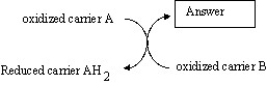
(Multiple Choice)
4.7/5 (90)
(90) The energy levels of complexes decrease as electron transport progresses.
(True/False)
4.9/5 (78)
(78) Identify each of the following metabolic pathways.
-the series of reactions that converts acetyl CoA to carbon dioxide and water
(Multiple Choice)
4.9/5 (80)
(80) In this figure depicting the Stages of Metabolism taken from your text, identify the metabolic substance numbered.  -process 9
 (Short Answer)
4.9/5 (77)
(77) In stage three of metabolism, the overall result is to release
(Multiple Choice)
4.9/5 (83)
(83) Which of the following is the net reaction for one turn of the citric acid cycle?
(Multiple Choice)
4.9/5 (79)
(79) In electron transport, the oxidized product from the reaction of FMN + NADH + H+ is
(Multiple Choice)
4.7/5 (98)
(98) The electron carrier __________ provides two ATP via electron transport.
(Multiple Choice)
4.8/5 (88)
(88) In the chemiosmotic model of oxidative phosphorylation, ATP is synthesized as
(Multiple Choice)
4.8/5 (79)
(79) When combined with electron transport, one turn of the citric acid cycle produces __________ ATP.
(Multiple Choice)
4.9/5 (69)
(69) Indicate the amount of ATP produced when each of the following reactions occurs.
-Acetyl CoA → 2CO₂
(Multiple Choice)
5.0/5 (76)
(76) Most of the energy released in the citric acid cycle is used to produce
(Multiple Choice)
4.9/5 (70)
(70) 
Filters
- Essay(0)
- Multiple Choice(0)
- Short Answer(0)
- True False(0)
- Matching(0)