



 Chat with AI
Exam 13: Analysis of Financial Statements

Exam 1: Managerial Accounting Concepts and Principles251 Questions
Exam 2: Job Order Costing and Analysis216 Questions
Exam 3: Process Costing and Analysis231 Questions
Exam 4: Activity-Based Costing and Analysis223 Questions
Exam 5: Cost Behavior and Cost-Volume-Profit Analysis248 Questions
Exam 6: Variable Costing and Analysis202 Questions
Exam 7: Master Budgets and Performance Planning215 Questions
Exam 8: Flexible Budgets and Standard Costs221 Questions
Exam 9: Performance Measurement and Responsibility Accounting210 Questions
Exam 10: Relevant Costing for Managerial Decisions145 Questions
Exam 11: Capital Budgeting and Investment Analysis157 Questions
Exam 12: Reporting Cash Flows240 Questions
Exam 13: Analysis of Financial Statements235 Questions
Exam 14: Time Value of Money83 Questions
Exam 15: Lean Principles and Accounting27 Questions
Exam 16: Accounting for Business Transactions251 Questions
Select questions type


Ratios may be expressed as (1) ________, (2) ________, or (3) ________.
(Essay)
4.9/5  (75)
(75) A company reported net income of $78,000 and had 15,000 common shares outstanding throughout the current year. At year-end, the price per share of the company's stock was $49.40. What is the company's year-end price-earnings ratio?
(Essay)
4.9/5 (71)
(71) Identify the financial analysis building block most appropriately associated with each ratio listed below by placing the letter of the building block a through d beside each ratio 1 through 10. Each building block may be used more than once.
A. Liquidity and Efficiency
B. Solvency
C. Profitability
D. Market Prospects
________ (1) Price Earnings Ratio
________ (2) Dividend Yield
________ (3) Accounts Receivable Turnover
________ (4) Days' Sales in Inventory
________ (5) Return on Total Assets
________ (6) Equity Ratio
________ (7) Debt Ratio
________ (8) Inventory Turnover
________ (9) Basic Earnings per Share
________ (10) Times Interest Earned
(Not Answered)
This question doesn't have any answer yet
The percent change of a comparative financial statement item is computed by subtracting the estimated period amount from the base period amount, dividing the result by the base period amount and multiplying that result by 100.
(True/False)
4.9/5 (85)
(85) When an item has a value in the base period and zero in the analysis period, the decrease is 100 percent.
(True/False)
5.0/5 (79)
(79) Measures taken from a selected competitor or a group of competitors are often excellent standards of comparison for analysis.
(True/False)
4.9/5 (84)
(84) Profitability is the ability to generate positive market expectations.
(True/False)
4.9/5 (84)
(84) When an item has a value in the base period and zero in the analysis period, the decrease is 0 percent.
(True/False)
4.8/5 (78)
(78) For the following financial statement items, calculate trend percentages using Year 1 as the base year:

(Essay)
5.0/5 (76)
(76) A company's sales in Year 1 were $250,000 and in Year 2 were $287,500. Using Year 1 as the base year, the percent change for Year 2 compared to the base year is:
(Multiple Choice)
4.9/5 (80)
(80) A corporation reports the following year-end balance sheet data. The company's working capital equals: Cash \ 40,000 Current liabilities \ 5,000 Accounts receivable 55,000 Long-term liabilities 35,000 Inventory 60,000 Common stock 100,000 Equipment 145,000 Retained earnings 90,000 Total assets \ 300,000 Total liabilities and equity \ 300,000
(Multiple Choice)
4.9/5 (83)
(83) A corporation reported cash of $27,000, total assets of $461,000, and total equity of $157, 895 on its balance sheet. Its common-size percent for cash equals:
(Multiple Choice)
4.7/5 (83)
(83) Jones Corp. reported current assets of $193,000 and current liabilities of $137,000 on its most recent balance sheet. The current assets consisted of $62,000 Cash; $43,000 Accounts Receivable; and $88,000 of Inventory. The acid-test (quick) ratio is:
(Multiple Choice)
4.9/5 (86)
(86) Profitability is the ability to provide financial rewards sufficient to attract and retain financing.
(True/False)
4.8/5 (76)
(76) External users of accounting information manage and operate the company.
(True/False)
4.8/5 (80)
(80) The building blocks of financial statement analysis include (1) liquidity, (2) salability, (3) solvency, and (4) fair presentation.
(True/False)
4.7/5 (85)
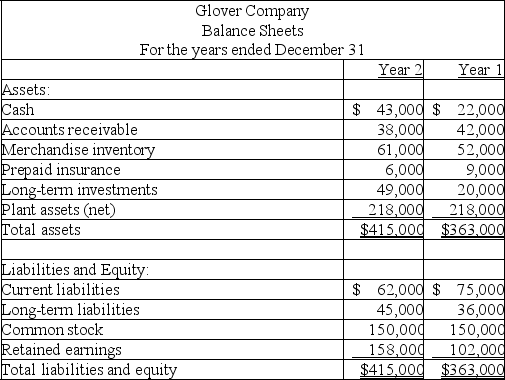
(85) Use the balance sheets of Glover shown below to calculate the following ratios for Year 2 (round to the hundredths):
(a) Current ratio.
(b) Acid-test ratio.
(c) Debt ratio.
(d) Equity ratio.
(Essay)
4.8/5 (71)
(71) A good financial statement analysis report usually includes the following six sections: (1) ________, (2) ________, (3) ________, (4) ________ (5) ________, and (6) ________.
(Essay)
4.8/5 (70)
(70) Liquidity and efficiency are the ability to meet short-term obligations and to efficiently generate revenue.
(True/False)
4.8/5 (68)
(68) 
Filters
- Essay(0)
- Multiple Choice(0)
- Short Answer(0)
- True False(0)
- Matching(0)