



 Chat with AI
Exam 13: Analysis of Financial Statements

Exam 1: Managerial Accounting Concepts and Principles251 Questions
Exam 2: Job Order Costing and Analysis216 Questions
Exam 3: Process Costing and Analysis231 Questions
Exam 4: Activity-Based Costing and Analysis223 Questions
Exam 5: Cost Behavior and Cost-Volume-Profit Analysis248 Questions
Exam 6: Variable Costing and Analysis202 Questions
Exam 7: Master Budgets and Performance Planning215 Questions
Exam 8: Flexible Budgets and Standard Costs221 Questions
Exam 9: Performance Measurement and Responsibility Accounting210 Questions
Exam 10: Relevant Costing for Managerial Decisions145 Questions
Exam 11: Capital Budgeting and Investment Analysis157 Questions
Exam 12: Reporting Cash Flows240 Questions
Exam 13: Analysis of Financial Statements235 Questions
Exam 14: Time Value of Money83 Questions
Exam 15: Lean Principles and Accounting27 Questions
Exam 16: Accounting for Business Transactions251 Questions
Select questions type


Refer to the following selected financial information from Mojave Corp. Compute the company's times interest earned. Interest expense \ 9,100 Income tax expense 22,700 Net income after tax 56,500
(Multiple Choice)
4.8/5  (88)
(88) Evaluation of company performance does not include analysis of (1) past and current performance, (2) current financial position, and (3) future performance and risk.
(True/False)
4.8/5 (73)
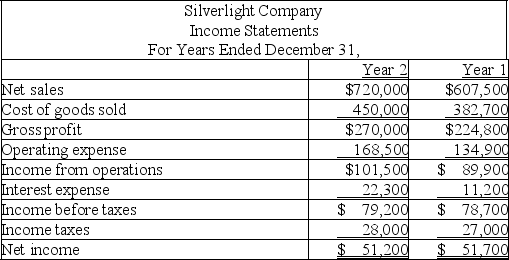
(73) The comparative income statements for Silverlight Company are shown below. Calculate the following ratios for Year 2:
(a) profit margin
(b) gross margin
(c) times interest earned.
(Essay)
4.9/5 (82)
(82) Zhang Company reported Cost of goods sold of $835,000, beginning Inventory of $37,200 and ending Inventory of $46,300. The average Inventory amount is:
(Multiple Choice)
4.8/5 (76)
(76) ________ ratios include the price-earnings ratio and dividend yield.
(Short Answer)
5.0/5 (72)
(72) Liquidity refers to the availability of resources to meet short-term cash requirements.
(True/False)
4.9/5 (68)
(68) The higher the accounts receivable turnover, the less quickly accounts receivable are collected.
(True/False)
4.9/5 (86)
(86) External users of accounting information make the strategic and operating decisions of a company.
(True/False)
4.9/5 (79)
(79) The following current year information is available from a manufacturing company:
Sales \ 740,000 Gross profit on sales 276,000 Operating income 64,000 Income before taxes 44,000 Net income 33,600 Accounts Receivable, beginning-year 58,000 Accounts Receivable, end-of-year 72,000 Calculate the company's accounts receivable turnover and its days' sales uncollected.
(Essay)
4.8/5 (97)
(97) Vertical analysis is the comparison of a company's financial condition and performance across time.
(True/False)
5.0/5 (79)
(79) An advantage of common-size statements is that they show patterns in data across periods.
(True/False)
4.8/5 (77)
(77) A company reports basic earnings per share of $3.50, cash dividends per share of $1.25, and a market price per share of $64.75. The company's dividend yield equals:
(Multiple Choice)
4.8/5 (73)
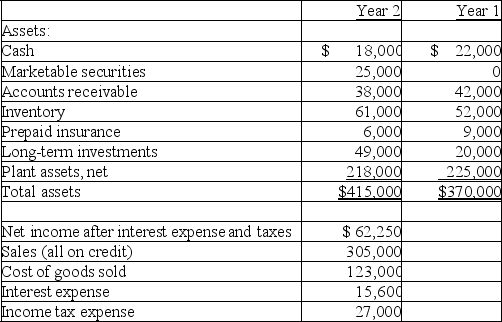
(73) Financial information for Sigma Company is presented below. Calculate the following ratios for Year 2:
(a) Inventory turnover.
(b) Accounts receivable turnover.
(c) Return on total assets.
(d) Times interest earned.
(e) Total asset turnover.
(Essay)
4.8/5 (82)
(82) A trend percent is calculated by dividing the analysis period amount by the base period amount and multiplying the result by 100.
(True/False)
4.9/5 (86)
(86) What are the four standards for comparisons in financial analysis? Give an example of each.
(Essay)
4.9/5 (74)
(74) The building blocks of financial statement analysis include (1) liquidity, (2) solvency, (3) profitability, and (4) market prospects.
(True/False)
4.9/5 (77)
(77) Gains and losses that are neither unusual nor infrequent are reported as:
(Multiple Choice)
4.8/5 (75)
(75) Vertical analysis is a tool to evaluate individual financial statement items or groups of items in terms of a specific base amount.
(True/False)
4.8/5 (74)
(74) 
Filters
- Essay(0)
- Multiple Choice(0)
- Short Answer(0)
- True False(0)
- Matching(0)