



 Chat with AI
Exam 13: Analysis of Financial Statements

Exam 1: Managerial Accounting Concepts and Principles251 Questions
Exam 2: Job Order Costing and Analysis216 Questions
Exam 3: Process Costing and Analysis231 Questions
Exam 4: Activity-Based Costing and Analysis223 Questions
Exam 5: Cost Behavior and Cost-Volume-Profit Analysis248 Questions
Exam 6: Variable Costing and Analysis202 Questions
Exam 7: Master Budgets and Performance Planning215 Questions
Exam 8: Flexible Budgets and Standard Costs221 Questions
Exam 9: Performance Measurement and Responsibility Accounting210 Questions
Exam 10: Relevant Costing for Managerial Decisions145 Questions
Exam 11: Capital Budgeting and Investment Analysis157 Questions
Exam 12: Reporting Cash Flows240 Questions
Exam 13: Analysis of Financial Statements235 Questions
Exam 14: Time Value of Money83 Questions
Exam 15: Lean Principles and Accounting27 Questions
Exam 16: Accounting for Business Transactions251 Questions
Select questions type


Zhang Company reported Cost of goods sold of $835,000, average Inventory of $41,750, and Net sales of $2,338,000. The Inventory turnover ratio is:
(Multiple Choice)
4.8/5  (90)
(90) Dividing Accounts receivable, net by Net sales and multiplying the result by 365 is the:
(Multiple Choice)
4.9/5 (89)
(89) Net sales divided by average accounts receivable, net is the:
(Multiple Choice)
4.8/5 (76)
(76) The ability to meet short-term obligations and to efficiently generate revenues is called:
(Multiple Choice)
4.8/5 (74)
(74) The evaluation of company performance and financial condition includes evaluation of (1) past and current performance, (2) current financial position, and (3) future performance and risk.
(True/False)
4.8/5 (78)
(78) The return on total assets can be calculated as profit margin times total asset turnover.
(True/False)
4.8/5 (78)
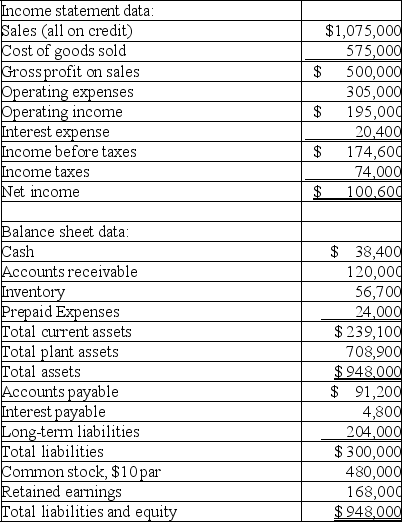
(78) Use the following information from the current year financial statements of a company to calculate the ratios below:
(a) Current ratio.
(b) Accounts receivable turnover. (Assume the prior year's accounts receivable balance was $100,000.)
(c) Days' sales uncollected.
(d) Inventory turnover. (Assume the prior year's inventory was $50,200.)
(e) Times interest earned ratio.
(f) Return on common stockholders' equity. (Assume the prior year's common stock balance was $480,000 and the retained earnings balance was $128,000.)
(g) Earnings per share (assuming the corporation only has common stock outstanding).
(h) Price earnings ratio. (Assume the company's stock is selling for $26 per share.)
(i) Divided yield ratio. (Assume that the company paid $1.25 per share in cash dividends.)
(Essay)
5.0/5 (75)
(75) Vertical analysis is used to reveal patterns in data covering two or more successive periods.
(True/False)
4.7/5 (66)
(66) The measurement of key relationships between financial statement items is known as ________.
(Short Answer)
4.8/5 (83)
(83) Stark Company's most recent balance sheet reported total assets of $1.9 million, total liabilities of $0.8 million, and total equity of $1.1 million. Its Debt to equity ratio is:
(Multiple Choice)
4.9/5 (76)
(76) The following selected financial information for a company was reported for the current year end. Calculate the following company ratios:
(a) Accounts receivable turnover.
(b) Inventory turnover.
(c) Days' sales uncollected
Accounts receivable, beginning-year $170,000
Accounts receivable, year-end 190,000
Merchandise inventory, beginning-year 80,000
Merchandise inventory, year-end 60,000
Cost of goods sold 580,000
Credit sales 1,000,000
(Essay)
4.8/5 (66)
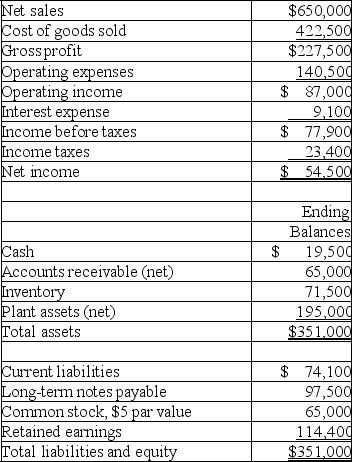
(66) A company's calendar-year financial data are shown below. The company had total assets of $339,000 and total equity of $144,400 for the prior year. No additional shares of common stock were issued during the year. The December 31 market price per share is $49.50. Cash dividends of $19,500 were paid during the year. Calculate the following ratios for the company:
(a) profit margin ratio
(b) gross margin ratio
(c) return on total assets
(d) return on common stockholders' equity
(e) book value per common share
(f) basic earnings per share
(g) price earnings ratio
(h) dividend yield.
(Essay)
4.8/5 (75)
(75) The return on common stockholder's equity measures a company's success in earning net income for its owners.
(True/False)
4.8/5 (86)
(86) Refer to the following selected financial information from Gomez Electronics. Compute the company's debt-to-equity ratio for Year 2. Year 2 Year 1 Net sales \ 478,500 \ 426,250 Cost of goods sold 276,300 250,120 Interest expense 9,700 10,700 Net income before tax 67,250 52,680 Net income after tax 46,050 39,900 Total assets 317,100 288,000 Total liabilities 181,400 167,300 Total equity 135,700 120,700
(Multiple Choice)
5.0/5 (89)
(89) Refer to the following selected financial information from Texas Electronics. Compute the company's accounts receivable turnover for Year 2. Year 2 Year 1 Cash \ 37,500 \ 36,850 Short-term investments 90,000 90,000 Accounts receivable, net 85,500 86,250 Merchandise inventory 121,000 117,000 Prepaid expenses 12,100 13,500 Plant assets 388,000 392,000 Accounts payable 113,400 111,750 Net sales 711,000 706,000 Cost of goods sold 390,000 385,500
(Multiple Choice)
4.8/5 (80)
(80) 
Filters
- Essay(0)
- Multiple Choice(0)
- Short Answer(0)
- True False(0)
- Matching(0)