



 Chat with AI
Exam 11: Risk and Return in Capital Markets

Exam 1: Corporate Finance and the Financial Manager86 Questions
Exam 2: Introduction to Financial Statement Analysis106 Questions
Exam 3: Time Value of Money: an Introduction112 Questions
Exam 4: Time Value of Money: Valuing Cash Flow Streams62 Questions
Exam 5: Interest Rates109 Questions
Exam 6: Bonds109 Questions
Exam 7: Stock Valuation63 Questions
Exam 8: Investment Decision Rules124 Questions
Exam 9: Fundamentals of Capital Budgeting111 Questions
Exam 10: Stock Valuation: a Second Look48 Questions
Exam 11: Risk and Return in Capital Markets110 Questions
Exam 12: Systematic Risk and the Equity Risk Premium103 Questions
Exam 13: The Cost of Capital110 Questions
Exam 14: Raising Equity Capital110 Questions
Exam 15: Debt Financing99 Questions
Exam 16: Capital Structure109 Questions
Exam 17: Payout Policy110 Questions
Exam 18: Financial Modeling and Pro Forma Analysis95 Questions
Exam 19: Working Capital Management110 Questions
Exam 20: Short-Term Financial Planning108 Questions
Exam 21: Option Applications and Corporate Finance102 Questions
Exam 22: Mergers and Acquisitions47 Questions
Exam 23: International Corporate Finance108 Questions
Exam 24: Leasing46 Questions
Exam 25: Insurance and Risk Management38 Questions
Exam 26: Corporate Governance45 Questions
Select questions type


If returns on stock A are more volatile than the returns on stock B, the geometric average return of stock A will be ________ the geometric average return of stock B when their arithmetic average returns are same.
(Multiple Choice)
4.7/5  (84)
(84) When looking at investment portfolios historically, was there a pattern between returns and volatility?
(Essay)
4.9/5 (86)
(86) The Ishares Bond Index fund (TLT) has a mean and annual standard deviation of returns of 5% and 10%, respectively. What is the 66% confidence interval for the returns on TLT?
(Multiple Choice)
4.8/5 (87)
(87) Treasury bill returns are 4%, 3%, 2%, and 5% over four years. The standard deviation of returns of Treasury bills is ________.
(Multiple Choice)
4.7/5 (81)
(81) What are the two components of realized return from a stock investment?
(Essay)
4.7/5 (90)
(90) Ford Motor Company had realized returns of 15%, 30%, -15%, and -30% over four quarters. What is the quarterly standard deviation of returns for Ford?
(Multiple Choice)
4.8/5 (69)
(69) The average annual return over the period 1926-2009 for small stocks is 21.2%, and the standard deviation of returns is 21.2%. Based on these numbers, what is a 95% confidence interval for 2010 returns?
(Multiple Choice)
4.8/5 (86)
(86) The probability mass between two standard deviations around the mean for a normal distribution is ________.
(Multiple Choice)
4.9/5 (83)
(83) As we increase the number of stocks in a portfolio, the standard deviation of returns of the portfolio ________.
(Multiple Choice)
4.9/5 (71)
(71) Amazon.com stock prices gave a realized return of 15%, 15%, -15%, and -15% over four successive quarters. What is the annual realized return for Amazon.com for the year?
(Multiple Choice)
4.9/5 (79)
(79) Amazon.com stock prices gave a realized return of 15%, 15%, 15%, and 10% over four successive quarters. What is the annual realized return for Amazon.com for the year?
(Multiple Choice)
4.9/5 (84)
(84) Consider the following realized annual returns:
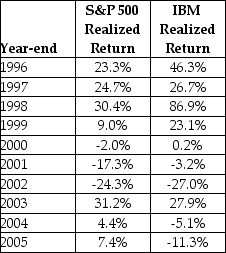 The average annual return on the S&P 500 from 1996 to 2005 is closest to ________.
 (Multiple Choice)
4.8/5 (97)
(97) Investors demand a higher return for investments that have larger fluctuations in values because ________.
(Multiple Choice)
4.7/5 (90)
(90) Consider the following average annual returns:
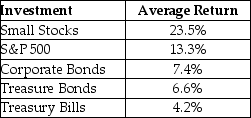 What is the excess return for Treasury bills?
 (Multiple Choice)
4.8/5 (71)
(71) Is volatility a reasonable measure of risk when evaluating the investment in a single stock?
(Essay)
4.9/5 (75)
(75) Consider the following price and dividend data for Quicksilver Inc.:
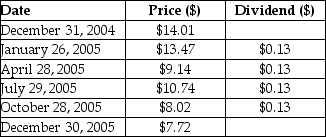 Assume that you purchased Quicksilver's stock at the closing price on December 31, 2004 and sold it after the dividend had been paid at the closing price on January 26, 2005. Your capital gains rate (yield) for this period is closest to ________.
 (Multiple Choice)
4.7/5 (79)
(79) Which of the following investments offered the lowest overall return over the past eighty years?
(Multiple Choice)
4.8/5 (77)
(77) The average annual return for the S&P 500 from 1886 to 2006 is 15%, with a standard deviation of 25%. Based on these numbers, what is a 95% confidence interval for 2007's returns?
(Multiple Choice)
4.8/5 (79)
(79) 
Filters
- Essay(0)
- Multiple Choice(0)
- Short Answer(0)
- True False(0)
- Matching(0)