



 Chat with AI
Exam 11: Risk and Return in Capital Markets

Exam 1: Corporate Finance and the Financial Manager86 Questions
Exam 2: Introduction to Financial Statement Analysis106 Questions
Exam 3: Time Value of Money: an Introduction112 Questions
Exam 4: Time Value of Money: Valuing Cash Flow Streams62 Questions
Exam 5: Interest Rates109 Questions
Exam 6: Bonds109 Questions
Exam 7: Stock Valuation63 Questions
Exam 8: Investment Decision Rules124 Questions
Exam 9: Fundamentals of Capital Budgeting111 Questions
Exam 10: Stock Valuation: a Second Look48 Questions
Exam 11: Risk and Return in Capital Markets110 Questions
Exam 12: Systematic Risk and the Equity Risk Premium103 Questions
Exam 13: The Cost of Capital110 Questions
Exam 14: Raising Equity Capital110 Questions
Exam 15: Debt Financing99 Questions
Exam 16: Capital Structure109 Questions
Exam 17: Payout Policy110 Questions
Exam 18: Financial Modeling and Pro Forma Analysis95 Questions
Exam 19: Working Capital Management110 Questions
Exam 20: Short-Term Financial Planning108 Questions
Exam 21: Option Applications and Corporate Finance102 Questions
Exam 22: Mergers and Acquisitions47 Questions
Exam 23: International Corporate Finance108 Questions
Exam 24: Leasing46 Questions
Exam 25: Insurance and Risk Management38 Questions
Exam 26: Corporate Governance45 Questions
Select questions type


Greg purchased stock in Bear Stearns and Co. at a price of $88 per share one year ago. The company was acquired by JP Morgan at a price of $11 per share. What is Greg's return on his investment?
(Multiple Choice)
4.8/5  (80)
(80) Ford Motor Company had realized returns of 20%, 30%, 30%, and 20% over four quarters. What is the quarterly standard deviation of returns for Ford calculated from this sample?
(Multiple Choice)
5.0/5 (86)
(86) The average annual return for the S&P 500 from 1886 to 2006 is 5%, with a standard deviation of 15%. Based on these numbers, what is a 95% confidence interval for 2007's returns?
(Multiple Choice)
4.8/5 (79)
(79) A stock whose return does not depend on overall economic conditions has a high systematic risk.
(True/False)
5.0/5 (91)
(91) The geometric average annual return for a large capitalization stock portfolio is 10% for ten years and 6% per year for the next five years. The geometric average annual return for the entire 15 year period is ________.
(Multiple Choice)
4.8/5 (69)
(69) The average annual return over the period 1926-2009 for the S&P 500 is 12.8%, and the standard deviation of returns is 21.4%. Based on these numbers, what is a 67% confidence interval for 2010 returns?
(Multiple Choice)
4.8/5 (77)
(77) The risk premium of a stock is NOT affected by its ________.
(Multiple Choice)
4.7/5 (74)
(74) Independent risks can be diversified by holding a large number of uncorrelated assets with independent risks.
(True/False)
4.8/5 (89)
(89) Suppose you invested $93 in the Ishares High Yield Fund (HYG) a month ago. It paid a dividend of $0.53 today and then you sold it for $94. What was your dividend yield and capital gains yield on the investment?
(Multiple Choice)
4.7/5 (87)
(87) Two slot machines offer to double your money 3 times out of 5. Machine A takes $10 bets and Machine B takes $100 bets on each occasion. A risk-averse investor prefers to bet on ________.
(Multiple Choice)
4.8/5 (75)
(75) Historical evidence on the returns of large portfolios of stock and bonds shows that investments with higher volatility have rewarded investors with higher returns.
(True/False)
4.9/5 (96)
(96) Suppose you invested $60 in the Ishares Dividend Stock Fund (DVY) a month ago. It paid a dividend of $0.63 today and then you sold it for $65. What was your return on the investment?
(Multiple Choice)
4.9/5 (91)
(91) Ford Motor Company had realized returns of 10%, 20%, -10%, and -10% over four quarters. What is the quarterly standard deviation of returns for Ford?
(Multiple Choice)
4.9/5 (74)
(74) In the United States over the long term, small stocks have provided the highest return followed by the large stocks in the S&P 500.
(True/False)
4.8/5 (76)
(76) The risk premium of a security is determined by its ________ risk and does not depend on its ________ risk.
(Multiple Choice)
4.8/5 (81)
(81) The average annual return for the S&P 500 from 1886 to 2006 is 9.5%, with a standard deviation of 18%. Based on these numbers, what is a 95% confidence interval for 2007's returns?
(Multiple Choice)
4.9/5 (75)
(75) The risk that is linked across outcomes is called ________.
(Multiple Choice)
4.8/5 (71)
(71) Suppose you invested $59 in the Ishares Dividend Stock Fund (DVY) a month ago. It paid a dividend of 0.38 today and then you sold it for $66. What was your return on the investment?
(Multiple Choice)
4.7/5 (80)
(80) The excess return is the difference between the average return on a security and the average return for ________.
(Multiple Choice)
4.9/5 (80)
(80) Consider the following average annual returns:
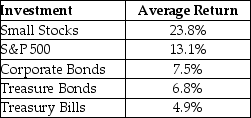 What is the excess return for corporate bonds?
 (Multiple Choice)
4.9/5 (83)
(83) 
Filters
- Essay(0)
- Multiple Choice(0)
- Short Answer(0)
- True False(0)
- Matching(0)