



 Chat with AI
Exam 19: Working Capital Management

Exam 1: Corporate Finance and the Financial Manager86 Questions
Exam 2: Introduction to Financial Statement Analysis106 Questions
Exam 3: Time Value of Money: an Introduction112 Questions
Exam 4: Time Value of Money: Valuing Cash Flow Streams62 Questions
Exam 5: Interest Rates109 Questions
Exam 6: Bonds109 Questions
Exam 7: Stock Valuation63 Questions
Exam 8: Investment Decision Rules124 Questions
Exam 9: Fundamentals of Capital Budgeting111 Questions
Exam 10: Stock Valuation: a Second Look48 Questions
Exam 11: Risk and Return in Capital Markets110 Questions
Exam 12: Systematic Risk and the Equity Risk Premium103 Questions
Exam 13: The Cost of Capital110 Questions
Exam 14: Raising Equity Capital110 Questions
Exam 15: Debt Financing99 Questions
Exam 16: Capital Structure109 Questions
Exam 17: Payout Policy110 Questions
Exam 18: Financial Modeling and Pro Forma Analysis95 Questions
Exam 19: Working Capital Management110 Questions
Exam 20: Short-Term Financial Planning108 Questions
Exam 21: Option Applications and Corporate Finance102 Questions
Exam 22: Mergers and Acquisitions47 Questions
Exam 23: International Corporate Finance108 Questions
Exam 24: Leasing46 Questions
Exam 25: Insurance and Risk Management38 Questions
Exam 26: Corporate Governance45 Questions
Select questions type


A firm offers its customers 1/10 net 40. What is the cost of trade credit to a customer who chooses to pay on day 40?

Free
(Multiple Choice)
4.9/5  (88)
(88) Correct Answer: Verified
B
Which of the following is the term used to describe short-term, unsecured debt issued by large corporations, usually in denominations greater than $100,000 or more?
Free
(Multiple Choice)
4.7/5 (68)
(68) Correct Answer:Verified
VerifiedD
What is credit period?
Free
(Essay)
4.8/5 (75)
(75) Correct Answer:Verified
VerifiedThe credit period is the total length of time credit is extended to the buyer i.e. the total amount of time they have to pay.
What is the effective annual cost of credit terms of 3/15 net 30, if the firm stretches the accounts payable to 60 days?
(Multiple Choice)
4.8/5 (90)
(90) Use the table for the question(s) below.
Luther Industries had sales of $980 million and a cost of goods sold of $560 million in 2006.
A simplified balance sheet for the firm appears below:
Luther Industries
Balance Sheet
As of December 31, 2006
(millions of dollars)
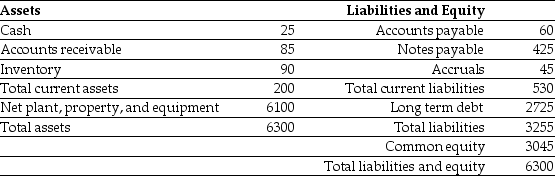 -Luther's cash conversion cycle is closest to ________.
 (Multiple Choice)
4.9/5 (75)
(75) The amount of cash a firm holds to counter the uncertainty surrounding its future cash needs is known as a(n) ________.
(Multiple Choice)
4.8/5 (83)
(83) Genovese Fine Foods, a manufacturer of foodstuffs, buys durham wheat flour on credit on June 1. It processes this flour to make pasta on June 6 and pays cash for the flour on June 15. On June 22 it sells the pasta to a chain of supermarkets, and on July 3 receives cash payment for this sale. What is the length of the cash cycle in this case?
(Multiple Choice)
4.8/5 (68)
(68) Which of the following best describes short-term debt issued by banks with a minimum denomination of $100,000?
(Multiple Choice)
4.8/5 (62)
(62) Which of the following is not a direct cost associated with inventory?
(Multiple Choice)
4.9/5 (86)
(86) Which of the following would decrease a firm's cash conversion cycle?
(Multiple Choice)
4.8/5 (77)
(77) If a firm wishes to invest cash that might be needed at short notice in the very near future, they would be most likely to invest in which of the following securities?
(Multiple Choice)
4.8/5 (76)
(76) Which of the following is/are direct costs associated with inventory?
I. Acquisition costs
II. Carrying costs
III. Order costs
(Multiple Choice)
4.8/5 (82)
(82) Which of the following short-term securities would a firm invest in if they wanted to invest cash for a term of only a few days?
(Multiple Choice)
4.9/5 (80)
(80) Which of the following best describes the availability float?
(Multiple Choice)
4.8/5 (77)
(77) Which of the following money market investments is a short-term, unsecured debt obligation issued by a large corporation? The minimum denomination is $25,000, but most have a face value of $100,000 or more.
(Multiple Choice)
4.9/5 (79)
(79) The difference between a firm's operating cycle and its cash cycle is ________.
(Multiple Choice)
4.9/5 (79)
(79) 
Filters
- Essay(0)
- Multiple Choice(0)
- Short Answer(0)
- True False(0)
- Matching(0)