



 Chat with AI
Exam 8: Investment Decision Rules

Exam 1: Corporate Finance and the Financial Manager86 Questions
Exam 2: Introduction to Financial Statement Analysis106 Questions
Exam 3: Time Value of Money: an Introduction112 Questions
Exam 4: Time Value of Money: Valuing Cash Flow Streams62 Questions
Exam 5: Interest Rates109 Questions
Exam 6: Bonds109 Questions
Exam 7: Stock Valuation63 Questions
Exam 8: Investment Decision Rules124 Questions
Exam 9: Fundamentals of Capital Budgeting111 Questions
Exam 10: Stock Valuation: a Second Look48 Questions
Exam 11: Risk and Return in Capital Markets110 Questions
Exam 12: Systematic Risk and the Equity Risk Premium103 Questions
Exam 13: The Cost of Capital110 Questions
Exam 14: Raising Equity Capital110 Questions
Exam 15: Debt Financing99 Questions
Exam 16: Capital Structure109 Questions
Exam 17: Payout Policy110 Questions
Exam 18: Financial Modeling and Pro Forma Analysis95 Questions
Exam 19: Working Capital Management110 Questions
Exam 20: Short-Term Financial Planning108 Questions
Exam 21: Option Applications and Corporate Finance102 Questions
Exam 22: Mergers and Acquisitions47 Questions
Exam 23: International Corporate Finance108 Questions
Exam 24: Leasing46 Questions
Exam 25: Insurance and Risk Management38 Questions
Exam 26: Corporate Governance45 Questions
Select questions type


What is the internal rate of return (IRR) of an investment that requires an initial investment of $11,000 today and pays $15,400 in one year's time?

Free
(Multiple Choice)
4.9/5  (92)
(92) Correct Answer: Verified
D
The owners of a chain of fast-food restaurants spend $25 million installing donut makers in all their restaurants. This is expected to increase cash flows by $11 million per year for the next five years. If the discount rate is 5.3%, were the owners correct in making the decision to install donut makers?
Free
(Multiple Choice)
4.8/5 (74)
(74) Correct Answer:Verified
VerifiedD
An investor is considering the two investments shown above. Which of the following statements about these investments is true?
Free
(Multiple Choice)
4.8/5 (64)
(64) Correct Answer:Verified
VerifiedD
Should personal preferences for cash today versus cash tomorrow play a role in the net present value (NPV) decision-making process?
(Essay)
4.9/5 (64)
(64) The Sisyphean Company is planning on investing in a new project. This will involve the purchase of some new machinery costing $420,000. The Sisyphean Company expects cash inflows from this project as detailed below:
 The appropriate discount rate for this project is 16%.
The net present value (NPV) for this project is closest to ________.
The appropriate discount rate for this project is 16%.
The net present value (NPV) for this project is closest to ________. (Multiple Choice)
4.9/5 (80)
(80) When comparing two projects with different lives, why do you compute an annuity with an equivalent present value (PV) to the net present value (NPV)?
(Multiple Choice)
4.9/5 (74)
(74) Use the table for the question(s) below.
Consider the following list of projects:
 -Assume that your capital is constrained, so that you only have $600,000 available to invest in projects. If you invest in the optimal combination of projects given your capital constraint, then the total net present value (NPV) for all the projects you invest in will be closest to ________.
 (Multiple Choice)
4.7/5 (73)
(73) When different projects put different demands on a limited resource, then net present value (NPV) is always the best way to choose the best project.
(True/False)
4.8/5 (89)
(89) Consider the following two projects:
 Assume that projects Alpha and Beta are mutually exclusive. The correct investment decision and the best rationale for that decision is to ________.
 (Multiple Choice)
5.0/5 (79)
(79) A mining company plans to mine a beach for rutile. To do so will cost $14 million up front and then produce cash flows of $7 million per year for five years. At the end of the sixth year the company will incur shut-down and clean-up costs of $6 million. If the cost of capital is 13.0%, then what is the MIRR for this project?
(Multiple Choice)
4.9/5 (86)
(86) When comparing mutually exclusive projects which have different scales, you must know the dollar impact of each investment rather than percentage returns.
(True/False)
4.8/5 (80)
(80) Use the information for the question(s) below. 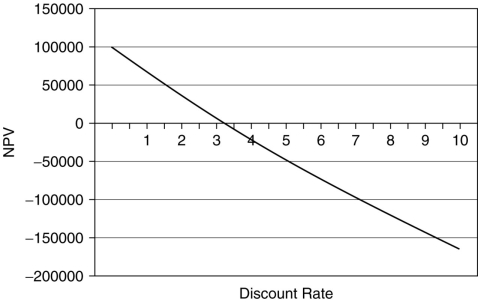 -The owner of a hair salon spends $1,000,000 to renovate its premises, estimating that this will increase her cash flow by $220,000 per year. She constructs the above graph, which shows the net present value (NPV) as a function of the discount rate. At what discount rate does her decision to renovate become untenable?
 (Multiple Choice)
4.7/5 (65)
(65) A consultancy calculates that it can supply crude oil assaying services to a small oil producer for $115,000 per year for five years. There are some upfront costs the consultancy will require the oil producer to absorb. What is the maximum that these upfront costs could be, if the equivalent annual annuity to the oil company is to be under $160,000, given that the cost of capital is 9%?
(Multiple Choice)
4.9/5 (79)
(79) Use the table for the question(s) below.
Consider the following list of projects:
-Assume that your capital is constrained, so that you only have $500,000 available to invest in projects. If you invest in the optimal combination of projects given your capital constraint, then the total net present value (NPV) for all the projects you invest in will be closest to ________.
-Assume that your capital is constrained, so that you only have $500,000 available to invest in projects. If you invest in the optimal combination of projects given your capital constraint, then the total net present value (NPV) for all the projects you invest in will be closest to ________. (Multiple Choice)
4.8/5 (64)
(64) Consider the following two projects:
 The net present value (NPV) for project alpha is closest to ________.
 (Multiple Choice)
4.8/5 (88)
(88) Use the table for the question(s) below.
Consider the following list of projects:
-Assuming that your capital is constrained, which project should you invest in first?
-Assuming that your capital is constrained, which project should you invest in first? (Multiple Choice)
4.8/5 (71)
(71) 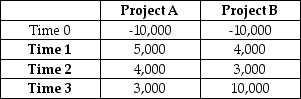 If WiseGuy Inc. is choosing one of the above mutually exclusive projects (Project A or Project B), given a discount rate of 7%, which should the company choose?
 (Multiple Choice)
4.9/5 (85)
(85) Consider the following two projects:
 Assume that projects A and B are mutually exclusive. The correct investment decision and the best rationale for that decision is to ________.
 (Multiple Choice)
4.7/5 (71)
(71) When using equivalent annual annuities to compare the costs of projects with different lives, you should not consider any changes in the expected replacement cost of equipment.
(True/False)
5.0/5 (77)
(77) 
Filters
- Essay(0)
- Multiple Choice(0)
- Short Answer(0)
- True False(0)
- Matching(0)